


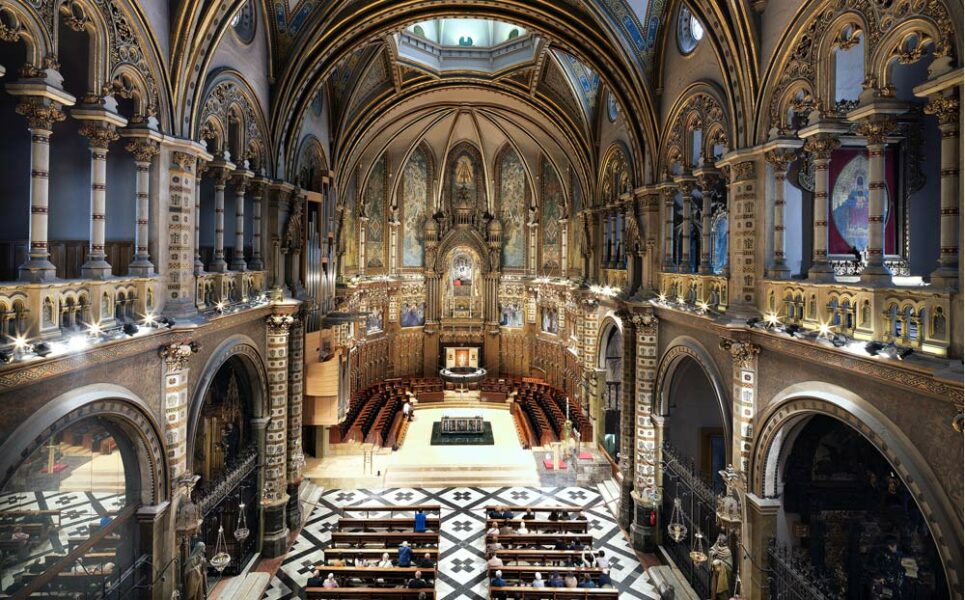
If we have recently seen the reforms carried out at the Abbey of Montserrat since the beginning of the 20th century, the role of Fr. Franquesa in the Consilium after the Second Vatican Council and the relationship of the monastery with Francoism, today we will pause to observe more closely the liturgical transformations in the monastery.
In the next article we will examine the reforms that took place in the Benedictine Order in the years around the Second Vatican Council, in which Montserrat played a prominent role.
We have already noted that the monk Dom Adalbert Franquesa participated in the Consilium, in the commission on concelebration, and that the first proper concelebration took place at Montserrat on 11 July 1964. The definitive rite of concelebration bore the approval signature of 7 March 1965, the same day on which the vernacular language was introduced throughout the world (except in the Eucharistic Prayer).
In preparation for the Second Liturgical Congress of Montserrat, to be held at the beginning of July of that same year, 1965, metal coat racks were installed in the so-called sacristy of the abbot to properly hang forty chasubles, leaving the amice and alb on a bar. Four large chalices were also chiselled for communion, which from then on were also used to give communion to the lay monks. A paten, three large candles and the lavabo were made, following the same style.
Changes at Montserrat followed one after another without cease: Linked to the theme of priestly concelebration was the evolution of the other liturgical ministries. The motu proprio Ministeria quaedam (15 August 1972) of Paul VI entailed the suppression of the subdiaconate and the reduction of the minor orders to the ministries of acolyte and lector. Visibly, the liturgy of Montserrat changed in favour of the revaluation of the diaconate. It assumed its proper functions —such as the drafting and proclamation of the universal prayer of the Mass— which led to the suppression of the figure of the assistant priest and, in simpler celebrations, that of the ceremonial assistant. The ministries —no longer minor orders, by the change introduced by Paul VI— of acolyte and lector, except in special cases, were and are conferred by the abbot only on candidates for the priesthood. In the past, the cantors performed a certain ministerial function which, on great feasts, was manifested by their participation among the celebrants, dressed in a cope. With the introduction of concelebration, first, and then, when the psalmody was sung in Catalan, this vestment was suppressed both for Mass and for the major hours of the Office.
Montserrat soon opted for the vernacular language in the liturgy. Fr. Bernabé Dalmau, in his work “The Liturgical Reform at Montserrat”, states that the liturgy of the sanctuary of Montserrat could not have been celebrated in the vernacular without the existence of four monks who created the current repertoire. These are Fathers Ireneu Segarra (1917-2005), Gregori Estrada (1918-2015), Brother Odiló M. Planàs (1925-2011) and Father Cassià Maria Just (1926-2008).
The aim was to maintain a high standard at Montserrat and to ensure that the chant of the Church reached the whole world. The chronological coincidence of the work of these four monk-composers meant that the choice to use the Catalan language was accompanied by a musical repertoire that sought to guarantee that the whole “had the dignity proper to sacred music”. That said, Latin and Gregorian chant were suppressed.
As for chant, with special insistence, all the directives of the Holy See during the post-conciliar period have reaffirmed that Gregorian chant is the proper music of the Roman Church. They have underlined that it is fitting for the faithful to know some elementary pieces. Fr. Dalmau himself, so much in favour of the reforms, acknowledges that Gregorian chant is so closely linked to the Latin language that it was to be expected that the introduction of the vernacular in the liturgy could deal it a mortal blow. In the Catholic world two positions were adopted in this regard: either through inertia or as an identity choice, both parishes and monasteries have striven to preserve it; at the other extreme, a revolutionary zeal has brought about its disappearance, with the same zeal with which the works of art located in churches were lamentably and unwisely mistreated.
What has been preserved of Gregorian chant at Montserrat? To begin with, with the sole exception of Compline, Matins in the form of a vigil and some Holy Week celebrations, all the hymns of the Divine Office have been kept in Latin.
The gradual rhythm with which the repertoire for the canonical hours in Catalan was composed allowed Gregorian chant to be preserved in many parts of the Divine Office, especially in the commemorations of the saints. As for the Mass, despite repeated good intentions, the recovery of certain chants of the Ordinary of the Mass has not taken hold, due to the number of foreign pilgrims who frequent the sanctuary. However, Gregorian chant has been maintained uninterruptedly during the Offertory rite on days when the Schola does not intervene with a polyphonic motet. The option, dating from the early years, of singing any piece from the Gradual has persisted, without taking into account that it is a current liturgical book and that each piece occupies a place in the calendar and at the moment of the Eucharistic celebration.
In his eagerness to present positively the destruction of traditional liturgy and the innovations, Fr. Dalmau continues to affirm that “respecting the creativity of liturgical chant in modern languages, in Catalonia, the task of creating neo-Gregorian music in the vernacular fell to the scholastic Miquel Altissent, who always carried out a true Gregorian apostolate in the schools of his religious congregation and in the scholae cantorum. He adapted the Missa brevis to Catalan and was one of those in charge of compiling the Ordinary of the Mass. He was also asked to intervene at Montserrat. When making a decision, the established commission highlighted, above all the drafts presented, the sensitivity of the monk-composer when applying music to the text (accents, synaloephas, hiatus, etc.), and Fr. Estrada’s option was the one that prevailed.
In summary: at Montserrat, with the exception of three or four compositions of the Ordinary of the Mass, almost the entire repertoire is composed by the four monks mentioned above. Fr. Estrada’s repertoire is valued as a liturgical continuation of Gregorian chant and, therefore, enjoys all the honour due to the sacred music of the post-conciliar Church.
The transformations of the Divine Office have constituted a true disaster. While the Rule of St Benedict commands that “nothing should be preferred to the Divine Office”, at Montserrat, as in other abbeys, they considered that the rhythm of 8 hours of Divine Office could not be maintained, in addition to the conventual Mass, private Masses, extra-liturgical devotions, lectio divina and, above all, what Fr. Dalmau does not mention, the Catalan nationalist cultural role assumed by the abbey, with its most militant monks continually going out to other tasks, and that is what made it impossible to maintain the rite of ora et lege et labora of a monastic community.
At Montserrat, the application of the conciliar reforms to the Mass, as in general elsewhere, followed the rhythm of the universal Church. It may now be difficult to imagine the various steps taken from the end of the Council to the implementation of the new liturgical books, which also required their own years of preparation. The mere fact of using the vernacular was not as simple as it may seem to us now; the conciliar constitution contemplates it as a concession, not as an objective to be proposed, to the point that the conciliar fathers themselves would not have imagined that even the prayers addressed to God could be recited in a language other than Latin.
The monastic breviary was different from the Roman one, since it followed the psalm distribution of the Benedictine Rule. Even when Pius XII promulgated a new version of the psalter in 1945 —the work of the future cardinal Agostino Bea— this had no effect in the monastic world, since it disregarded the Vulgate and used classical Latin, not Christian Latin.
The conciliar application of the Liturgy of the Hours followed a slower rhythm than that of the Mass in the monasteries, since a restructuring was necessary. Already in mid-1964, without altering the structure of the Rule, Abbot Gabriel M. Brasó had the good will to publish a monastic psalter that presented the Catalan version alongside the original.
Incomprehensibly, Montserrat abandoned the Benedictine Office and opted for the Roman one.
The first musical audition of the Divine Office took place on 10 July 1967. Taking advantage of the provision regarding Vespers, which, in the presence of the people and with a homily, could consist of only three psalms, the Magnificat in Catalan and the Our Father with alternating “Amen” (both by Fr. Estrada) were premiered. A homily was rarely preached; instead, a text was read after the brief biblical reading. The treatment of the psalms was not always for two choirs, but a paradigm shift occurred: if the text allowed, soloists were introduced. This arrangement became permanent and was extended by adapting the text of the Liturgy of the Hours.
Apart from Vespers, the preparation of the books for the other canonical hours was simpler, always starting from folders with mimeographed texts until, after a few years, the printed books were reached. In this way, the definitive edition could incorporate the appropriate corrections or modifications. The simplest book, due to its brevity, was naturally that of Compline. The transition from the provisional to the definitive phase entailed a change in the way the Canticle of Simeon was intoned. The hymn incorporates some Gregorian melodies and three new ones composed by G. Planàs; the text is always the same in Catalan, an adaptation of one that was already circulating outside the monastery at the beginning of the reform.
The whole celebration is simpler than that of the Roman Liturgy of the Hours, although it maintains its psalmody. The penitential act takes place before the initial versicle and after the reading of a chapter of the Rule. Following the prescription of the same, the psalmody and the Gospel canticle have no antiphon.
With the passage of time, the “Sub tuum praesidium” was added to the traditional Marian antiphons —which are always sung in Latin and in Gregorian chant— and, later still, the antiphon “O virgo virginum” was added for the week in which the “O” antiphons are sung at Vespers.
For the midday hours, at Montserrat it was decided to celebrate a single minor hour: Sext (before lunch) on feast days, or None (before afternoon work) on weekdays. The hymn is the one prescribed by the Roman liturgy, always in Latin and in Gregorian chant.
The last canonical hour to be incorporated into the conciliar spirit was Lauds, now always separated from Matins. On great solemnities it was already sung, but on most days the psalmody was recited.
Much of the psalmody that G. Odiló M. Planàs had prepared for the community of Solius was used. The current distribution is exactly 50 % psalmody by G. Planàs, and the rest by the other three composers. To these was added, for the Saturday psalmody, the adaptation of Gregorian melodies carried out by Fr. Jordi-Agustí Piqué.
Furthermore, Montserrat underwent a process of what they themselves call “intellectual modernisation”: many of its monks travelled abroad to train, promoting disciplines such as ecumenical theology, sociology and the study of the Bible from a scientific and modern perspective. God knows the evil that has radiated from there to the whole Church in Catalonia.
As we saw in the previous text on the reforms at the abbey of Montserrat, it introduced innovations from the 1930s onwards, in contact with the Central European protagonists of the liturgical movement and the advances of the Council: Fr. Bernabé Dalmau, author of “The Liturgical Reform at Montserrat”, maintained that “the pastoral sense that the altar facing the people favoured the participation of the faithful” was already quite common at Montserrat before the Civil War, and in the 1950s the remodelling of the presbytery was already planned. The current high altar was consecrated on 23 April 1959. The remodelling allowed the number of seats in the lower choir, on both sides of the altar, to be increased, a first phase of which had been installed in the mid-1930s.
The more or less permitted liturgical experiments came from previous decades: liturgical experiments, some secret, in Central European abbeys and the secret commission for the reform of the liturgy created by Pius XII in 1948. In the specific case of the Benedictine Order, during the 1960s it underwent a profound and rapid transformation, driven mainly by the Second Vatican Council (1962-1965). In application of the decree Perfectae Caritatis (on the adapted renewal of religious life), the monasteries had to reconcile fidelity to the Rule of St Benedict with the demands of the modern world. The vernacular languages progressively replaced Latin in the Divine Office and in the Mass. This profoundly modified the sonic aesthetic of the abbeys and, at times, set aside traditional Gregorian chant in favour of new musical compositions. Sacred spaces were also modified: The altar was turned so that the priest could celebrate Mass facing the people (versus populum). In many monasteries, the physical barriers separating the monastic enclosure from the public (such as the choir grilles) were removed or simplified. As a sign of “openness to the world”, the norms of monastic enclosure were softened. Access to newspapers and radio, as well as permissions to leave (especially for medical, family or study reasons) became more frequent.
Thus, the revolution in the Catalan monastery was not unique, but took place in the context of an earthquake throughout the Order in the years before and after the Second Vatican Council. In the case of the Catalan monastery, it also opted decisively to place itself at the forefront of Catalan culture, increasingly close to apostasy.
Note: The articles published as Tribuna express the opinion of their authors and do not necessarily represent the editorial line of Infovaticana, which offers this space as a forum for reflection and dialogue.