


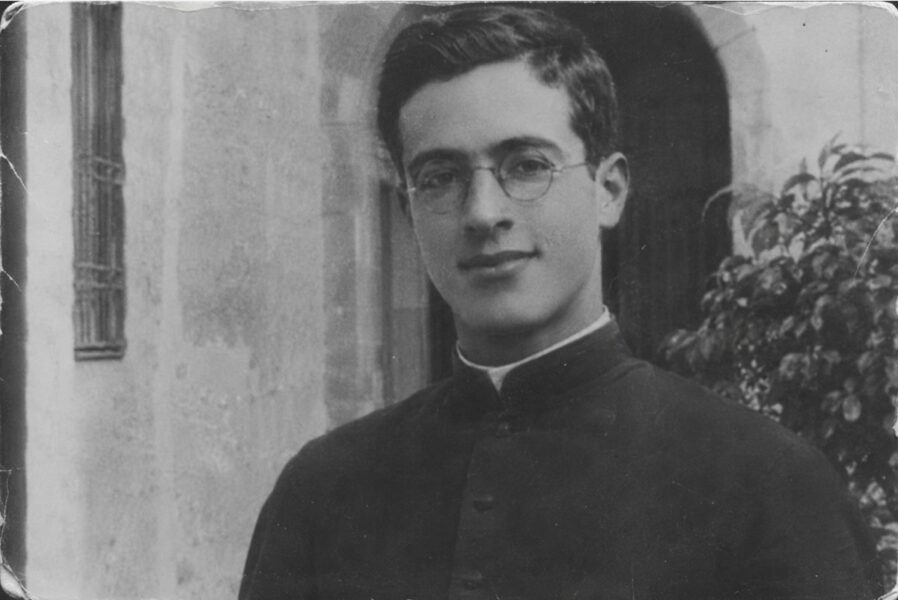
Dear brother:
My story was far less orderly than that of a quiet house, with everything in its place, a father and mother united and children advancing without stumbling. My name is Pablo Chomón Pardo. I was born in Quintanilla de Escalada, Burgos, on 25 September 1914, and I grew up amid family difficulties I did not choose. My father, Guillermo, was a day labourer. My mother, Petra, took my brother Lorenzo and me to Madrid when living together became difficult. My father remained in the village. For a long time he heard nothing more of us; he came to believe us dead. I tell you this because perhaps some seminarian carries in his heart a wound from his home and thinks that because of it he will be less suited for the priesthood. Not necessarily: grace does not need a biography without cracks.
My priest-uncle Don Julio Pardo Pernía played a decisive role. He had baptised me and had directed a school in our village. In Madrid, other relatives helped us make our way. My brother soon left the seminary; I persevered through twelve courses, between 1924 and 1936. The parish priest of Ciempozuelos would report for my admission to tonsure: “I know of no difficulty other than that his father does not live with the candidate. The aspirant to orders is domiciled in this village with his mother, whom her husband does not accompany.” I studied with pleasure and achieved good marks. During holidays I went to Ciempozuelos with my mother and with Uncle Julio, confessor there to the Hospital Sisters. Seeing him work with those who suffered taught me more about the priesthood than any romantic imagining, because a priest must know how to draw near to pain without making himself the protagonist.
In 1936 I was an acolyte and studying theology. The old discipline was leading us toward the altar with a succession of sacred charges. The acolyte was entrusted with serving the light and preparing the service of the altar. It was not a ceremonial pastime; we understood that a flame demands vigilance: if you are careless, it goes out; if you protect it, it gives light to others. I awaited the subdiaconate as the decisive day of my stable commitment to celibacy and the breviary as a visible step toward the intimacy of sacrifice. Those rites possessed an educative force difficult to forget. If one day you come to know them, do not look on them as museum pieces: ask yourself what truth of the priesthood they express.
The summer of 1936 surprised me in Ciempozuelos, where there was a committee made up of leaders of the UGT and the Casa del Pueblo. The militiamen controlled the village, multiplying searches and arrests—so many that the cemetery vault became too small, and the parish church and the convents of the Hospital Sisters of St John of God, the Oblates of the Most Holy Redeemer, the Hospital Sisters of the Sacred Heart and the Poor Clares were fitted out as places of confinement. With the priests Don Juan Manuel Navarrete and Don Ginés Hidalgo, my uncle and I took refuge in the women’s mental asylum of the Hospital Sisters, where we exposed the Blessed Sacrament every day and spent many hours in adoration.
When groups of militiamen from Madrid arrived in Ciempozuelos to seize the two asylums in the village, the three priests, the nine nuns and I, together with some lay people, quickly consumed the Blessed Sacrament so as to leave in haste. To one of the sisters my uncle said: “It is prophetic that you have placed in a side chapel of the church the altar of the sixteen Carmelite martyrs of the French Revolution, those of Compiègne, so that you may take courage and example and be, if God asks that sacrifice of you, heroines like them. Do not fear the hired killers. My sisters, repent of the sins of your whole life, for I am going to give you absolution in articulo mortis.”
With my uncle, already in his house, one day twelve militiamen arrive and, pointing rifles at us, dragged us from our beds amid threats, took us to the jail set up in the parish church, and on 7 August murdered us in the outskirts of Valdemoro, on the Torrejón road. It was the first Friday of the month, the same day they blew up the monument to the Sacred Heart on the Cerro de los Ángeles. We were buried in a common grave in the municipal cemetery of Valdemoro, until we were moved, without individual identification, to the Basilica of the Holy Cross of the Valley of the Fallen. My uncle Julio was sixty-three; I was twenty-one.
So much for the facts. Now let me say to you: do not become a judge of those who gave you life, nor be ashamed of your family, nor use it to excuse a bad temper. There are wounds that take years to heal, but Christ heals them. Mercy is what is manly, not resentment.
Nor should you fashion for yourself an idea of the priest as a man who controls everything. My uncle served in an institution where mental illness and human suffering imposed their reality every day, and one learned that vocation often consists in accompanying someone who can thank you for nothing.
Be a good companion in the seminary. Do not make talent an instrument of superiority. Welcome the one who has less facility for study. Share your books and your time. Do not reduce fraternity to gathering to eat or converse: it is also built when a companion passes through a crisis and finds someone who knows how to listen without indiscreet curiosity.
When an insignificant task is assigned to you, think of the acolyte’s office: the light he holds is not his own; neither is the altar he prepares. If you become a priest, souls will not be yours; you will have received the privilege of serving them to God.
My first Mass remained in the land of dreams. My offering was beside my uncle, who had taught me to love the priesthood. In their apparent failure, our lives attained a fruitfulness that only heaven understood.
He accompanies you with special affection who knows what it costs to grow, your brother
Pablo Chomón Pardo
Acolyte seminarian and martyr