


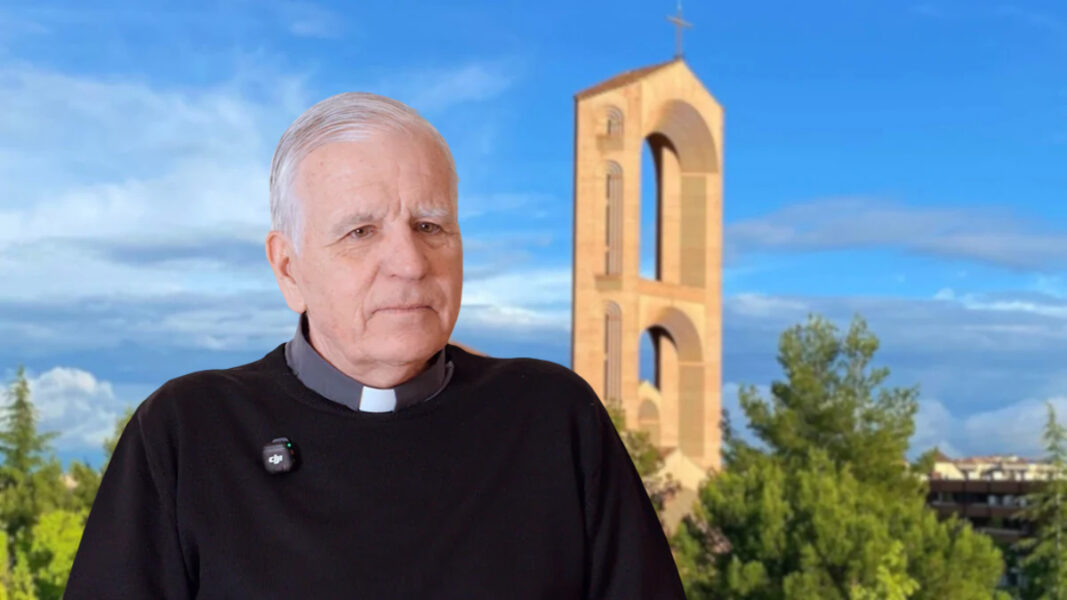
The parish priest of Santa María de Caná, in Pozuelo de Alarcón, spent more than two hours in front of the microphone with Adrià Solà Pastor on the podcast A Una Palabra, published last November 6. He rejected the idea that abuses should be covered up or that the Church should console itself with percentages, admitted that in the confessional he has heard confessions of murder and that nothing there has seemed more horrific to him than the abuse of a child, and offered his portrait of God: the one who punishes is a “caricature” and the only “non-negotiable” thing is never to doubt that God loves man.
The most horrific thing Jesús Higueras has heard in thirty-six years in the confessional is not a murder, though he admits he has heard one. It is the abuse of children. The parish priest of Santa María de Caná said so in those words, “I am very clear about it,” in the conversation of more than two hours he held with Adrià Solà Pastor on A Una Palabra, and from that certainty hung the hardest part of the interview: there is no room in the Church for cover-ups or for the consolation of statistics. “That business of covering up, moving people around, ‘nothing happened, we’re wonderful,’” he listed, mimicking the defensive reflex of his own, and dismissed it in a single phrase: “Well, there shouldn’t be any at all.”
The interview, the 48th of the program, was recorded at the castle of Santa Florentina, in Canet de Mar (Barcelona), and was published under the title “An unfiltered conversation with a priest about the Church, God, abuses and the devil.” The setting is not ecclesiastical. Solà Pastor is a popularizer of public speaking and personal development whose YouTube channel, according to his own website, has more than a million and a half subscribers, and in recent months his table has hosted experts in non-verbal language, protocol or financial freedom, as well as an exorcist. To that audience he presented his guest as “one of the most recognized priests in Spain,” with “the Pope’s authority to forgive the gravest sins.” Higueras, ordained in 1990, has been parish priest of Caná since 1995 and a missionary of mercy since 2016, presides over the foundation for people with disabilities born in the parish and lends his voice to Palabra de vida, a daily three-minute reflection that, according to his own figures, reaches between 30,000 and 50,000 people.
A society that believes it can live without God
The first question was what he would say to a society that believes it can do without God. Higueras answered with another: who am I, why am I here, who has called me to a life I could not give myself. The dilemma, he posed, is whether man is “a highly evolved animal” or whether there is in him a qualitative leap, a dimension that touches the transcendent; if the latter is true, doing without God “would in some way dehumanize us,” and whoever believes he does not need Him is missing one of the most specific dimensions of the human, that of knowing oneself called to life with a mission and not being “a mere biological fact.”
On the causes of disenchantment he was less predictable. He cited the twentieth century, “the century of horrors,” with its world wars and genocides, and the question he left hanging: “But where is God in the face of so much evil?” He mentioned in passing the philosophical roots, from the Enlightenment to Nietzsche, and Marxism, in which the State was to cover what had previously been left to Providence. And he added a third factor that forced him, he said, to throw stones at his own roof: the role of the institutions that have to represent God since the second half of the century. “I don’t know if we have got it right. I don’t know if we have known how to be in our place and have known how to give what could be expected of us.” The result is not, in his view, an attack: “No one attacks God, no one attacks Jesus Christ.” It is indifference, that of a relative of his who, invited to pray, replied that he did not need it. Nor did he want to read it as a condemnation of people, but as an examination of those responsible: “I don’t think we have done it well.” To that omission he added the ideologies of consumption and of success at any price, those of a world in which each person is worth what he has, in contrast to the Sermon on the Mount that calls blessed those who mourn and the poor in spirit.
The consequence that worries him most is “the systematic contempt for weakness.” The elderly, who are parked because both parents work and the children must be raised. Children with disabilities: he told the case, which he said he knew by hearsay, of parents compensated by a hospital that had not warned them that their child would have Down syndrome, “as if it were a disease and not a way of being as legitimate and human as any other.” He linked it to the “throwaway culture” of which Francis spoke and to chapter 25 of Saint Matthew, from which he drew that the Christian God “is not the God of the winners, not the God of the powerful, not the God of the strong, He is the God of the weak.” He recalled one of the directors of Atapuerca, for whom the sign that there was already humanity there were the bones of a sick girl, a burden to the group, who nevertheless lived for years because everyone cared for her. And from there he moved to gratuitous love, with Saint Bernard, for whom love is its own reward, and with Josef Pieper, and with the mothers who every Saturday bring a baby to be baptized who does nothing but cry, eat and keep them awake.
To the question of what this society has that leads to that apathy he answered with individualism, that of the person who becomes the center of the universe and uses others as stepping stones. He attributed to Higinio Marín the idea that “desires have become rights” and took it to the absurd: wanting to be rich, to be handsome or to have seven girlfriends does not generate any right. From the frustration of those desires he derived addictions and what he called “a kind of social anesthesia,” that of leisure as escape, and repeated a borrowed definition: “Immaturity is intolerance to frustration.” The question that matters, he concluded, is what gives value to a life, and the answer cannot lie in having, because then greatness would be the privilege of an elite. What defines a person is how he responds to what life puts in front of him.
God, in that scheme, enters without forcing. “God is a very elegant gentleman,” he said: He does not impose or invade, He knocks at the door and asks if they will let Him in. The first thing He brings is light, and that is why baptism was called illumination; he paused on Saint Augustine, who sought outside the truth he carried within and which is fashionable, he joked, now that there is an Augustinian Pope. From truth he made freedom depend, “without truth there is no freedom,” and he specified that he was not speaking of a scientific or axiomatic truth, but a relational one, of those that are only known by experience, like being in love or floating in the Dead Sea. He recalled a boy who asked him to pray that he would do what he wanted and not what he felt like doing. The second thing God brings is company, and he placed it within: He is not in the stars, “where I find God is inside me.” That God, he admitted, does not change the course of history or make Hitler or Stalin die before their time: “mysteriously He allows that,” but He leaves each person an interior freedom and a grace to respond. He recommended La libertad interior, by Jacques Philippe, and summarized its thesis: I do not choose what is going to happen to me, I choose how I respond, and that is why one can be free in prison or in a wheelchair.
It was there that the word that structures his discourse appeared. Between the “caricature” of a God who is in heaven, punishes the sinner and sends him to hell for having failed the exam of the Ten Commandments, and a God who says “I want you to be happy, I want to accompany you,” Higueras chose the second, and made Him say: “I cannot avoid the mystery of evil because it is not in my hands to avoid it. Because the Achilles heel of God is the freedom of man. But I can accompany you in the experience of evil.” Solà Pastor then asked him how a religion whose central message is love can have a God who punishes and sends to hell. The answer was that that is precisely the caricature, the result of the Church having allowed each age to project its cultural elements onto the transmission of the Gospel: the faith was not explained the same way in the medieval Church as in that of the early twentieth century or in that of artificial intelligence, he said in allusion to the encyclical of Leo XIV. Only the saints, who “had no filters,” announced the nuclear message cleanly, that of a God who sent His Son not to condemn the world, but to save it. Whoever does not want to be saved, he summarized, “is his own problem.” But he warned of the opposite distortion with the same energy: man fabricates a God in his own image, and as false is the one of the sword that cuts off heads as the one of the feeling with which “I can do whatever I feel like” because everything is justified. “We must let God be God.”
The interviewer wanted to know if the Inquisition was an example of that use of God to dominate. Higueras conceded that in the history of the Church “the methodology of the evangelical announcement has been equivocal” many times, recalled John Paul II’s request for forgiveness in the jubilee of the year 2000 and listed the ordeals and trials of popes’ corpses, which he placed vaguely between the ninth and eleventh centuries; the documented episode is that of Pope Formosus, exhumed and tried in 897. He said that none of that scandalizes him, because “in the civil world they did the same and worse,” and applied the same reasoning to the tribunal that had prompted the question: “The Inquisition is not an invention of the Church, it is an element that already existed,” he maintained, referring to the museum of Santillana del Mar. “Let us not think that the Church is a machine for inventing evils”; what happens is that some of its members are inoculated with a worldliness that is not proper to it, like that of the Roman cardinals of the sixteenth century and their palaces. The double condition, human and divine, helps him to believe, and he illustrated it with a joke he asked to be understood as such: the most evident proof that God is in the Church are the priests, because there is no company with worse employees, “I start with myself,” and people keep coming closer to God after two thousand years. Opposite he placed the silent Church of parents, cloistered nuns and missionaries that does not appear anywhere.
The majority of abuses, in the family
The step to abuses was taken by Solà Pastor, who lamented that the first thing projected when the Church is mentioned are cases of pedophilia. Higueras began with the defense. Those news items, he said, “are very ideologized”: one reads one newspaper and another and they seem to be talking about different continents. “No one denies that there have been miseries in the Church,” but “we cannot blame the collective for the sins of an individual,” and he resorted to football: if a group of Barça or Madrid fans burns cars after a defeat, no one says that the entire fan base is scum. That is, in his view, “the great injustice” that is committed today with the Church. He admitted that there may be ten priests who are “disturbed, perverted or disgusting,” “and unfortunately there are,” but that beside them there are a hundred or a hundred and twenty who are not. And he accepted as good a figure without citing a source: “It has already been sociologically demonstrated that, unfortunately, the issue of abuses in 97% of cases is within the family.”
He supported it with his experience. “I have been hearing confessions for 36 years, and a lot,” he said, and what he has heard in that time are above all domestic abuses: “An older brother, an uncle, a cousin.” Almost always men. Families that keep silent because they are not going to denounce the other son or make a fuss. Of those victims, he affirmed, no one wants to speak, and some have reproached him indignantly: only the abuses of certain groups are spoken of and never of them, “who are the great majority.”
The turn came without anyone asking for it. There is a culture of denunciation that is important, he said, and thanks to it “the things that are not going well in the Church must be denounced.” What came next was this: “That business of covering up, moving people around, ‘nothing happened, we’re wonderful’; ‘no, no, no, all this is bad people who don’t like us.’ Well, there shouldn’t be any at all.” And against the argument he himself had just used: “Sometimes we think we console ourselves by saying: ‘No, but we are the 3%.’ It is a horror, it is a nightmare that that happens.” He described the destruction of a child as one of the gravest sins that exist, because of the “feeling of dirtiness, of indignity, of existential shame” that the victim drags through life: “It is as if you have killed him while he is alive.” He half restrained himself, “I, if I weren’t a priest, I’m not going to say what I would do to those people,” and took a position: “If it has to splash on us, let it splash.” The guilty members of the clergy must pay, submit to legislation and justice, “and they must not be covered up or hidden by anyone.” He recalled that “zero tolerance” is the watchword of John Paul II, Benedict XVI, Francis and now Leo XIV, and that as long as it is not clear the Church will remain exposed. He believes that today there is a great deal of care and that cases are becoming less and less frequent.
The other side came next, and it was also opened by the interviewer when he said he understood the insecurity of priests. Higueras endorsed it twice, “the presumption of innocence has been lost,” and added: “It’s that we are sold out.” It would be enough, he said, for someone from his parish to claim that Father Jesús did something to him when he was little. He recounted that when he built the church, inaugurated in 1999, he imposed a rule: “all glass doors,” because “everything that happens must always be seen.” Even then he was afraid, he explained, because there are people who have suffered abuses, “but there are also people who have wanted to confuse things there, and sometimes it is not clear.” Of false accusation he said that it is “a death in life” and cited the proverb: calumny, something always sticks. He reproached part of the press for passing sentence before the trial and “regardless of the evidence of a process.” He offered the consolation of the beatitudes for whoever suffers an injustice, and immediately set a limit that portrays his style: one thing is to be persecuted for Christ and another to be persecuted for having done wrong. If a priest takes 50,000 euros from a parish and says he is being persecuted for the Gospel, the answer is different: “They are persecuting you because you are a fool.”
Suicide and euthanasia
The conversation then entered the confessional. Have sins changed between 1995 and 2026? Yes and no, he answered. The capital sins are the same as always, and he verified it, he recounted, hearing confessions in an international seminary from young people from Japan, China, India, Africa and America: all brought the same ones. What has changed is the gaze. When he was ordained, in 1990, he perceived “an excessive moralism” that declared things sins without analyzing them: “Lying, sin. Shouting at a person, sin. The whole sixth commandment, sin. Sexuality, sin.” That moralism, he affirmed, “has been maintained practically in the Church until recently, or is maintained in some priests.” By the law of the pendulum it has later fallen into psychologism, in which every behavior has an explanation and the explanation is taken as an excuse. He gave the example of the husband who justifies the mistress because of how unbearable his wife is: “I understand you, but I don’t have to approve of you.” The error of the age is that people identify “understanding with approving,” and they come to confession giving explanations. His formula: “Neither moralism nor psychologism.”
As an example of the middle point he chose suicide. Until shortly before his ordination, he recalled, the suicide was not buried in a Catholic cemetery because it was presumed he had died in grave sin, something he called “an aberration” and which today is unthinkable. “Everyone knows it is an illness,” he affirmed, a chemical matter of which the person is not master: “You do not choose to die.” The Church of the last third of the twentieth century, he said, was intelligent enough to listen to neuroscience and psychology and recognize that “there are acts that are not free.” And he formulated the rule: “We will never say that suicide is good, how could it be good? It is a horror. But we will never condemn the person who has done it.” The reverse, he added, is euthanasia, and he mimicked the sentimental reaction to a recent case, “‘oh, how cute this girl is that they are asking to be killed,’” before pronouncing: “That is a suicide of a lifetime.” He did not name her; the description points to Noelia Castillo, the 25-year-old who received euthanasia last March 26 in the province of Barcelona after the lawsuit undertaken by her father to prevent it. When someone loses the vital instinct, he reasoned, there is a serious and deep illness, and what is appropriate is to cure it, “one must not take away his life.” Asked whether Spain is heading toward a slippery slope, he answered yes, cited the Swiss clinics where one pays to die and closed the argument: “If we believe the desire for death is not an illness, then we are lost.” It is, he said, a century of shadows and lights, with more social sensitivity than ever and, at the same time, with the weak being eliminated because they are in the way.
The most common sin in the confessional
And the most common sin? It depends, he answered: “the ladies from the waist up and the gentlemen from the waist down.” Of the male he described the sexual impulse, an expression he prefers to “lust” for being less derogatory, as something natural and good, since God made it, and that twists when it ceases to be lived with love and becomes satisfying oneself by using another. He pointed to pornography as one of the worst addictions of young people, which they reach, according to the studies he mentioned without detailing, from the age of nine or ten, and which appears “a great deal” in the confessional. He explained it with a crudeness for which he apologized to the audience: before one heard the word “ass” and had to imagine it; now one presses a button and they all come out one after another on the mobile. The result is slavery, self-contempt and lost hours, and the conversion of the person into an object: “My body is not part of me, my body is me.” Of women he said that their terrain is the sentimental, that of temper, envy and criticism, and he cited a parishioner: “Criticizing is a sin, but it unites a lot.” He assumed that the generalization could sound sexist. And immediately he deactivated it, because those are not, he maintained, the sins that worry him most. What worry him are greed, which breaks families as soon as the parents die, and anger that does not reach the punch but turns a house into hell. A sin of sexuality, he compared, is like fireworks: it explodes and it is over. The ones that rot are the daily ones, the discontent and the reproach drop by drop, and those do “much more damage.”
The change begins by realizing, he said, because what is habitual is to justify oneself by saying that everyone is like that. He returned to the question about the value of a life with a funeral scene. He usually meets with the family beforehand so they can tell him about the deceased. Once he gathered the five children of a well-known man, the kind who appear in magazines, and the response was this: “We don’t remember any positive thing about our father. He was never there.” Higueras summarized it with a stock phrase: “He was a man so poor, so poor, so poor, that he only had money.”
Pozuelo: Money, wealth and austerity
Pozuelo gave rise to talk about money. Higueras qualified the cliché: the municipality has around 90,000 inhabitants and not everything is rich, although three footballers are enough to skew the average. To the question of whether one can be an entrepreneur, want to make money and follow the Gospel he answered yes, as long as the company generates jobs and well-being and is just. “Wealth is not for oneself, it is to place it at the disposal of others,” he summarized as the social doctrine of the Church: it is not bad that there are rich people if they know they will have to give an account of their management. He avoided pronouncing on whether public or private management should weigh more, which is what separates conservatives and social democrats, because they are, he said, two debatable positions, and he gave as an example of well-understood wealth Amancio Ortega, whom he referred to only by surname, for the jobs created and the donations against cancer. The gifts of God that one keeps for oneself rot, he warned, and referred to the parable of the rich man and poor Lazarus.
To the children of that abundance he dedicated a section of his own. Having everything does not do them good; what a child needs is to hear the word “no,” and without it they come out “monstrous children” who do not tolerate frustration. He recounted that the parish takes groups of one hundred and two hundred youngsters on the Camino de Santiago, to sleep on the floor and share water, and that what is gained in fifteen days is lost upon returning to a house where everything is done for them. “Suffering is part of happiness,” he maintained, although God does not want it, and “he is not happier who suffers less.” To the rich father he prescribed a word, “austerity,” a virtue he recalled as pre-Christian and already present in the Nicomachean Ethics. And another confessional scene: he asked a penitent what he gave his children, the man answered money and wanted to know if that seemed little to him. Very little, he replied: that the autonomous community can give.
The interviewer then brought up a detail from before the recording. The program serves coffee in porcelain cups brought from France and Higueras was, according to Solà Pastor, the only guest who insisted on a cardboard cup. He explained it without solemnity: the cup is pretty, but it can break and someone will have to wash it, and “if one can choose the simple, better.” He confessed that he is ashamed to enter a fancy restaurant with his clerical collar when a parishioner invites him, and that he prefers a set menu.
The next question came loaded: how does one reconcile a structure to which thousands of people come, with its own foundation and resources the interviewer called millionaire, with the “vow of poverty,” which diocesan priests do not take and which Higueras did not correct. He responded by describing the parish on three pillars: the announcement, the sacraments and charity, without which “prayer is a lie.” The charity of Caná is concretized in Cáritas, in the foundation for people with disabilities, with a day center and leisure activities that give respite to the parents, and in help to immigrants so they can find a contract “with dignity, without exploitation” and regularize their situation. None of that would be possible without the laity: some two hundred people among catechists, workers and volunteers, and only five or six employees. To measure attendance he gave a sacristy figure: the parish buys 38,000 hosts a month, which he translated into about a thousand people a day, and on weekends, he calculated roughly, about eight thousand pass through. In some Sunday Masses whoever does not arrive a quarter of an hour early does not get a seat, and there are loudspeakers in the street. He downplayed his own part with a biblical proverb, “God spoke through Balaam’s donkey,” and attributed the result to three things: that there are very good people, that “we are very normal, we don’t do extravagant things” and that there is always a priest available.
The seal of confession, before a murder
Available, above all, in the confessional, to which “many broken people” come who do not want to be judged, but understood: “Not approved, but understood.” He described it as a showcase of life where the same person enters a mentally ill person to whom Saint Michael appears ordering him to eat macaroni as a mother who does not know what to do with the son who consumes. Non-believers also enter who ask what they have to do to confess. “First get baptized,” he answers them, but if they want to tell their sins and have him ask God to forgive them, he listens, even if it is not the sacrament. From there he moved to the seal. A penitent can say he has murdered, “which could have happened to me, as is logical,” and the confessor could only recount the sin without ever linking it to a person, under penalty of excommunication. If someone confesses a crime, he is silent, but he tells him he must go to the police and incriminate himself if the matter is serious, or return what was stolen, because one cannot absolve where there is no purpose of amendment. Solà Pastor was direct: if someone had come to him saying “I have murdered.” “Yes, of course.” And before the interviewer’s astonishment: “It is part of the pact of being a priest.”
Then came the question about the most impactful thing he has heard, and the answer with which this chronicle begins: “The most horrific thing I can hear in confession, I am very clear about it, are the abuses.” More than a murder, more than an abortion, which also deprive of life, because an abuse “is to destroy a child forever, is to leave him broken.” He recognized that the confessional is not a place to scold and that, even so, before those penitents he becomes “very energetic”: he tells them they have done the worst a human being can do, that they be aware of the gravity, that it cannot be repeated and that they must go to a doctor. And if there is a denunciation underway, that they not deny it: “You must acknowledge what you have done.” Solà Pastor asked him if behind it is Satan. Not directly, he answered, and cited a definition he attributed to Pope Francis, sin is what destroys man, and the scene from Mel Gibson’s The Passion in which a pack of deformed children harasses Judas. He ended in the Gospel, in the sentence against whoever scandalizes a child, for whom it would be better to be thrown into the sea with a stone tied: “I have not heard in the whole Gospel a sentence so grave as that.”
Of what weighs on him as a priest he mentioned battered women, addictions and, above all, parents who have lost a child, for whom the parish has a group: it is “like a grenade thrown inside you.” Asked how all that affects him, he took the opportunity for a reproach to his brothers that he said he makes unwillingly: there are not many churches in which priests sit to hear confessions for hours and hours, in some one has to “submit seven applications” to get it, and the argument that no one comes has an answer: “No one comes because you don’t sit down.” His relief is the tabernacle, before which he places himself every morning. And his protection against success, a lowering of himself that he formulated without nuances: “Father Jesús is a lost fool. Father Jesús is worth nothing.” Eternity, he joked, is going to be like the universal ¡Hola!, because everyone will find out about everyone’s sins, and he dies of shame thinking about it. “The protagonist of my parish is called Jesus Christ,” he said. He, at most, gets in the way.
What is hardest for him to combat, he confessed next, is seeking himself: using others, and God, as a stepping stone to tell himself how well he is doing. Flattery embarrasses him, including that of those who listen to him every day, because the merit is not his, and he compared it with the pearl necklace that was once lent to a sister: “It is not mine, it has been lent to me.” The same with the money that passes through the parish, of which he said he is clear that none of it is his. He revealed his salary: he earned 800 or 900 euros when the pastoral council, whose members earned “at least 5,000, 6,000,” proposed raising it, and today a priest earns 1,200 or 1,300. He refused, he recounted, because he did not see why the priest of a village in the mountains or of a poor neighborhood should earn less than he does.
Solà Pastor raised a personal complaint: he feels judged as a bad Christian by people who, in his view, are the ones with the most disorganized personal lives. Higueras agreed with him and returned to moralism, this time as a method of evangelization. Giving doctrine without more, the interrogation of whether you have gone to Mass, confessed or eaten meat on Friday, seems to him an “suffocating” and counterproductive methodology: “If we are few and on top of that the few of us treat each other with kicks…” Many people go to church, he explained, who have not confessed in a long time, and he does not see himself with the authority to scold them, because he has the formation he has and no one has told him that the Church asks that it be done at least once a year. He applied the criterion to the interviewer himself, as a pastoral case: if he did not have that knowledge, he told him, he does not sin when he receives Communion. He invited him to try confession, explaining to him that to absolve means to unlink, that sin ceases to form part of one. And he finished against the alternative: to whom it is said that either he confesses or he goes to hell, the natural thing is that he sends everything to the devil. “That is the Church that does not interest me. That is the Church that does not attract, that frightens.”
The only non-negotiable for a believer
The interviewer then asked what the non-negotiables are for being a good believer. The answer is Higueras’s thesis in its pure state: “The only non-negotiable is that you never doubt that God loves you.” That is the base, he added, and if it is not understood everything else is useless: Christian asceticism becomes a pseudo-therapy for being good and one can be very much of Mass and doctrine with life broken behind. He invoked Benedict XVI to maintain that no one is Christian without a real relationship with Jesus Christ and asked not to confuse faith with morality. He illustrated it with the story of a Chinese saint, a doctor and opium addict, whose confessor denied him absolution for lack of purpose of amendment and who died a martyr in the Boxer Rebellion proclaiming his love for Christ; from the description it is Marcos Ji Tianxiang, canonized in 2000. “Did he have faith? All of it,” he summarized. Moral demands are not, in his approach, conditions for being good, but paths to love more, and being a good believer consists in treating Jesus Christ as the best friend.
Solà Pastor then brought up faith à la carte. Higueras portrayed it with an example: the one who cheats the Treasury, insults his wife and then receives Communion with all the holiness in the world. “Well, receive less.” But on the Eucharist he set a principle in the other direction: “Communion is not the prize of the just,” it is not received by the goody-goodies for their merits, but it is the remedy of the weak. He listed what is needed to approach it: to be baptized, to know oneself loved by God and, if one is conscious of having wounded someone, to be reconciled with him. He added no other condition.
Infidelity, matrimonial nullity and abortion
From there the talk drifted to infidelity. Should one tell the other? One must live in the truth, he said, but he distinguished. If a boyfriend has had a one-off slip at a bachelor party, of those he described as horrific, “I would almost tell you not to say anything,” because it would only succeed in embittering the girlfriend and loading her with his own weight: “An anecdote does not define a person.” If it has happened more than once throughout the courtship, it must be said, because the other has the right to know with whom he is marrying, and he recalled that deliberately concealing who one is is grounds for nullity.
On nullities he first dismissed the cliché that they were bought: it was “a bit of a myth,” although the processes were very heavy before the reforms of John Paul II and Francis. He said he had accompanied a great many people in that procedure without it costing him money, because what varies is the lawyer’s fee that each one chooses and whoever has no resources has a free lawyer. He compared a null marriage with a madeleine that lacks flour: an essential element is missing, almost always freedom. It is taken away by ignorance, when something relevant is concealed such as a known sterility, years of drug consumption or a psychiatric treatment; fear, of being left alone or of what people will say; and immaturity, which is by far the most frequent. There he gave a figure: “I don’t know in other tribunals, but where I am almost 70%, 80% is for immaturity of one of the two.” He defined it as the inability to assume conjugal commitments, that of the person who marries but continues going out for drinks or goes shopping in Paris and leaves the children to the other. And of marriages that last he said they have two things in common, believers or not: truth, being able to look the other in the eyes without lying, and the cultivation of love, which requires that the spouse come before work and also before the children.
What remained was to explain the title with which he had been presented. Being a missionary of mercy, he recounted, means being able to absolve certain grave sins that were reserved to the Holy See and carried excommunication; Francis, in what he called a success, distributed that faculty among some priests to save the trip to Rome. He calculated without certainty that in Spain there would be forty or fifty. He cited three of those sins: the violation of the sacramental seal, the profanation of the Eucharist and that of the confessor who absolves someone who has sinned with him or uses the confessional to obtain sexual relations, which he named in Latin as sollicitatio ad turpia and which lent itself, he said, to spiritual abuse. They are, he admitted, sins above all of priests, and if he committed one he would have to go to another missionary. On abortion he specified that it retains the penalty of excommunication, although its absolution, previously reserved to the bishop, now corresponds to any priest, and he described it as very grave: not letting live a child who is already alive. But he asked to qualify with a blunt phrase, “no one aborts for pleasure, everyone aborts out of fear,” from which he only excluded “some very frivolous people” and the men who pressure with abandonment. The women he has confessed, he said, have suffered a great deal and spend years calculating the age the child would have.
The devil exists, but illness does not come from him
The devil, announced in the title, did not appear until the final stretch. Higueras stuck to the classical definition: Satan is “a personal being,” a creature God did not create to be evil and who chose not to love, “he is not a myth, a personification of evil.” He is the instigator, but each man then positions himself before evil, which he defined as privation of good, and executes it or rejects it. To the question of whether there are bad people he answered that there are people who do bad things, because acts are judged and not persons. And when Solà Pastor wanted to know if he had ever felt the presence of the demon, he said yes, sometimes, and that he tries to minimize his dealings with him. In persons, very few. “I am not an exorcist,” he clarified; he only had to perform an exorcism once, with the bishop’s permission, and it was nothing particular. He placed himself between those who see the demon everywhere and those who deny he exists with a “neither so much nor so bald,” and he questioned himself: “Is he there? Yes. Have I experienced his presence? Yes. In a real way? Yes.” It has not been frequent, and when it occurred it was evident that it was he. He did not want to give an example: “It embarrasses me.”
He was categorical about what the demon does not do. The interviewer recalled that a previous guest on the program had explained how to distinguish the illness that comes from God, to learn something or draw closer to Him, from the one that arrives as a curse from the devil. Higueras denied both halves. Illness does not come from the devil, “I believe it does not,” and neither from God: “Illness never comes from God, because God can never want evil.” He attacked the pious phrase of accepting the will of God before a cancer or the death of a child: that is not His will, God does not want anyone to fall ill or die, and besides “He suffers more than you.” He grounded it in the cross. With Saint Thomas he distinguished the love of benevolence from that of compassion, which is to suffer with the beloved, and maintained that the pain of Christ was not the nails or the thorns, but having asked the Father to experience every instant of pain of every human being in history: “The cross of Christ is a cosmos of pain.” In the enumeration the matter of the whole conversation returned, “what a child has suffered when he has been abused.” From there his conclusion, which contrasts with what he himself had said at the beginning about Hitler and Stalin: “How can you say that God likes evil? Either God permits evil or God wants evil. If He suffers it Himself.” A God indifferent and unalterable before pain would be, he said, monstrous.
His last message was an invitation to know Jesus Christ, “the one of now,” without fear. He assured that in Spain an approach to the Church is taking place that is noticeable in the street and in the confessional, and that more and more adults are being baptized, people of 19, of 30 or of 43 years. He attributed it to the fact that the world is very empty and having does not satisfy. His advice was “to try it”: to approach Jesus, to speak with Him and to verify that He is nothing of what they will have told them, but much more.
The program ends with a roulette wheel that chose for him the question about the personal difficulty he is facing right now. The answer returned the conversation to its beginning: not letting “cultural intoxications” blur for him the true face of God. He asks himself in which God he believes, whether in the punisher, in the friend, in the one of the Old Testament, in the one of the New or in the one some groups present, and he lives it as a bet with consequences for eternity. “Whom do I trust?”, he asked aloud, because the Gospel is the same but each one tells him it wants to say something different. “I don’t want anyone to tell me what it means, I want to discover it without letting myself be intoxicated.” The farewell gift bore his name and a phrase the priest had said in another podcast and which he recognized as his own: “Hell is not letting oneself be loved.”
Read also