


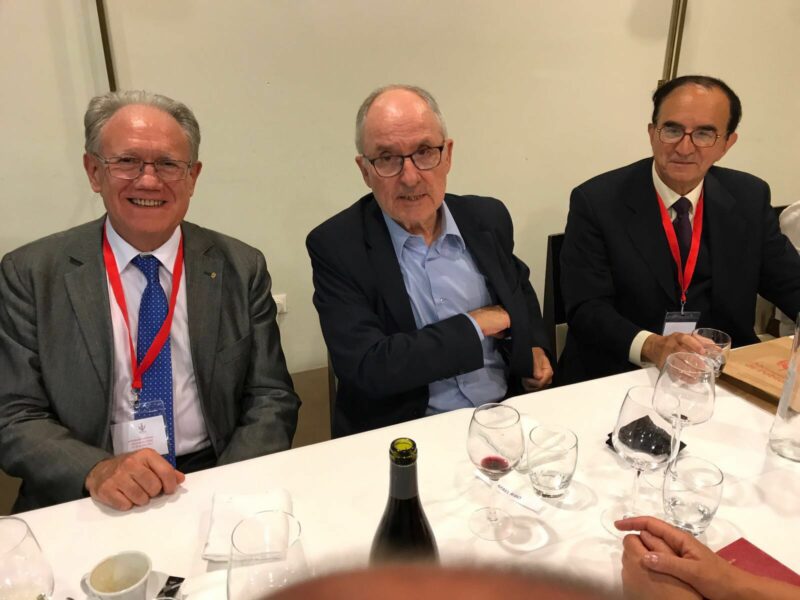
Masons of the high degrees of the Scottish Rite in Catalonia held a meeting from June 9 to 11, 2017, at the Royal Monastery of Santa María de Poblet, which its organizers titled “Meeting and Convent of Catalan Philosophical Freemasonry.” The call came from the Supreme Council of the 33rd and last degree of the Ancient and Accepted Scottish Rite for Spain, the governing body of the fourth to thirty-third degrees of that rite, and extended to all its bodies in Catalonia. The abbot of Poblet at the time was Octavi Vilà, elected on December 3, 2015, and named this Wednesday by Leo XIV as archbishop of Barcelona.
The meeting lasted three days, described in the chronicle published by the Supreme Council itself in August of that year as a fraternal gathering with lectures and debate. The three lectures, given by Masons identified only by their first names, dealt with social philosophy, the social construction of Masonic reality, and socioeconomic issues. As a speaker, the Supreme Council brought in Rafael Ribó, then síndic de greuges, the ombudsman of Catalonia, and the subsequent debate was, according to the text, extensive. There was also a dinner, violin music, and a performance by a gospel group from Lleida. The chronicle attributes the closing to Felipe Llanes, acting sovereign grand commander, and mentions among those present the mayor of Vimbodí i Poblet, Joan Güell, the mayor of Montblanc, Josep Andreu, and the senator for Tarragona, Josep Rufà. The farewell, according to the same account, was a tribute to the spirituality of the place.
The second source is institutional. A note from the Síndic de Greuges office, dated June 12, 2017, and collected by the European Network of Ombudsmen, places the inaugural lecture of a day titled “Social Construction and the Masonic Family” on Friday the 9th at the monastery, with Ribó as speaker and about fifty attendees. The same text places alongside the síndic Óscar de Alfonso Ortega, grand master of the Grand Lodge of Spain since 2010, and records his thanks for an intervention dedicated to social rights and duties.
Neither of the two texts specifies in which parts of the complex the sessions were held, and neither mentions the abbot or the community of monks, either as hosts or as attendees. There is no trace of rituals or liturgical acts in them. The term “convent” in Masonic vocabulary designates the assembly of an obedience, not a building. Since 2010, Poblet has had, within the monastic enclosure, an external guesthouse with 42 rooms and three meeting rooms, the largest for about eighty people, which is advertised for business meetings. Its management corresponds to the Fundació Populus Alba, a private entity linked to the monastic community. The presidency of that foundation fell in 2021 to Vilà himself and today falls to his successor, Rafel Barruè. Whether the Masons stayed and met in the guesthouse or in other facilities is something the sources do not clarify.
Poblet also preserves the tombstone of the Duke of Wharton, former grand master of the Grand Lodge of England and founder in Madrid, in 1728, of the first lodge in Spain, with an inscription that attests to his death in the monastery on May 31, 1731, within the Roman Catholic Church. Franco’s visit in 1952 moved the slab outside the wall, and today it is outside the ambulatory. The Supreme Council’s chronicle does not mention Wharton.
The current doctrine is that of the 1983 Declaration on Freemasonry, signed by Cardinal Ratzinger, which maintains the prohibition on affiliation and declares in grave sin, and separated from communion, the faithful who belong to Masonic associations. Rome returned to the matter on November 13, 2023, in a response from the Dicastery for the Doctrine of the Faith to the Filipino bishop of Dumaguete, approved by Francis, which confirms the prohibition and proposes catechesis in all parishes on the reasons for the incompatibility. Both texts deal with the affiliation of the faithful. Neither regulates the cession of Church spaces.
The biography published by the Episcopal Conference dates Vilà’s entry into Poblet to July 2005, his solemn profession in 2010, and his appointment as prior in May 2014. When the Masons met at the monastery, he had been abbot for a year and a half. His time at the head of the abbey ended with his appointment to Girona on February 29, 2024. His installation in Barcelona is set for December 19.
Read also