


By Stephen P. White
We had a strong start to our year-end campaign yesterday, despite the federal holiday. But we need an even stronger response from all the friends of TCT. Today. Not to boast, but every day we try to do our part to bring you ideas, news, and observations about the Church and the world that you can’t find anywhere else. Will you do yours? Click the button, be generous, and help advance the work of The Catholic Thing. – Robert Royal
One of the most exasperating things about the mass media that inundate us daily is the way they play on our propensity to get worked up over people or events that have very little to do with us and over which we have no control at all. The “news cycle” is, most of the time, the product of an unfortunate oscillation between powerlessness and anger.
Yet every so often some news really does hit close to home. For me, the terrible events that took place last Saturday in Kraków, Poland, hit very close to home. Today, grief and reflection are in order. I have seen enough anger, powerless or otherwise.
For the past two decades, Kraków has been a kind of summer home for me. I have come to know the Old Town particularly well. I have many friends there. I know the churches and cafés, the restaurants and shops, the museums and markets of Kraków as well as I know those of my home in the Washington suburbs.
In all the years I have been traveling to Kraków, I can recall exactly one instance of gun violence, and that was an armed robbery in which no shots were fired.
So a mass shooting like the one that occurred last week—an act of terrorism that, at the time of writing, has left six dead and another sixteen wounded—though sadly familiar in some places (including, alas, the United States), is absolutely shocking and unheard of in a place like Kraków. More than monstrously inhuman, the violence was decidedly un-Polish.
It is not only that the shooting took place in a place that is familiar to me, nor even that I have friends and colleagues who were close enough to hear the shots and sirens with perfect clarity. I was struck by videos of the bloodshed in the Main Square. I was especially moved by the videos of the end of the chase: a police officer, armed only with a pistol, staggering and then kneeling from the pain and blood loss of multiple gunshot wounds, finally managing to subdue his heavily armed and armored adversary.
I know that place. The entire horrific scene ended on the street where I live when I am in Kraków, about 200 yards from my door. And that intersection, where I have crossed the street on the way to breakfast hundreds of times, now appears in media outlets around the world in a scene of both depravity and heroism. As I said, it hits very close to home.
In recent days I have thought more than once about Kraków’s violent history. If a mass shooting like the one we have just witnessed is something out of the ordinary (to put it with enormous understatement), the city has known its share of gratuitous violence.
One of this week’s videos shows passersby huddled for shelter in a church as the attacker sped by in a car, pursued by police. The church building where they took refuge—St. Andrew’s on Grodzka Street—survived the Mongol invasion of the thirteenth century.
The chase passed by Wawel Castle, over which Nazi soldiers once raised the repulsive swastika. As the chase sped past the castle, it also passed the Church of St. Giles (where for many years the Dominicans offered Mass in English every Sunday morning). In front of St. Giles stands a stark monument to the thousands of Poles murdered by Soviet agents in the forests of Katyn.
When the attacker was finally stopped, several hundred yards later, he was about to cross into the Kazimierz district, where, within living memory, thousands of Kraków’s Jews were herded into a ghetto before being liquidated by the Gestapo.
Yesterday, November 11, Poland celebrated its national Independence Day, which commemorates the emergence of the Second Polish Republic after 123 years of partition and foreign rule. Yes, Kraków has known its share of violence and suffering. In a sense, the blood—shed so senselessly on Saturday—is but a drop in the lake of blood shed in Poland over the centuries.
Still, how does one make sense of so much violence? How does one make sense of comparatively small atrocities—like this week’s—in light of such a history?
The recent killings will be remembered for a long time by those who were there. But in the face of the great tides of history, will such events be remembered? Or should they be allowed to fall into oblivion, like so many other sad and bloody episodes of history? And what is lost in forgetting? What is gained in remembering?
I have no answers to these questions. But there is an episode in the Gospel of Luke that has been very much on my mind, because it contains two “minor” episodes that are remembered nowhere in history except in the Gospel.
At that very time there were some present who told him about the Galileans whose blood Pilate had mingled with their sacrifices.
He asked them, “Do you think that because these Galileans suffered in this way they were worse sinners than all other Galileans?
No, I tell you; but unless you repent, you will all perish as they did.
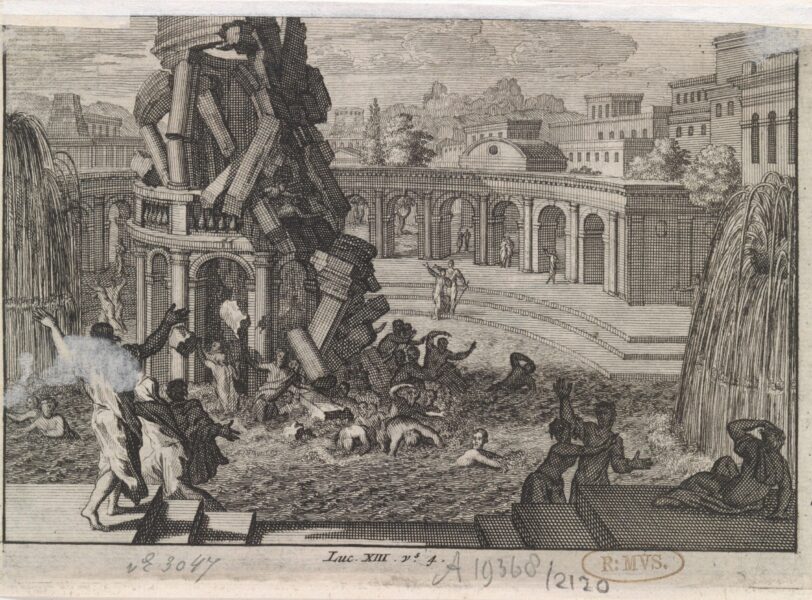
Or those eighteen who were killed when the tower of Siloam fell on them—do you think that they were worse offenders than all the others living in Jerusalem?
No, I tell you; but unless you repent, you will all perish just as they did.”
Jesus knows what became of the Galileans killed at Pilate’s command. And the eighteen crushed by the tower of Siloam are under his care. The victims of Kraków are, too. What remains for us is to commend ourselves, and to commend the dead, to the same loving God. And to repent, lest we perish likewise.
Please pray for the dead and for the living. Pray for Kraków.
About the Author
Stephen P. White is executive director of the National Shrine of St. John Paul II and a fellow in Catholic Studies at the Ethics and Public Policy Center.