


By Robert Royal
A confession: I am an enthusiast, perhaps too much of an enthusiast, for this whole line of thought and life, because it is precisely what we have tried to do for nearly two decades here at The Catholic Thing. And, in my own stumbling and fragmentary way, I myself had been arriving at these truths despite the contrary winds in various educational institutions. The need is even more urgent today. I am so convinced of its critical importance at this moment in history (in fact, in every age) that I feel justified in turning to you, our dear readers of TCT, a few times a year to ask for your financial support. And that time has come again. Next year will be marked by various kinds of public chaos; all the more reason for us to strive to build all the personal and social order we can, each of us, in the circumstances in which we find ourselves. Only the Catholic, the fullness of our tradition, is equal to that task. TCT will be here, every morning, 365 days a year, for you, offering you the best opinion and commentary, in a readable format, that we are capable of. As I always say during our funding campaigns, I know that you, the readers, understand why we are here, why you are here, and why your support is so vital. So please, do what you always do. Give generously, in the way that suits you best, to The Catholic Thing. – Robert Royal
Rome is usually rainy and cold in November, but the last few days have been mostly sunny and mild. The Pope may be in Latin America, but the Eternal City continues to attract enormous crowds, even in his absence, judging by the masses that fill every public and private space, comparable to those he gathers (as I write) in Uruguay and Argentina. It is a somewhat reassuring thought that, whoever is in charge at any given moment, the Catholic barque continues to sail, in Rome and throughout the world. But there are also dangerous shoals beneath the surface.
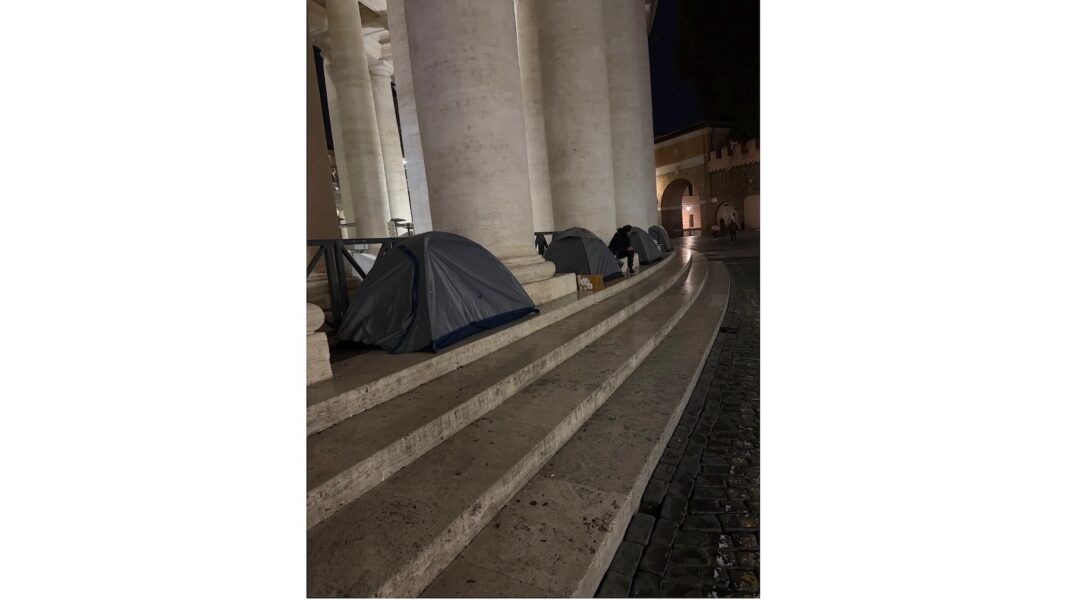
One of the most surprising things I have seen in Rome on this trip is a whole series of individual tents set up at night among the columns of the colonnade in St. Peter’s Square. This is new to me.
There is no doubt that those who organized it have good intentions. But, like those who distribute “clean” paraphernalia for drug use in American cities, they are facilitating precisely the behavior they want to remedy. In a civilized society, or in a Church that truly cares for the poor, institutions are created and funds are obtained so that people (most of whom need psychological and addiction assistance) do not live on the street, to their own and our detriment.
I am in Rome this week for the publication of the Italian translation of my book on The Martyrs of the New Millennium, but also to participate in a conference sponsored by the U.S. National Endowment for the Humanities (NEH) on “Classical Foundations and Moral Authority.” The two events are not unrelated to each other, nor to social and ecclesial reform. Without clear foundations and principles, our moral efforts, as we see around us these days, not least in St. Peter’s Square, degenerate into mere kindness and incoherence. And without people willing to sacrifice, to suffer, even to die for the truth, even the highest intellectual and ethical principles remain mere ideas.
We have just celebrated the feast of St. Charles Borromeo. If anyone was a Catholic reformer, it was he. He confronted the lazy, the servile, the corrupt, and the decadent in Rome and in Milan (his archdiocese); he helped organize the final session of the Council of Trent; and he played a central role in drafting the Tridentine Catechism, intended to form priests, who, in his view, were then poorly instructed and therefore unprepared to meet the deepest needs of the people.
Although heir to the fortune of one of the noblest and wealthiest families of Renaissance Italy, he lived simply and was not afraid to get his hands dirty. When the plague struck Milan in 1576, he remained in the city and organized assistance for tens of thousands of people, often funding it from his own fortune. (It ran in the family: his cousin Federigo plays a similar role in Manzoni’s great novel The Betrothed.) Naturally, his efforts were harshly criticized and resisted; someone even shot at him, but missed. Still, he pressed on, as countless Catholic reformers have done throughout the centuries.

Today we need a similar effort of reform and education in the secular sphere as well. At the NEH conference “Classical Foundations and Moral Authority,” some of the leading social thinkers from the United States and Italy discussed the urgent need for a religious humanism today.
Marcello Pera, a philosopher who also served as president of the Italian Senate, presented a clear account of where we are now. (If you have not read Without Roots, the book he wrote with Joseph Ratzinger, do so. It is a delight.) Citing the Founding Fathers of the United States, Kant, and Tocqueville, he described how we have formed Western societies that claim to believe in fundamental human rights. Rights, we seem to suppose, simply are there, independent of and prior to each one of us. But, without belief in a God who confers them, where do they come from?
It is a philosophical question, and philosophers normally like to ask questions. Without God, however, there is no answer. So, instead of rethinking the nature of the human communities in which we live, we have simply chosen to stop asking the question. It is a kind of solution, but not one that can survive for long in the face of the numerous challenges confronting free societies today.
Brian Burch, the United States Ambassador to the Holy See, took the argument further. Both the classical tradition and the early political vision of the United States recognized that virtue, the self-discipline necessary to lead a proper human life, also has a public role to play. The entire Christian tradition thought the same. That self-discipline does not restrict us; rather, as an Italian historian said, it is “a school of freedom.” Yet today we speak and act as if people’s lives were only their own affair, with no consequences beyond individual “choice.”
How we got into this mess is a complex story that many of the speakers traced with acuity. James Hankins, who taught at Harvard for decades (but is now at the University of Florida), described how Harvard stopped teaching Western civilization forty years ago and replaced it with global history. At the time it seemed generous and liberal, but look at the result. Students maintain that other nations and cultures are valuable, but that their own civilization is not. The remedy, he said, is not to lose the global perspective, but to approach it only after having learned about one’s own culture.

The violent “student” protests continue here in Europe, not only in France, but in Germany and even in Italy. Is it an exaggeration to think that the discontent, misdirected against our own culture, is connected with decades of poor education?
Sometimes it is hard to believe, especially in Rome, where millennia of classical and Christian history surround you, that we Westerners have allowed ourselves to drift away from the only cultural tradition capable of setting our lands in order. But that is precisely why we need today the witness of the martyrs, the effort of the reformers, and the courage of thinkers, not only to speak but to act and save us before it is too late. Congratulations to the NEH and especially to its president, Michael McDonald, for organizing a powerful conversation that, despite many obstacles, attempts to point the way.
About the Author
Robert Royal is editor-in-chief of The Catholic Thing and president of the Faith & Reason Institute in Washington, D.C. His most recent books are The Martyrs of the New Millennium: The Global Persecution of Christians in the Twenty-First Century, Columbus and the Crisis of the West, and A Deeper Vision: The Catholic Intellectual Tradition in the Twentieth Century.