


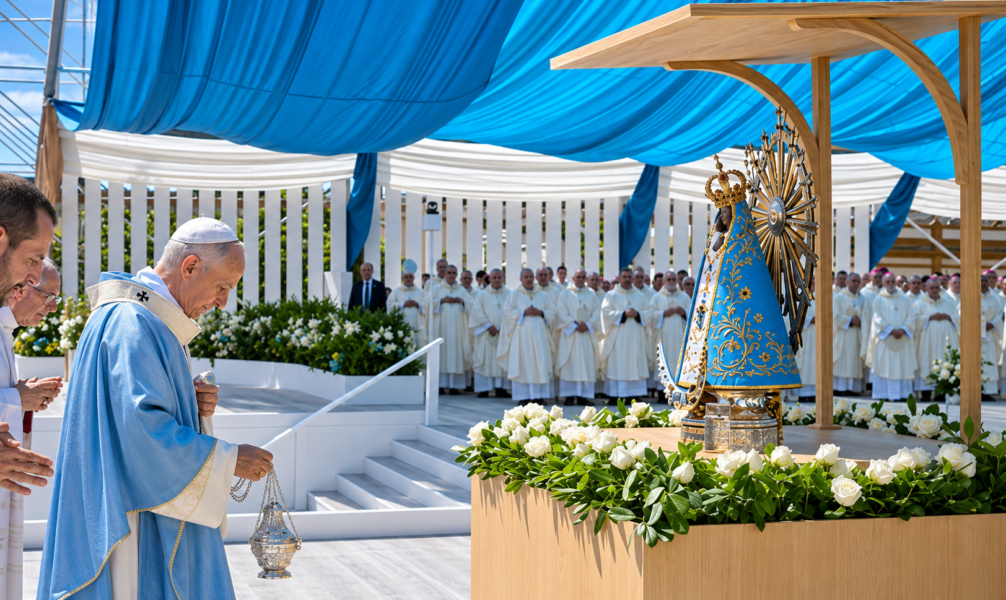
The Pope presided over the final celebration of his visit to Argentina before the Basilica of Our Lady of Luján, with an attendance that the Holy See Press Office estimated at more than two million people. He proposed a four-step itinerary drawn from the Eucharist itself: reconciliation, Word, communion, and mission. He closed with an exhortation that all the media repeated: “Argentina, arise and walk.” After the Mass he departed for Peru.
A phrase on unity
The passage that deserves the most attention is in the third step, that of communion. Leo XIV drew on his own encyclical Magnifica humanitas (n. 88). He recalled that the Eucharist, “sacrament of unity,” nourishes belonging to the body of Christ, and added: “The diverse sensibilities present in the Church, the strong convictions that animate each person, are a richness if they remain anchored in the certainty of unity as a gift received and as a task to be assumed.”
The text does not mention the liturgy or any specific group. The encyclical from which it comes, published on May 25, is a document of social doctrine on the human person in the age of artificial intelligence. Reading the quotation as a liturgical nod would go beyond what the Pope said. Even so, the context of the trip invites one to ask to whom that recognition extends.
The request Argentina was waiting for
On Monday the 9th, as the popemobile passed through Buenos Aires, a group of university students unfurled banners with the slogan “Young people want the traditional Mass.” They sign as “Catholic Youth.” In a document released before the visit, they take up the official motto, “Everyone welcome,” to ask that those attached to the traditional liturgy also be welcomed. They request that priests recover the freedom to celebrate with the 1962 Missal wherever there are faithful who ask for it. They declare themselves in full communion with the Church and faithful to the Pontiff.
The day before the trip, the emeritus archbishop of La Plata, Héctor Aguer, asked in an interview to “repeal Traditionis custodes.” Aguer died on November 10, during the papal visit.
The request clashes with an intact legal framework. Francis’s motu proprio of July 2021 subjected the celebration of the ancient rite to the bishop’s authorization. A 2023 rescript reserved certain dispensations to the Holy See.
Signals in both directions
Leo XIV has not personally pronounced on the future of the norm nor has he published any document on the matter. His gestures, however, have pointed in different directions.
In September 2025 he announced that he would listen to the faithful attached to the ancient rite. He then lamented that the issue had become a matter of “ideology” rather than of communion. In October of that year he personally authorized Cardinal Raymond Burke to celebrate the traditional Mass at the altar of the Chair of Saint Peter.
In the opposite direction, the nuncio to the United Kingdom communicated in November 2025 to the bishops of England and Wales that the Pope would not repeal Traditionis custodes. Last October, the prefect of the Dicastery for Divine Worship, Cardinal Arthur Roche, went further in an interview: he stated that Leo XIV “is not going to change” the norm nor return to Summorum Pontificum. Roche based this on words of the Pope to priests and consecrated persons at Notre-Dame.
Those statements belong to the prefect, not to the Pontiff. Between the phrase at Luján and a possible normative decision lies a distance that only Leo XIV himself can cover. In Argentina, the Pope wrote that different sensibilities are a richness when they remain in unity. The young people who met him in Palermo say they are asking for exactly that: a place within it.
Related
- The young people behind the banner to Leo XIV: a document, a rosary and 5 reasons to free the traditional Mass
- A group of young people shows Leo XIV in Buenos Aires a banner: “Young people want the traditional Mass”
- Archbishop Aguer asks to “repeal Traditionis custodes” during Leo XIV’s visit to Argentina
- Monsignor Héctor Aguer, emeritus archbishop of La Plata, dies during Leo XIV’s visit to Argentina
- “He is not going to change Traditionis Custodes”: the prefect of Divine Worship on Leo XIV
- The “liturgical limbo” of Leo XIV