


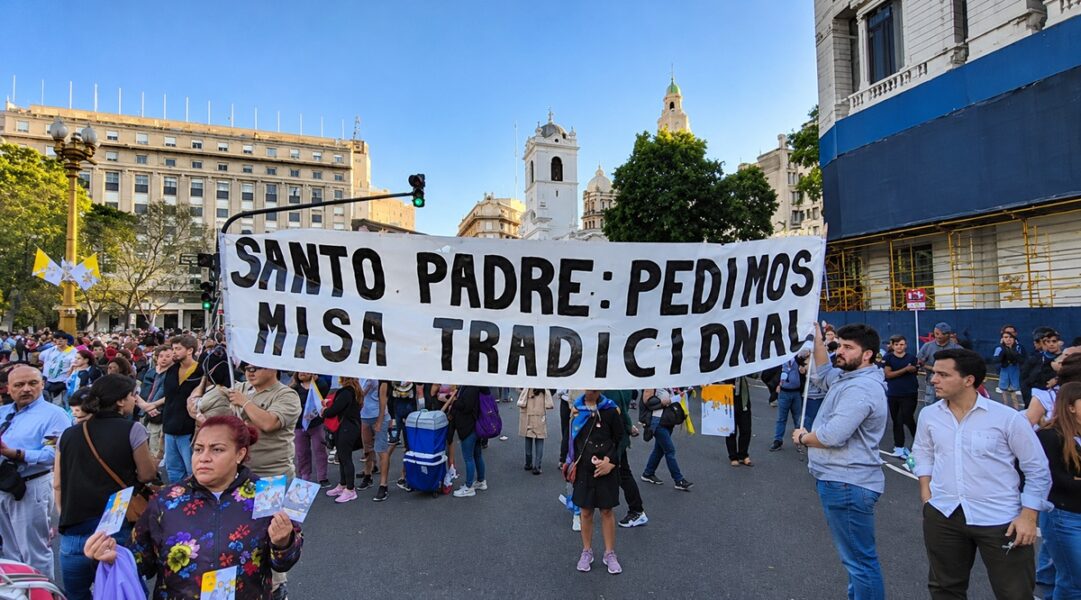
Last November 9, during the second day of Pope Leo XIV’s trip to Argentina, a group of university students welcomed the pontiff by unfurling several banners with a demand they have been making for years: “Young people want the traditional Mass,” read one of them. “Holy Father, we ask for the traditional Mass,” proclaimed another.
It was a premeditated campaign, following the circulation of the text Request for Freedom for the Traditional Mass by Catholic Youth, accounts such as that of the X user @pchazarreta having been promoting it in the days leading up to the pontiff’s visit. The campaign has ultimately received wide coverage in national and international media, with the same user being interviewed by Infobae.
“We are simply asking for freedom”
In that interview, Chaza highlighted the love many young Argentines have for the traditional liturgy and reiterated his wish that priests “who wish to celebrate it in parishes, whenever the faithful request it, be allowed to do so.” He also described the traditional Mass as the one celebrated in Latin and “facing the tabernacle, facing God,” a liturgy that, he explained, has been perfected by saints over the centuries and is “rich in signs.”
When the interviewer objected that Latin is generally not understood by anyone, the young man admitted that he did not understand it at first either: “Now I clearly love it, and that is the beautiful part—learning as you go.” He also recalled that “everything is for God.” The journalist replied with humor that God is multilingual and understands everything; the interviewee then insisted on the richness of the prayers and psalms, and on the silence and recollection that accompany the celebration. Asked whether they want the Pope to “return” the traditional Mass, he summed it up this way: they are asking “that there be freedom for those who wish to celebrate it to be able to do so.”
Santiago, another young man from Buenos Aires interviewed among the faithful waiting for the Pope, introduced himself as part of a group of university students gathered to make “a very special request to Leo XIV”: “the liberation of the Mass according to the traditional rite, which the Church has always permitted.” He defined it as the rite the Church has handed down “from the first Christian centuries,” which “evolved organically” until reaching a fullness of perfection and beauty that brings the faithful “much closer to the mystery of the holy Mass.”
“We are simply asking for freedom for the celebration of the rite,” he insisted. “We are many faithful throughout the world who were affected in 2021 when its celebration was restricted.” Santiago listed its features: Latin, the orientation toward the tabernacle, and numerous visible gestures and signs that, he explained, help the faithful unite more deeply with the mystery and with God in prayer.
A document in five questions
The text signed by “Catholic Youth” has two parts. The first is an open letter “to Catholics” that celebrates the visit of the successor of Peter as an occasion to foster the unity of the Church in Argentina, but also notes “the difficult situation the Church is going through.” The signatories maintain that, in the face of confusion in doctrine and morals and the consequent weakening of the faith, a growing number of faithful find in the traditional liturgy “a source of clarity.”
The letter takes up the motto of the trip, “Everyone is welcome. Go and announce,” and applies it to their own situation: “We too want to be welcomed, those of us who are sincerely attached to the traditional liturgy.” The young people reject the idea that their desire is “a nostalgia of a past generation” and expressly ask “that in our beloved homeland the Holy Mass may be celebrated according to the traditional rite with full freedom.” The document also encourages the laity to “assert the rights the Church recognizes for us, even if they are not always respected.”
The second part is a three-page dossier answering five questions: who they are, what the traditional Mass is, why it was restricted, why they want it, and what they are asking for. The authors present themselves as lay faithful who wish to participate in it “in full communion with the Church and with full fidelity to the Supreme Pontiff,” invoking canon 212 of the Code of Canon Law, which recognizes the right of the faithful to manifest their spiritual needs and desires to their pastors. They emphasize that it is not “another Mass or a different sacrament,” but the same sacrifice, celebrated with the rite the Church has perfected over the centuries.
Among their reasons, the document highlights silence, the orientation of the altar, and the priest’s gestures of reverence, which “place God at the center”; the theological precision of prayers filled with psalms and biblical texts; and Latin as an expression of the unity and universality of the Church. The concrete request is highlighted in bold: that the Holy Father “restore freedom to priests to celebrate regularly the Holy Mass according to the 1962 Missal wherever there are faithful who request it, for the good of souls and for the greater glory of God.”
Their five reasons for requesting the Traditional Mass
The fourth section of the dossier answers the question “Why do we want the Traditional Mass?” There, the young people gather, in their own words, the reasons that lead them to request it:
- Out of love for God. “Because we love God and what we most desire is to unite ourselves closely to Him. In prayer we find the principal means of encountering God and speaking with Him, according to the interior dispositions of each person; therefore, if there is a way of praying at Holy Mass that is more fitting through recollection, silence, and signs, it is entirely legitimate and appropriate to ask the Church not to deprive us of so great a treasure.”
- Because it strengthens faith. “We want it because it strengthens and increases our faith, makes us participate with greater devotion and fervor in the holy sacrifice of Calvary, expressing through its visible signs that tremendously real reality which is made present.”
- Because it places God at the center. “Silence, the orientation of the altar, and the numerous external gestures of reverence by the priest place God at the center and reflect the transcendence and immensity of the mystery celebrated, fostering recollection, adoration, and the interior participation of the faithful.”
- Because of the richness of its prayers. “Its prayers and formulas contain a doctrinal richness of great theological precision, incorporating throughout the rite numerous prayers taken from the psalms and other biblical texts.”
- Because of Latin. “Latin in turn manifests the unity of the Church and its universality across the ages and the nations of the whole world.”
From this arises the request with which the text concludes, highlighted in bold: that the Holy Father “restore freedom to priests to celebrate regularly the Holy Mass according to the 1962 Missal wherever there are faithful who request it, for the good of souls and for the greater glory of God.”
From Summorum Pontificum to Traditionis custodes
The dossier reviews the recent history of the issue. After the liturgical reform following the Second Vatican Council, Paul VI promulgated the new Roman Missal in 1969, but the 1962 Missal was never abrogated. In 1988, John Paul II asked the bishops in the motu proprio Ecclesia Dei for a broad and generous application of permissions for the previous rite, and in 2007 Benedict XVI recognized with Summorum Pontificum the freedom of priests to celebrate with the 1962 Missal without the need for authorization. From the letter accompanying that motu proprio comes the quotation that closes the young people’s document: “What earlier generations held as sacred, remains sacred and great for us as well.”
On July 16, 2021, Francis changed that framework with Traditionis custodes, which subjected the celebration to the authorization of the diocesan bishop. A rescript of February 2023 reserved to the Holy See, through the Dicastery for Divine Worship, the dispensations to celebrate in parish churches and for priests ordained after the publication of the motu proprio. “The Traditional Latin Mass remains valid,” the signatories summarize, “but to celebrate it requires permissions that are extremely difficult to obtain.” Those norms remain in force under the pontificate of Leo XIV.
The young people close their appeal by asking those who recognize “the importance of this legitimate request” to join them “in prayer and in charity.”
Related