


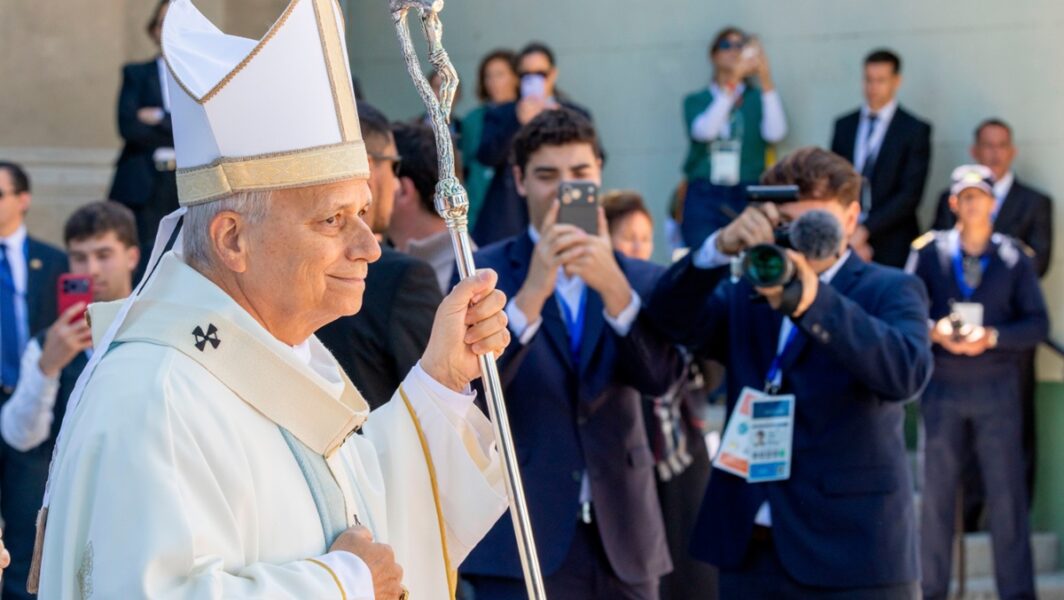
Pope Leo XIV met on the afternoon of Monday, November 9, at the Apostolic Nunciature in Buenos Aires, with five victims of abuse committed by members of the clergy and Argentine ecclesiastical institutions. According to the communiqué from the Holy See Press Office, reported by the EFE agency and by elDiario.es, they were victims “presented by the local Church”. Among them was no representative of the former auxiliary numeraries of Opus Dei who are denouncing before Argentine justice that they were recruited as girls or adolescents and subjected to servitude, and who had been requesting an audience with the Pope for weeks.
The meeting lasted more than an hour and was not on the public itinerary of the trip, although the Holy See had announced at the end of October that the Pontiff would meet with survivors of abuse during his tour of Uruguay, Argentina and Peru. According to the Vatican note, the Pope “spoke individually with each of them” and, upon saying goodbye, “imparted his blessing and thanked them for the meeting and their testimony of faith.” Leo XIV conveyed to them, and through them to other victims with whom it was not possible to meet, his desire to strengthen in the Church the channels of protection, welcome and accompaniment. The Holy See has not disclosed the identity of the five people or the cases they represent.
That same morning, the former numeraries had released a video through the international network of survivors Ending Clergy Abuse (ECA) to request the audience again. “We want Pope Leo XIV to listen to us. We want justice. What happened to us is human trafficking”, they say in the recording, according to elDiario.es. The formal request was submitted to the Vatican on September 15 and, according to EFE, remained unanswered. Sources close to the women cited by elDiario.es confirm that the audience did not take place.
The complainants, 43 former auxiliary numeraries, maintain that they were recruited in childhood or adolescence with promises of studies and work, and that they spent years in unpaid domestic tasks, with long working hours, restrictions on their freedom and psychological violence. They filed their complaint with Argentine justice in September 2024. The Prosecutor’s Office for Human Trafficking and Exploitation (Protex) accused members of the prelature of operating a system of recruitment and labor exploitation, and the Prosecutor’s Office has requested the preliminary hearing of five former Opus Dei leaders in Argentina, whom, according to the women’s lawyer, Sebastián Sal, the judge has not yet summoned. Opus Dei denies the accusations.
Argentine lawyer Sergio Salinas Giordano, who represents victims of abuse and heads ECA in Latin America, criticized the reserved manner in which the meeting was handled. “It is a communiqué that generates discontent and not hope in the Church”, he told elDiario.es, adding that the meeting “has further revictimized tremendously vulnerable victims.” ECA has called a press conference in Buenos Aires for Wednesday, whether or not the audience takes place, with Salinas Giordano and German Matthias Katsch.
It is not the first time the women have tried to reach the Pope. In October 2025, Leo XIV received representatives of ECA, and in March 2026 the British journalist Gareth Gore, author of the book Opus, who delivered documentation from the Argentine fiscal investigation. Sal has criticized that the Pontiff received the prelate of Opus Dei, Fernando Ocáriz, while they were still waiting. The Pope leaves Argentina on Wednesday, November 11, heading to Peru, where he is scheduled to meet in Chiclayo with victims of the Sodalitium of Christian Life.
The Pope listened in Buenos Aires to the victims presented to him by the local Church; those denouncing Opus Dei continue to await a response.
Read also
- The 43 former auxiliary numeraries of Opus Dei ask Leo XIV to receive them on his trip to Argentina
- Leo XIV will hold meetings with victims of abuse during his trip to Uruguay, Argentina and Peru
- Escardó denounces that the nuncio and the Peruvian Episcopal Conference exclude him from Leo XIV’s meeting with victims of the Sodalitium