


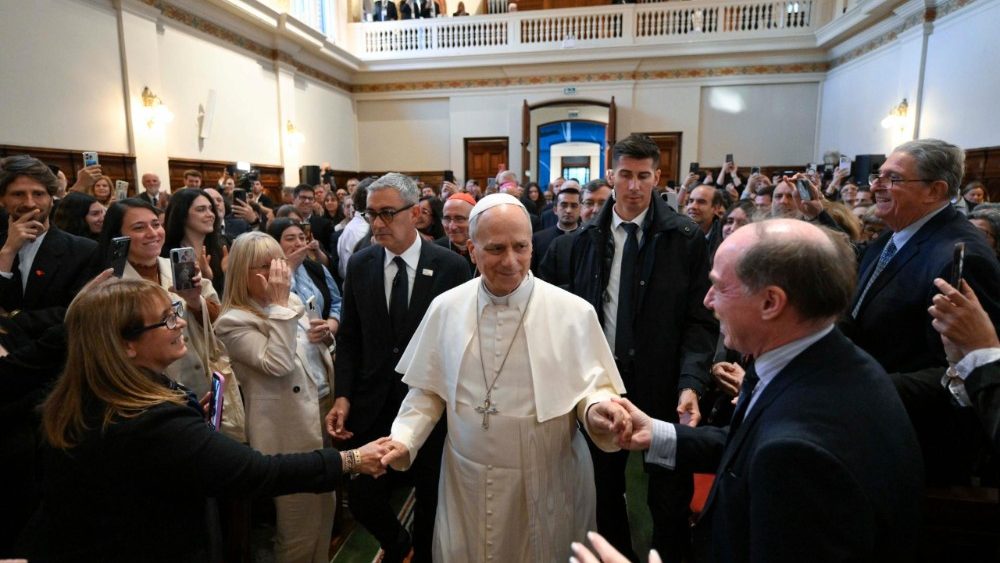
Pope Leo XIV asked Catholic educators in Uruguay this Saturday for an “integral and humanizing” education that forms the whole person, with special attention to the use of artificial intelligence. He did so in the Aula Magna of the Universidad Católica del Uruguay, in Montevideo, during the meeting with the world of education that took place at 6:00 p.m. as part of his apostolic journey to Uruguay, Argentina and Peru, according to the official text of the address published by the Holy See.
The Pontiff proposed a brief “walk” through the five senses as the guiding thread of his reflection, under the title “educating from the five senses.” He also recalled John Paul II’s visit to the university in 1988 and described Catholic education as the concrete way in which the Gospel becomes “an educational gesture, a relationship, a culture.” Among those attending the meeting were Cardinal Daniel Sturla, Archbishop of Montevideo, and the rector, Jesuit Julio Fernández Techera.
Contemplation, touch, discernment: three educational tasks
He associated sight with contemplation, which he linked to attention, a capacity that, according to the Pope, is becoming increasingly difficult in a distracted world. “To contemplate is to evangelize in that increasingly difficult cognitive process,” he stated. He related touch to the hands, which can build peace or wage war, and asked Catholic institutions to educate new generations in peace. “Whoever feels embraced by the Father is, inevitably, a builder of peace,” he added.
He connected taste with wisdom, which is born of experience and discernment rather than the mere accumulation of information, and quoted the First Letter of Saint Peter: “You have tasted that the Lord is good.” At that point he called on schools and universities to contribute to the “wise use of technologies and AI, placing the person before the algorithm.” According to the text, that task must balance technical, emotional, social, spiritual and ecological intelligences.
Against discard and dualism
To smell he devoted a warning about the culture of discard. Using Augustine’s image of good reputation as a good perfume, he recalled that rejecting and belittling people has become normalized and stressed that no one can be rejected. The address also referred to the “process of dehumanization we are experiencing” as one of the challenges facing schools and universities.
The Pope likewise maintained that it is necessary to overcome dualistic views of the human being and affirmed the unity of “body and soul, heart and conscience, intelligence and will.” Reducing the body to an object, he warned, amounts to denying human dignity. For this idea he cited the conciliar constitution Gaudium et spes (n. 14) and his general audience of September 9, 2026.
Listening and the final blessing
With hearing he closed the journey and evoked the words of the Gospel of Matthew: “Whoever has ears, let them hear.” He explained that listening means recognizing the other as a good and not as a threat, which opens possibilities of encounter with families, society and authorities. He entrusted the work of educators to the Virgin, Seat of Wisdom, and imparted the apostolic blessing.
At the end, in an improvised greeting, he expressed the hope that the enthusiasm of the day would endure and that educators would give Uruguay a voice that affirms faith, the value of human life and the value of each person. After the meeting, the Pope took part in the vigil with young people at the Estadio Centenario, where he asked them to marry “for life,” as reported by InfoVaticana. The meeting with the educational world had been announced days earlier by the university itself.