


By Anthony Esolen
The other day I saw a photo of a school assignment a boy had done, which the teacher had marked as incorrect. The question read: “Which is greater, 0.2 or 0.14?” The boy answered, correctly, that 0.2. But the teacher wrote: “0.14 has more digits! Please study.” I hardly know where to begin. A teacher who does not know what decimals mean? I suppose she would have thought that 0.20 was greater than 0.2, and that 0.2000 was much greater than both!
I also had occasion to write about Gerard Manley Hopkins’s poem “Hurrahing in Harvest,” and, being far from home and my books, I had to look it up on the internet. The first site that came up offered a brief analysis, protected by copyright. It was the work of AI, riddled with stupidity and incoherence. But how can an algorithm know what it is to contemplate the clouds in a luminous, windy autumn sky, much less know what it is to think or to praise God?
The work of the human administrator of the site, who introduced Hopkins, was no better. I fear that, although Western man no longer heeds the loving command of Genesis, “Be fruitful and multiply,” stupidity does, and will continue to do so in those who lack a true education to protect them from it.
Then I came across a clip of podcaster Ben Shapiro interviewing popular science communicator and despiser of religion Neil deGrasse Tyson. The topic was freedom and the apparently insoluble enigma—insoluble only if one denies reality—of men pretending to be women and bursting into women’s sports. “It’s a free country,” said Tyson, and concluded that this means one should be allowed to do whatever one wants in sexual matters, because freedom, as he understood it, was merely negative: unless there is evident material harm, no one can forbid you your favorite source of pleasure.
I pointed out that not a single one of the ancient pagan philosophers, not even Epicurus, would have agreed with him. They all understood the difference between freedom and license. They all warned that license enslaves.
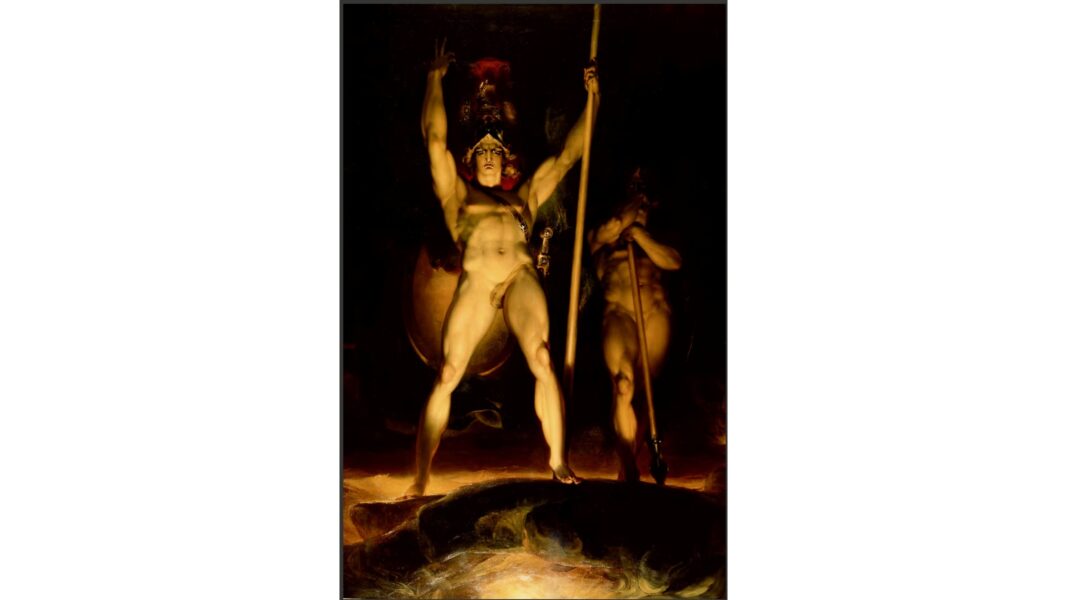
Christians agreed. Here is the archangel Michael answering Adam in Paradise Lost, after Adam expressed his disgust at hearing that one of his descendants, Nimrod, would be the first tyrant, a “mighty hunter”:
But know further
that, since your original fall, true liberty
has been lost, which always with right reason dwells
twin, and without it has no proper being.
Reason in man obscured or disobeyed,
at once disordered appetites
and upstart passions seize the government
from reason, and reduce to servitude
the man who was free before. Since, then, he permits
unworthy powers within himself to reign
over free reason, God, in just judgment,
subjects him outwardly to violent lords
who often, with equal lack of merit, enslave
his outward liberty: tyranny must exist,
though the tyrant is not thereby excused.
A licentious nation is also a stupid nation. Its slavery is inevitable. The same holds for all human groups—the churches and schools are not immune at all—and for every person.
You will have noticed that I used as examples three things I found on the internet. I distrust it, because I feel the powerful impulse to swim in that lagoon of information and distortion, where the passions are kept always at a simmer, until they raise a constant dermatitis of the soul. You may also notice that in each case I had a counterweight, some means of judging what I saw or of freeing myself from that magnetic force.
But it is exhausting in both senses. And if it is so for me, how much more will it be for the young who do not have Hopkins or Milton within reach or in their hearts, not even the simplest facts of arithmetic!
Earlier generations could not be so distracted, because they lacked the means; nor could they be so stupid, because the near and pressing demands of life prevented it. As confirmation, while I was sick in bed, I opened at random an old book I had on the nightstand and there read a speech delivered in the Senate by John Sherman, younger brother of the famous general William Sherman, on gold and silver currency, their relative values, and the price of goods, especially those produced by farmers.
No one could write it today: too reflective, too careful, too judicious with evidence, and too cultured. John Sherman never went to college.
Sometimes I wonder whether the Church will seize this opportunity to preserve once again the humanities in a profoundly dark age. The problem is that this time the darkness is not outside, pressing against the walls. It is inside.
We know how to read, if by reading we mean deciphering letters on a page. But true reading requires time, patience, equanimity, whereas everything around us devours our time, distracts us, and unsettles us. Today more than ever we need Catholic schools, but who will teach in them? Today more than ever we need Catholic teachers and ministers who turn our minds and hearts toward eternal things, but how can that be achieved amid so much noise?
I will make one suggestion among the hundred that could be made. Remember the power of silence and of song. Both are close to prayer, and therefore Hell knows nothing of them. Remove the screens from our schools: noise and addiction to noise.
Teach students to listen to true music; that is one thing the monstrous internet can serve for. Teach them to sing it, and to love singing. I might say that everything must be done anew, except that no human culture before ours had to do what arose so naturally. The silliest old song you can teach is closer to the love of God than all the shouts, denunciations, sales pitches, obscenities, and frivolities of the internet.
In any case, and by all means, become human again, as God intended us to be.
About the author
Anthony Esolen is a lecturer, translator, and writer. His books include Out of the Ashes: Rebuilding American Culture and Nostalgia: Going Home in a Homeless World, and most recently, The Hundredfold: Songs for the Lord. He is a distinguished professor at Thales College. Be sure to visit his new website, Word and Song.