


By Auguste Meyrat
To the dismay and disappointment of writers and English teachers, the habit of reading is being set aside throughout the developed world. Study after study shows that fewer and fewer people are reading books, and even most Ivy League students can no longer get through a classic novel without intense effort. Instead of the written word, people increasingly rely on screens to occupy their thoughts.
Although most people recognize this problem, it is unclear how it will affect us. Will the decline of verbal literacy simply give way to a rise in some kind of digital literacy? Will a certain class of literati pursue the Benedict Option and separate from the mainstream to preserve a culture of reading? Or are we facing a new Dark Age in which humanity once again embraces superstition, tyranny, and tribalism?
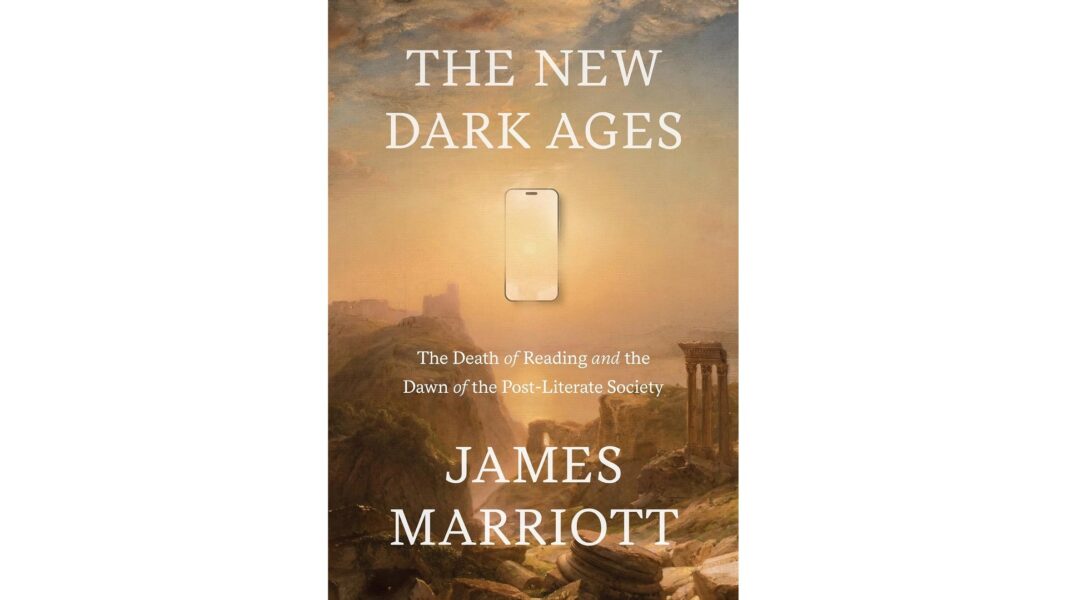
London Times columnist James Marriott argues in The New Dark Ages: The Death of Reading and the Dawn of the Post-Literate Society that it will likely be the latter. In Marriott’s view, the rise of mass literacy explained many, if not most, of the goods enjoyed by modern Westerners, specifically scientific progress and a stable order. But when the practice of reading fades, this complex system will inevitably unravel: “As the age of print gives way to the age of the screen, the world we once knew is disappearing.”
Marriott concedes how unnatural the act of reading actually is. Reading was not merely an aspect of human evolution that manifested in humans without any stimulus. It was a revolutionary cognitive system that allowed entire civilizations to emerge. The intellectual act of turning symbols into ideas, however, requires an enormous mental expenditure, constant practice, and the presence of actual reading material.
The oldest texts were mostly handwritten or carved in stone, so only a small group of people could actually read and write, while the masses remained largely illiterate.
Marriott’s secular liberal bias begins to show when he tends to dismiss the progress achieved during the millennia before mass literacy. He admits that advances were made in all areas of life, but he falsely believes there were no complex systems of government, scientific revolutions, or highly successful literary works. As he himself says: “Society is a better and more rational place thanks to the advance of reading.”
Reading alone does not make a person better, as Marriott knows, but he still wants us to believe that reading makes people more empathetic, charitable, logical, productive, intelligent, and generally happy. In his view, it was not Christianity that led to the abolition of slavery, the establishment of human rights, and the creation of countless social welfare programs (including those that taught people to read). It was “the rise of reading.”
Revealingly, Marriott skips over the atrocious chapters in the history of certain hyper-literate societies (e.g., interwar Germany) that slid into brutal fascist and communist autocracies and committed genocide against their own people.
In recent decades, the culture of literacy has given way to the culture of the screen. This began with television. Almost every extra hour of leisure hard-won after the mid-twentieth century was spent watching television. This led to the sad reversal that “many wealthy and highly educated people [are] much less well-read than many members of the less privileged classes… in the mid-twentieth century.”
This problem only worsened when televisions became pocket-sized devices equipped with high-speed Internet access. The smartphone not only eliminated all remaining opportunities for reading but also addicted users to screens. In Marriott’s view, this was the final blow to the culture of literacy.
So what does that mean for society at large? This is where Marriott’s own political and philosophical biases detract from an otherwise well-written and well-argued book. In a later chapter, he recounts how his own reading itinerary led him to embrace the New Atheists of the early 2000s along with secular progressives like Steven Pinker, who celebrate the Enlightenment as the pinnacle of reason.
Thus, Marriott primarily fears the rise of superstitious thinking (i.e., religious), personality cults, anti-intellectualism, and the erosion of public discourse and democratic principles.
Although some of these concerns are valid, they ignore the much greater problems of the decline of religious practice: the crisis of meaning, the epidemic of loneliness, global depopulation, and political and cultural radicalization.
These factors contribute far more to a Dark Age than, say, podcaster Tucker Carlson complaining about demons or President Trump expanding the East Wing of the White House to enhance his image. Moreover, while the screen has wreaked havoc on communities and social life, books brought people together and articulated deeper truths that enriched humanity.
Predictably, Marriott does not know how to revive a culture of literacy, since he can only think in worldly terms: “As reading dies, we are living through a remarkable and dangerous period in history.” It was the Church that largely taught Western populations to read in the first place; so Marriott fails to see that the Church will likely be a strong ally in reviving reading.
After all, Christianity is a religion of the book, and the Bible has been the most widely printed book of all time. That is why saints like Augustine, Alphonsus Liguori, and Francis de Sales strongly promoted reading. A population that can no longer read is a population that can no longer be fully catechized.
More importantly, reading is a means, not an end in itself. There must be a greater purpose that inspires people to “take up and read” once again. Marriott comes so close to accepting this conclusion, but then misses the point entirely.
He is right to lament the decline of reading and the rise of ignorance and superficial thinking, but he forgets the ultimate goal of reading, which is to love and serve God and neighbor better. Without a transcendent foundation, reading, along with any other human activity, becomes meaningless and soon dies.
About the author
Auguste Meyrat is an English teacher in the Dallas area. He holds an MA in Humanities and an MEd in Educational Leadership. He is editor-in-chief of The Everyman and has written essays for The Federalist, The American Thinker, and The American Conservative, as well as for the Dallas Institute of Humanities and Culture.