


By Francis X. Maier
Suann, my beautiful wife of 56 years, has a radiant smile. She uses it every time I tell a certain story, which goes something like this. A year or two ago, I began to notice that my hearing was getting worse. I attributed it to age; for a man in his seventies, it’s a common thing. But it seemed especially marked at home. Suann would say something—something clearly important, judging by her tone—and I would hear it muffled or confused.
This did not please her at all, even when I explained the complex physics at work. Sound waves have a hard time passing through walls, ceilings, and floors (like ours). The 90-degree angles, so common in a modern house (also like ours), pose another annoying acoustic problem. Dissatisfied, she suggested instead that I go to the doctor. And I did. A young and competent specialist gave me a full battery of tests and, in the end, informed me: “Your hearing is excellent, Mr. Maier; what needs work is your listening.”
Assuming one has healthy ear canals, hearing the many sound waves emitted, for example, by a beloved spouse happens whether we admit it or not. Ignoring confusing requests or instructions may seem temptingly reasonable, but it can end badly.
Listening, on the other hand, implies intention, attention, and understanding. Homer’s two great epic poems, The Iliad and The Odyssey, each have more than 12,000 lines. The ancient Greek bards recited them from memory, for hours. And the Greek audience listened, for hours. They lived the recitals orally, because the words were not set down as formal texts until a late stage in the poems’ development. Even so, the crowds were spellbound, because listening to a well-told story or poem has an electric effect on the imagination; an effect no screen can match, and that even reading a great novel or play cannot fully reproduce.
All of which is a preamble to what follows.
November is a kind of vestibule month. It is a place in the calendar where we pause to pray for the faithful departed, but also to take an honest inventory of our own life. In these fading autumn days, we are called to reflect on the four last things—death, judgment, Heaven, and Hell—before entering Advent and a new liturgical year. Death comes to us all. November is a time to remember that. Our lives, our choices, and our actions matter. And they will have consequences in the life to come.
In his book Things Worth Dying For, Charles Chaput notes that, even with a firm faith in God as the Author of beauty and love, the idea of being judged after death by Someone “who knows us better than we know ourselves” can be deeply unsettling. In that encounter, we will see with intense clarity “who we really are and what we have become,” and we will likely be “our own sternest prosecutors.”
That is why he points out:
The most frightening thing about death is not that God, when we see him face to face, will be an “implacable judge” with a record of our crimes. Jesus repeatedly describes God as a loving Father. And no such Father will allow the destruction of his child unless the child actively prevents him from avoiding it. If a soul has even an ember of love and goodness left from its earthly pilgrimage, God will seek to rekindle it with his breath. So the truly frightening thought about the next life is not that God might condemn us. It is that we can freely condemn ourselves. We can choose Hell because we have become the kind of creatures who prefer it.
Unfortunately, this is the problem we face when reflecting on eternal realities and our personal place in them, given the current moment in the United States. We live in a fiercely materialistic culture of 24-hour noise, toxic opinions, and commerce, which obscures any horizon beyond itself. It is also an increasingly post-literate bubble, thanks to the deterioration of reading ability, the frantic pace of modern life, and the addictive distractions of television and the internet. We may want to read Dante’s Divine Comedy someday, but good luck finding the time and silence needed.
And that brings us, by an indirect route, back to the value of listening.
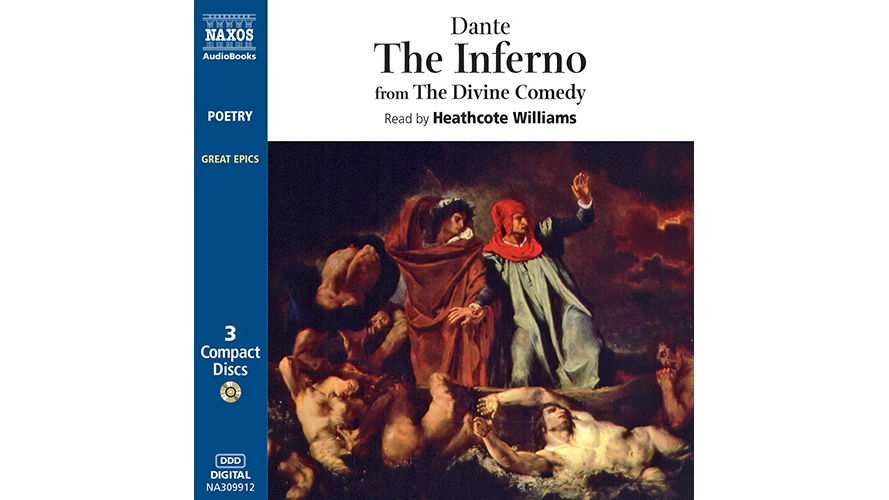
Over the past decade, while going about my daily tasks and driving, I have listened to magnificent unabridged versions of Boccaccio’s The Decameron, Chaucer’s The Canterbury Tales, and a dozen other classic texts that I would otherwise never have read. But especially useful for our purposes, here and now, are Heathcote Williams’s astonishing unabridged narrations of Dante’s Inferno, Purgatorio, and Paradiso, available from Naxos Audiobooks.
If you want terror to lead you to a life of virtuous conduct by Christmas, while being captivated by an extraordinary voice, his reading of the Inferno will do the job. His performances of the Purgatorio and the Paradiso are equally powerful, though for happier reasons. Be sure to get Williams’s narrations. There are other good readings, but I would say his are the best.
There is more. Joss Ackland’s reading of The Screwtape Letters and Julian Rhind-Tutt’s narration of The Great Divorce, both works by C. S. Lewis and both available on Audible, are excellent resources for a November of reflection and conversion. And finally, Descent into Hell, by Charles Williams (no relation to Heathcote)—a friend of C. S. Lewis and probably the strangest member of the Inklings—is the curious but captivating story of two souls. One is saved by his willingness to love and share the burdens of others; the other is damned by a life of selfishness and illusions. Narrated by David Pickering, it is also available on Audible and well worth listening to.
I suppose the lesson is this: listening to the work of great Christian men and women has a unique power of its own to ignite the imagination and heal the wounded or confused heart. We need much more of that. Especially now.
And as for me, now I not only hear, but also listen, much better than before. Suann would surely agree. Prudence is good medicine.
About the author
Francis X. Maier is a senior fellow in Catholic studies at the Ethics and Public Policy Center. He is the author of True Confessions: Voices of Faith from a Life in the Church.