


By Elizabeth Edwards Spalding
As the United States heads to the polls, it is worth recalling a heroic case of resistance to tyrannical socialism. In 1956, for nearly two weeks, a communist regime was overthrown behind the Iron Curtain. Hope and determination began on October 23 and ended in anger and sorrow on November 4, exactly 70 years ago tomorrow. Soviet tanks and infantry crushed the Hungarian Revolution of 1956. The West stood by and did nothing—a grim reminder of what happens when good people do nothing in the face of evil.
The January 7, 1957 issue of Time magazine named the Hungarian Freedom Fighter its “Man of the Year” for 1956. “One man’s terrorist is another man’s freedom fighter,” the saying goes. But moral equivalence has no place when it comes to freedom fighters against a dictatorial regime. In 1956, the resistance began when some 20,000 students protested—in part in support of an earlier workers’ uprising in Poland—and grew to some 200,000 Hungarians who marched through the capital and gathered in front of the Hungarian Parliament and the buildings of Magyar Radio (about two and a half kilometers apart). They were peacefully protesting the one-party communist state imposed by the Kremlin’s masters and implemented by the Hungarian Working People’s Party, the secret police (AVH), and the Hungarian People’s Army. The AVH responded by opening fire on the peaceful demonstrators in front of the Magyar Radio building.
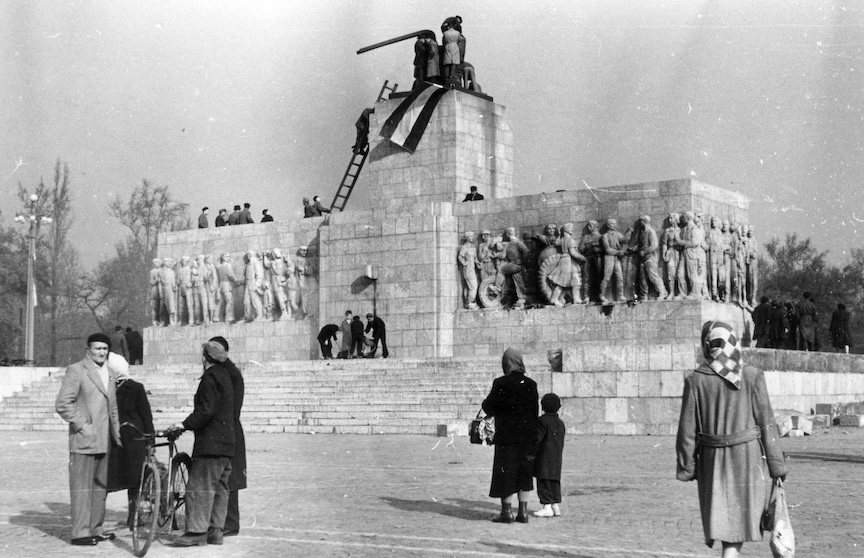
One of their demands was the dismantling of a large monument to Joseph Stalin, on the edge of Budapest’s main park. Communist Hungary had built the monument as its official gift for the celebration of Stalin’s 70th birthday in 1949. It took 100,000 Freedom Fighters—including engineering students and welders with tools and trucks—to topple, desecrate, and dismantle the statue. They left their boots behind.
And that was only the first day.
As the uprising continued and grew, some Hungarian military units defected, and the Freedom Fighters acquired rifles in addition to those they had taken on their own and exercised the right to bear arms against a tyrannical regime. More than 25,000 civilians (including many of the 15,000 industrial workers in Budapest) and 2,000 soldiers fought alongside the resistance. From a previously secret arms factory, the workers distributed at least 1,000 rifles. On October 28, a ceasefire was announced, and on October 30, Soviet military units began withdrawing from the capital.
According to moral equivalence, the justification for an armed uprising is a matter of opinion. But, as Americans would say, by the laws of nature and of nature’s God, this was a just uprising. Hungary was not governed according to the rule of law or fundamental rights that are guaranteed a priori rather than granted by the state. The one-party communist state imposed an ideological, totalitarian, and therefore unconstitutional regime. It was unjust in its lack of freedom.
The first of all freedoms—religious freedom—was central to the Hungarian Revolution and underpinned its constitutional goals and the just character of the armed uprising. During the days of euphoria between two rounds of active fighting against Soviet tanks and troops, when the Hungarians dared to dream they were winning, some 8,000 political prisoners were released. The most notable was Cardinal József Mindszenty, who had led his people in resistance to both fascism and communism.
During World War II, Mindszenty was imprisoned by the Nazi-sympathizing Arrow Cross Party. Several years later, at the hands of the communist party, he was tortured and sentenced to life imprisonment in a show trial in 1949. When Mindszenty was released, jubilant crowds in villages and towns greeted him along the way to Budapest.
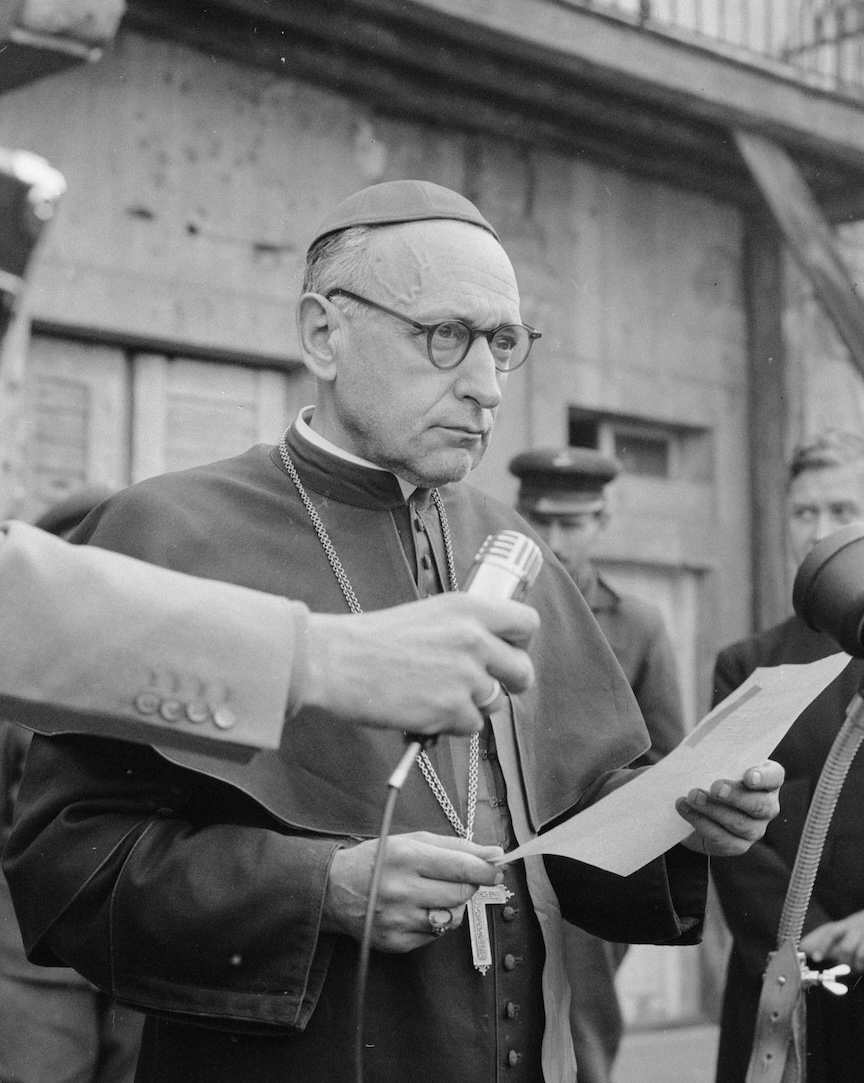
Cardinal Mindszenty was the supreme moral, spiritual, and even political leader of the Hungarian Revolution. He endorsed the armed resistance, blessed its leaders and met with them, and believed that the course of the revolution—and the future of Hungary—should be set by the Freedom Fighters and not by the reformist communist government. His counsel, both public and private, aligned with Christian democracy as it developed in post-war free Western Europe.
Mindszenty delivered a live radio address on November 3. “By the grace of God,” he began, “I am the same as I was before my imprisonment. I stand by my conviction, physically and spiritually intact, just as I was eight years ago, although prison has left its mark on me.” Mindszenty appealed to his people’s patriotic nationalism, their love of freedom, and their home in Europe. He continued: “A small nation feels a sincere joy because, for its love of freedom, other nations have made its cause their own,” and reaffirmed that he remained “independent of every party and—by my office—also above it.” He stressed that new, free, and transparent elections must be held in which all parties could participate “under international control,” and that those who had served the “fallen regime” would have to answer before “independent and impartial” courts.
In words that Soviet tanks could not crush the next day, Mindszenty said:
This has been a struggle for freedom unparalleled in the world, with the young generation at the head of the nation. The struggle for freedom was waged because the nation wanted to decide freely how it should live. It wants to be free to decide on the management of its state and the use of its labor.
He looked ahead to “the practical framework of what must be done, since we live in a constitutional state,” including the immediate granting of freedom for Christian religious instruction and the restoration of the Catholic Church and its institutions, associations, and press. He ended by trusting “in Providence, and not in vain.”
The American Revolution is unique. From Lexington Green and the Declaration of Independence to the Treaty of Paris and the Constitution of the United States, we sought independence to found an entirely new regime—based on inalienable rights, consent, and the rule of law—that preserved the best of what the Founding Fathers held to be true from nature, history, and experience. It was, and remains, an experiment in self-government. In 1776 it was a leap of faith.
In the space of less than two weeks, the Hungarian Revolution of 1956 was also a leap of faith. Although sporadic resistance continued for days after November 4, the uprising ended with some 2,000 dead, another 20,000 wounded, tens of thousands more unjustly imprisoned, 229 executed, and some 200,000 Hungarians who fled their homeland for Austria, Western Europe, and the United States.
Cardinal Mindszenty was forced to seek political asylum at the United States Embassy in Budapest, where he lived, prayed, and wrote while celebrating Mass daily for the next 15 years. As the United States celebrates the 250th anniversary of our own successful revolution against despotic rule, let us also commemorate the 70th anniversary of the premature Hungarian Revolution, of another people willing to pledge their lives, their fortunes, and their sacred honor for freedom.
About the author
Elizabeth Edwards Spalding, Ph.D., is a senior fellow at the Pepperdine University School of Public Policy, chair of the Victims of Communism Memorial Foundation (VOC), and founding director of the Museum of the Victims of Communism in Washington, D.C.