


By Daniel B. Gallagher
After two years of preaching the Gospel to the Guale people along the coast of present-day Georgia, Friar Pedro de Corpa had much to be thankful for. Unlike other missionaries, he did not need a military escort, because the natives welcomed him in peace. He walked barefoot among them, learned their language, and achieved greater success than the Jesuits who had preceded him. The Guale even helped him build two mission settlements known as Nuestra Señora de Guadalupe de Tolomato and Santa Catalina de Guale.
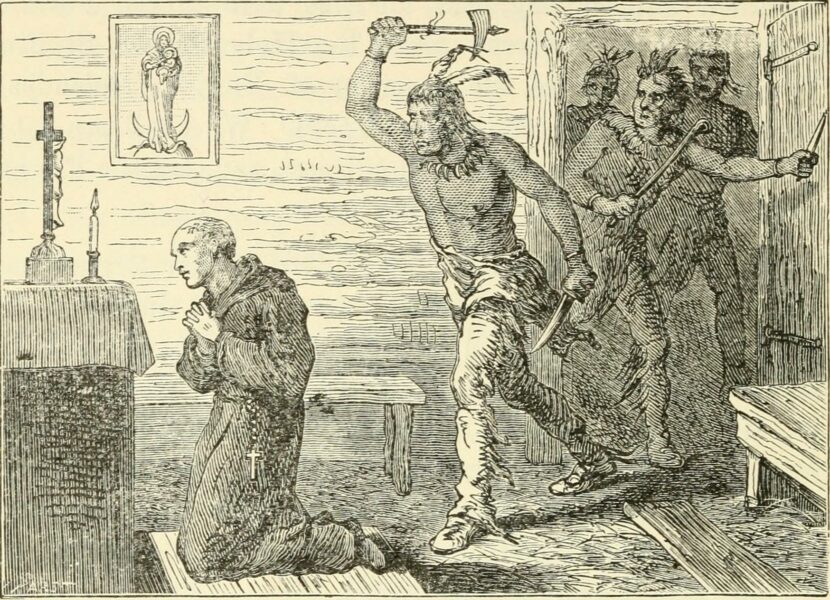
Among the newly baptized was the presumed heir to the chieftainship, Juanillo. After sacramentally marrying a woman in the Church, Juanillo took another wife. Friar Pedro’s public rebuke led Juanillo to organize an uprising in 1597. On September 14—the feast of the Exaltation of the Holy Cross—Juanillo gathered a band of tribal warriors and beat Friar Pedro to death as he prepared for Mass. Then the jubilant war party cut off the friar’s head and raised it high on a pike for all to see.
The beatification celebrated today in Savannah of Friar Pedro and four other Spanish Franciscans will be the first in the southern United States. Bishop Stephen Parkes highlights the importance of honoring men who shed their blood not only for Christ, but “for the sanctity of marriage,” and adds that “we must continue to promote marriage and family life as a priority for our country, for our communities, for our society.”
The message of the “Georgia martyrs” is clear: marriage is worth dying for. The only way to promote peaceful coexistence is to defend marriage, even at the cost of one’s life.
One need not delve deeply into Christian history to see how central this has always been to the preaching of the Gospel. The early martyrology shows that dying for Christ was often the act of an entire family.
After Saint Getulius was martyred around the year 120, his wife Symphorosa refused to offer sacrifices to the Roman gods. Her disobedience to the emperor’s order cost not only her life, but also the lives of her seven children. A similar story is told of Saint Felicity, who died in Rome around the year 165. The concept of the “domestic church” was virtually indistinguishable from that of the family.
“The family –taught Pope Benedict XVI– is the domestic Church and must be the first school of prayer. It is in the family that children… learn to perceive the sense of God” and to “live in an atmosphere marked by the presence of God.”
The message of the Georgia martyrs is intimately linked to that of the early Roman martyrs. The first step in creating “an atmosphere marked by the presence of God” is the mutual promise of a man and a woman to “be faithful,” to “love” and to “respect” one another “in prosperity and adversity, in health and in sickness.” If it does not begin there, it will not lead to the heroic witness of a Saint Symphorosa or a Blessed Pedro.
The beatification of the five Spanish martyrs is a magnificent reminder that marriage is worth dying for. If we believe we will never be called to shed blood to defend Christian marriage, it is enough to recall how quickly the tide turned against Friar Pedro and his companions.
Almost no one foresaw how grave the crisis would become in the years before and after the promulgation of Humanae Vitae in 1968. The turmoil surrounding the formulation of magisterial teaching on artificial contraception caused Saint Paul VI intense suffering, and it is providential that the two miracles that led to his canonization in 2018 involved the miraculous healing of prenatal life: one in California and the other in Verona.
The heavenly intercession of Saint Paul VI is unsurprising, given his tireless mission to promote marriage and the family with remarkable vigor while still on earth. “Every attack on the fundamental value of the family –preached in 1969–, whether eroticism or violence, the defense of divorce or antisocial attitudes among the young, is an attack on the true good of man.”
His words reveal that the polygamy opposed by Friar Pedro and his companions is only the tip of an iceberg that includes layers of abortion, artificial contraception, same-sex unions, and in vitro fertilization.
In an interview granted earlier this year, the former president of the Pontifical Academy for Life and grand chancellor of the Pontifical Theological Institute John Paul II for Marriage and Family Sciences, Archbishop Vincenzo Paglia, explained that he had introduced drastic changes to the Institute because of what he perceived as its concern for “abstract moral norms” and its lack of an “interdisciplinary” approach.
The blood shed by Friar Pedro and his companions demonstrates that “abstract moral norms” and an “interdisciplinary approach” should be the least of our concerns. Ironically, Archbishop Paglia’s complaints are typical of the same ad intra obsession that Pope Francis denounced. Teaching, defending, and living the fundamental truths of marriage and the family is the true concern, and an initial success never guarantees that the path ahead will be free of stumbling blocks.
On May 13, 1981—the feast of Our Lady of Fatima—John Paul II climbed into the popemobile to head to the platform in St. Peter’s Square for his weekly general audience. He was especially excited because he was going to announce the founding of a new institute dedicated to the study of marriage and the family. That excitement was cut short by four bullets fired at point-blank range by Mehmet Ali Ağca, one of which nearly killed the pontiff. Instead of celebrating the creation of the new institute, John Paul fought for his life at Gemelli Hospital.
Saint John Paul never hesitated to link both the Virgin and his plans to announce the Institute for Marriage and Family with the assassination attempt that day. By the grace of God, he survived to carry out those plans, and he taught us that marriage and the family are not an appendix to the Gospel, but are at its very center.
Few things in this life are worth dying for, but marriage and the family are certainly among them.
About the author
Daniel B. Gallagher teaches philosophy and literature at Ralston College. He previously served as Latin secretary to Popes Benedict XVI and Francis.