


The new book Trads: Latin Mass Catholics in the United States, by sociologists Stephen Cranney and Stephen Bullivant, is now available in digital format through Oxford University Press. The work offers a comprehensive study of American Catholics who attend the traditional Latin Mass and is particularly relevant because its authors were received in a private audience by Pope Leo XIV on March 5, when they personally presented their research to him.
Professor Peter Kwasniewski has shared on his X account his recent meeting with Bullivant in Oxford, during which he had the opportunity to see the first copies of the book. Kwasniewski recalled that this is the research that both sociologists presented to the Pontiff.
The work, titled Trads: Latin Mass Catholics in the United States (Trads: Latin Mass Catholics in the United States), combines original surveys, ethnographic observation, and in-depth interviews to study who these faithful are, what their religious motivations are, and what relationship they maintain with the Church as a whole.
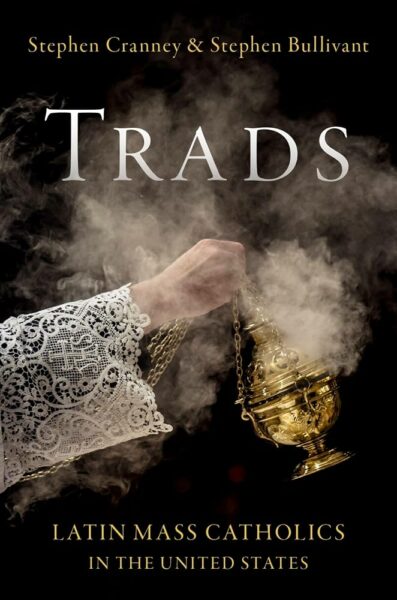
The digital edition from Oxford University Press is listed as published on October 22, 2026, while the print edition is scheduled for March 2027.
Who are the Catholics who attend the traditional Mass really?
The research by Cranney and Bullivant aims to answer a question that has occupied much of the liturgical debate in recent years: who are the Catholics connected to the traditional Mass and what leads them to prefer this form of celebration.
In the official presentation of the book, Oxford University Press notes that these faithful have been described as divisive, extremist, and even close to a sect, while others consider them the future of Catholicism.
Faced with these opposing characterizations, the authors have developed a large-scale sociological study to analyze the composition of these communities, their beliefs, and their differences from American Catholics as a whole.
The study addresses issues that have been present in liturgical controversies: whether traditional Mass attendees are primarily young converts, whether they reject the Second Vatican Council and the contemporary Church, or whether their connection to the ancient rite is fundamentally a search for beauty, reverence, and continuity with tradition in worship.
It also examines the consequences of papal reforms on these communities and the significance of their growth for the future of the Church.
The researchers present their work as an attempt to separate prejudices from reality through empirical data. According to their explanation in the editorial summary, the result shows a community considerably more complex than what both its supporters and detractors usually acknowledge.
A study that Leo XIV personally learned about in March
On March 5, Leo XIV received in a private audience Stephen Bullivant, professor of theology and sociology of religion at St Mary’s University in London, and Stephen Cranney, data scientist and professor of sociology at The Catholic University of America in Washington.
The meeting was recorded in the official Vatican audience bulletin, although the Vatican did not release details about the content of the conversation.
The University of Notre Dame Australia, where Bullivant also carries out his academic work, later confirmed that both researchers had presented their work on American communities connected to the traditional liturgy to the Pope.
The audience took place in the context of successive meetings of Leo XIV with personalities connected to the traditional Mass, including Cardinals Raymond Burke, Robert Sarah, and Gerhard Müller, as well as Bishop Athanasius Schneider.
A few days earlier, the Pontiff had also received the leaders of two personal ordinariates established for former Anglicans, structures created during the pontificate of Benedict XVI that allow certain liturgical traditions to be preserved within full communion with Rome.
The succession of meetings had sparked interest in the possibility that Leo XIV was examining the situation of communities affected by the restrictions imposed on the traditional Mass during the pontificate of Francis.
The data questions the identification of traditionalists with rejection of Vatican II
One of the most relevant aspects of the research is the relationship of traditional Mass faithful with the Second Vatican Council and the authority of the Church.
In a previous work published in 2024, Bullivant and Cranney pointed out the lack of objective and systematically collected data on these communities, whose study had until then been dominated by opinion articles and historical or theological analyses.
The results of their surveys show that nearly two-thirds of participants accept the teachings of the Second Vatican Council to some degree. Twenty-two percent expressed strong agreement with them, 27% agreed, and 15% somewhat agreed, while only 4% expressed outright disagreement.
The University of Notre Dame Australia highlighted these results when reporting on the researchers’ audience with Leo XIV and noted that the study had also found a high degree of adherence to Catholic doctrine on the Eucharist and broad recognition of the Pope’s authority.
Among the data previously released was that 98% of surveyed faithful claimed to believe in the real presence of Christ in the Eucharist.
These figures provide elements for examining one of the most frequent accusations against Catholics connected to the traditional liturgy: their supposed widespread rejection of the Second Vatican Council and papal authority.
The research distinguishes between disagreements that may exist regarding certain disciplinary decisions or subsequent interpretations of the Council and acceptance of the Church’s teachings.
Reverence, beauty, and continuity with tradition
Another aspect examined by the researchers is the motivations that lead American Catholics to participate in the traditional Mass.
The book analyzes the importance these faithful place on reverence in worship, the beauty of the liturgy, and continuity with Catholic tradition.
It also studies the presence of young families, the role of converts, and the differences between these communities and American Catholics as a whole.
The work pays attention to the relationship that attendees of the ancient liturgy maintain with parishes where Mass is celebrated according to the Missal reformed after the Second Vatican Council.
The authors also examine how decisions of recent pontificates have affected the life of these communities, especially since the promulgation of Traditionis Custodes in July 2021.
The research thus offers an approach to a phenomenon that is not limited to controversies over liturgical discipline, but also encompasses issues related to the transmission of faith, family life, and Catholic identity.
The impact of Traditionis Custodes in the United States
The study comes five years after Francis promulgated the motu proprio Traditionis Custodes, which considerably restricted the celebration of Mass according to the 1962 Roman Missal and subjected its authorization to new conditions.
The measures had direct consequences for numerous American communities that had until then been able to regularly attend the traditional liturgy.
According to data released by the researchers, before the 2021 restrictions there were more than 800 parishes in the United States offering this celebration. Subsequently, the number was reduced to fewer than 500 parishes not connected to the Priestly Fraternity of St. Pius X.
The authors also place at 103 the number of Fraternity chapels in American territory, a reality that must be distinguished from communities that celebrate the traditional Mass under the authority of diocesan bishops.
The reduction in places of celebration constitutes one of the elements studied by Cranney and Bullivant to understand the effects of papal decisions on the faithful.
A study that provides new data to the liturgical debate
The appearance of Trads makes available to the public research that the Pontiff already had the opportunity to learn about directly during the March audience.
The work of Cranney and Bullivant introduces sociological data into a debate that for years has been marked by controversies over ecclesial unity, papal authority, and the continuity of Roman liturgical tradition.
Its results show the importance of distinguishing between the different sensibilities and positions existing among Catholics who attend the traditional Mass, rather than treating them as a homogeneous group.
The research also allows for a better understanding of the religious motivations of these communities and the impact that liturgical restrictions have had on their ordinary life.
While Traditionis Custodes remains in force, the publication of Trads offers new documentary elements for examining the situation of faithful whose connection to the traditional liturgy continues to be one of the open questions of the current pontificate.