


By John M. Grondelski
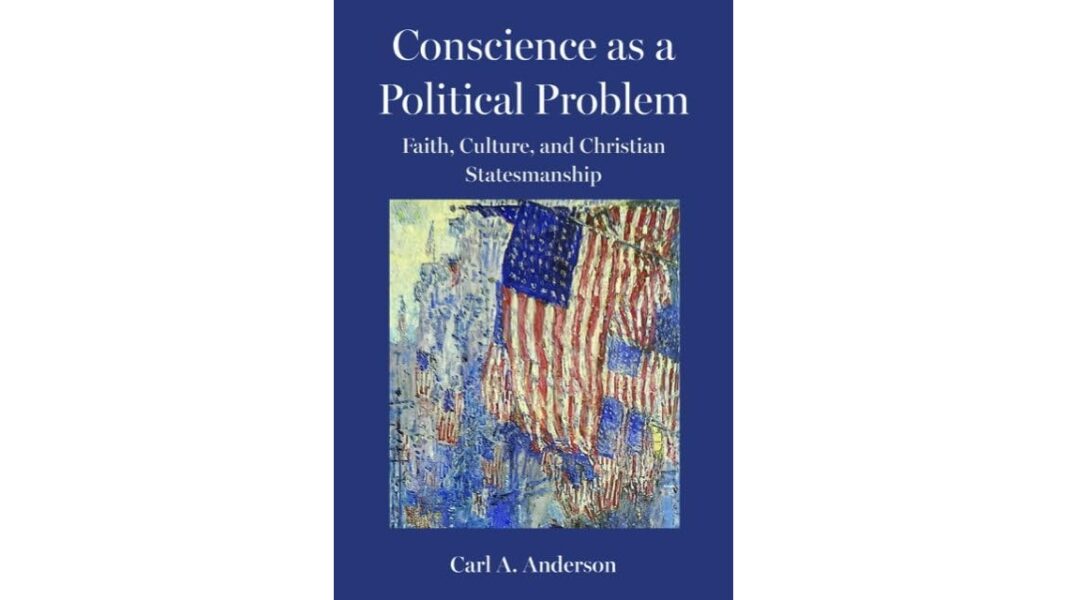
Many commentators place the origin of the “personally I oppose, but” approach of politicians (especially Catholic Democrats) toward abortion in John F. Kennedy’s 1960 presidential campaign, particularly in his speech in September before the Greater Houston Ministerial Association. Carl Anderson, former Supreme Knight of the Knights of Columbus, argues that this is not entirely accurate—at least not in a straight line, though there are similarities. His book, Conscience as a Political Problem, aptly explains why.
Kennedy knew there was a “Catholic vote,” that the Democrats needed it, and that JFK could secure it. The problem was that the United States had never had a Catholic president. Could a Catholic candidate overcome Protestant prejudices and deliver on his promises? Kennedy believed so, invoking “conscience” as a guarantee of his independence from any papal interference in the nation’s affairs.
Anderson argues that, in the context of the time, Kennedy was right. Most Protestants who opposed Kennedy did so out of fear that a Catholic president would send an ambassador to the Holy See and promote aid to parochial schools. But, as Anderson points out, those were matters of prudential policy: Catholics were not bound to either. To the extent that JFK asserted his independence on such policy matters, he remained within Catholic bounds. And Kennedy, in Houston, was not dissecting theological principles but simply saying what was necessary to get elected.
Where “conscience” became a more serious problem was when the issues were no longer prudential policy matters but involved permanent moral questions, abortion in particular. That was not an issue for Kennedy in 1960; it would be for Ferraro in 1984, for Kerry in 2004, and for many others since then.
However, the main contribution of Anderson’s book is not the history, important as it is. It is his recognition that the crucial questions are anthropological and remain central: Who do you say that man is? He deals with this problem in his final chapter. But, far from considering it the end of the story, I take it as the beginning, an unfinished idea that deserves ongoing and broad Catholic engagement.
The anthropological problem is twofold. First, it involves a proper definition of conscience. Anderson seeks to provide one by drawing on John Henry Newman’s distinction between a “Christian” conscience and a “secular” or “counterfeit” conscience. For Newman, a Christian conscience is what Catholics rightly understand by conscience: a faculty that examines objective good and evil and, guided by the first principle of practical reason (“do good and seek it, and avoid evil”), issues judgments in light of objective reality. A secular or “counterfeit” conscience has the appearance of conscience, but is, in reality, self-will mixed with pious-sounding rationalizations.
When Protestants in the sixties heard JFK invoke the term “conscience,” they heard the praise of the hymn: “Our fathers, chained in prisons dark, / were still in heart and conscience free.” But by the eighties, historic traditional Protestantism was collapsing, and evangelicals took on the task of defending that old-time religion. Traditional Protestants began to recognize that the Catholic notion of conscience—the responsibility before pre-existing moral good and evil—was also their own.
And many Protestants also began to understand that the political invocation of “conscience” was being used, quite often, to evade that proper understanding, in effect ignoring moral good and evil and replacing it with a secular counterfeit that imagines that a radically free person creates moral truths rather than finding them.
Kennedy never addressed the broader question of conscience, that of what happens when political choice and objective moral good collide, at least not in a systematic or reflective way. It remains a ghost that haunts the way a true Catholic acting in the political sphere should bear witness to Catholic principles (and not merely flatter Catholic voters to win their vote), especially since Vatican II insisted on the crucial role of the laity as leaven in the modern world.
Anderson acknowledges the lack of a strong Catholic presence in the public square, which allows him to launch into extensive considerations on natural law (and its marginalization, even in Catholic circles) in the modern world. Natural law is a settled system, accessible in principle to all; contemporary invocations of human “dignity” are often ambiguous as to what the term means and its objective and ontological foundations.
At the same time, Anderson explores the anthropological question so cherished by St. John Paul II: if Christ fully reveals man to man himself, how does a Catholic statesman communicate those anthropological truths in a religiously plural society like the United States?
Christ does not reveal esoteric dogmas about the human person exclusive to Catholics. Catholicism has long recognized that Christ and the Church also properly teach natural truths, because man, as a consequence of sin, has clouded even his vision of those truths. Still, in the contemporary world, where religious origin already makes ideas suspect, how does the modern Catholic make those vital and indispensable anthropological truths influence culture and society at large?
Many observers, Catholic and non-Catholic, have argued that, contrary to popular opinion, Kennedy’s election was less a victory of Catholics “arriving” in the United States than a detour down other paths, not least in the way Catholics disguise their religious identity to appear acceptable in a society where that identity is a minority.
But, as Anderson also observes, in the meantime the “majority” opinion has changed. In 1960 it could be an almost fundamentalist Protestantism that saw Catholic politicians as possible puppets of the Pope. Today it is more a secularism that sees religion and its morality per se as an obscurantist regression that, if it cannot be eliminated, must at least be completely relegated to the private sphere.
Many traditional Protestants have come to see that Catholics are not the real enemy. But that still leaves the task of building a public philosophy that incorporates real moral values (often with religious ties) into public conversation, rather than trying to translate them into something else.
By recognizing the task that remains to be done, Carl Anderson opens a door that today’s Catholics, less fearful of their place at the table, must walk through on the path to creating a very different United States.
About the author
John Grondelski (Ph.D., Fordham) is former associate dean of Seton Hall University’s Immaculate Conception Seminary School of Theology in South Orange, New Jersey. All opinions expressed here are his own.