


By K. E. Colombini
Thanks to the wisdom of Popes John Paul II and Benedict XVI, Catholics who came of age after the Second Vatican Council have been able to experience something of the Catholic liturgical tradition that was previously out of reach, and many have decided that they like it.
Above all, this has happened through the Traditional Latin Mass (TLM) of the 1962 Roman Missal, the last one published before the major liturgical changes of Vatican II and the subsequent 1970 Missal. Until the abrupt one-hundred-and-eighty-degree turn brought about by Pope Francis’s 2021 apostolic letter Traditionis custodes and its subsequent documents, the Traditional Latin Mass—which Pope Benedict XVI had granted greater freedom—experienced a resurgence that filled church pews and inspired many.
Yet, because everything in tradition is connected, other devotional practices that likewise deserve our attention and support have also returned. What had been lost for years was found again, and thus discovered to be even more valuable.
I realized this recently when our youngest daughter became engaged. Being more traditional in her liturgical inclinations, she and her fiancé chose a brief rite of betrothal at their parish, one of the two oratories in our archdiocese where the Traditional Mass is celebrated.
Bishops have often imposed on those seeking the sacraments requirements that may go beyond what is reasonable: demanding “hours of community service” for Confirmation, for example, or weekend retreats for couples before marriage. Indeed, when it comes to marriage preparation in the Catholic Church, an entire small industry of programs has emerged, with names such as TOBET4Engaged, FOCCUS, SmartLoving, Witness to Love, Better Together, or Joy-Filled Marriage. In a way, this was to be expected, as pastors try to ensure that engaged couples are prepared for a marriage meant to last until death amid a culture that suggests precisely the opposite.
It is easy to understand the concern for marriage preparation when one looks at the divorce or annulment rates among Catholics in the United States. Historically, the United States has not only declared more annulments than any other country, but fewer than 10 percent of applications are rejected. This says something about the state of marriage preparation, and it is not good.
One may personally disagree with the obstacles to receiving the sacraments, and it is not difficult to find terrible stories about them. However, when it comes to marriage, it can also be argued that the traditional betrothal ceremony would be a wise addition to marriage preparation and that, at the very least, priests and others tasked with helping engaged couples should certainly offer and encourage it. The betrothal rite is steeped in tradition, yet it has everything that should appeal to the modern Catholic sensibility. It is brief and in the vernacular. And one does not even have to kneel.
The rite lasts about ten minutes, during which the priest encourages the couple with words such as these:
In the time that remains until then, they will prepare for the sacrament of marriage through a period of virtuous courtship, so that, when the happy and blessed day arrives on which they irrevocably give themselves to each other, they will have laid a solid spiritual foundation for long years of pious prosperity on earth and, in the end, for blessedness together in the life to come. May the union they propose to consummate today as husband and wife be found worthy of being, in all truth, the image and sacramental reality of the union of Christ with his beloved Bride, the Church.
Next, the couple exchange a promise that does not differ greatly from the marriage vows they will pronounce a few months later; the woman’s words are similar to the man’s, who says: “In the name of the Lord, I promise that one day I will take you as my wife, according to the ordinances of God and of the holy Church. I will love you as myself. I will keep faith and loyalty to you, and so I will help and comfort you in your needs; all this, and all that a man ought to do for his betrothed, I promise to do for you and to fulfill by the faith that is in me.”
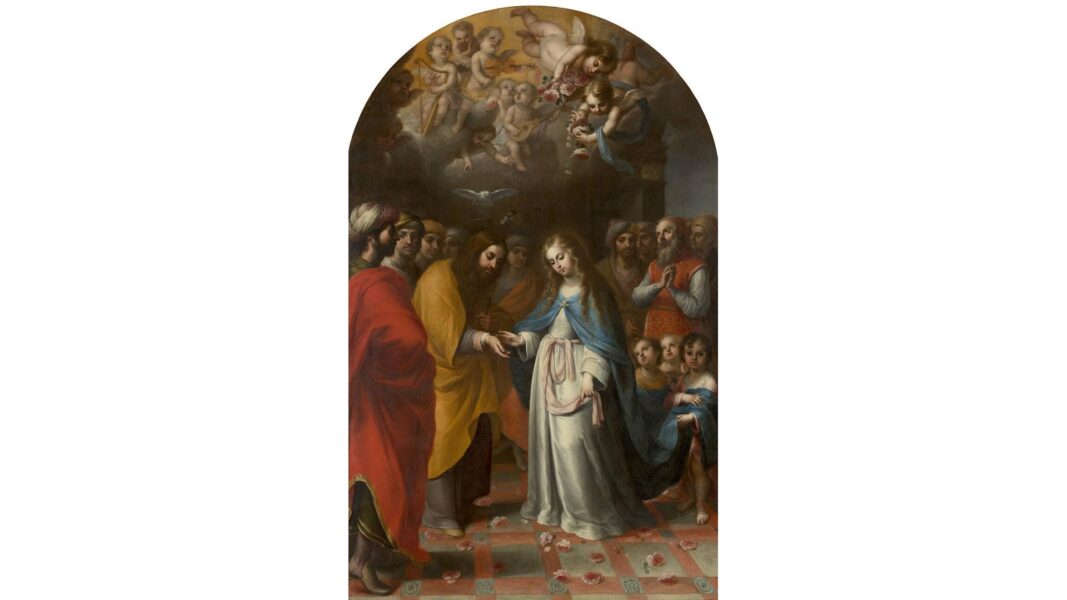
Then the priest blesses the engagement ring, the man places it on his fiancée’s finger invoking the Most Holy Trinity, and each seals the betrothal with a kiss—not given to the other, but to the image of the crucifixion usually found in the altar missal, on the page facing the beginning of the Roman Canon. Perhaps this is the best and most profound part.
Even before the Second Vatican Council, the betrothal rite was not a common experience for Catholics in the United States, but that is no reason at all to discourage its wider use today. “What earlier generations held as sacred, remains sacred and great for us as well, and it cannot be all of a sudden entirely forbidden or even considered harmful,” wrote Pope Benedict XVI in a 2007 letter to the bishops that accompanied his Summorum Pontificum, which allowed wider use of the traditional rites. Unfortunately, too many traditional and beneficial liturgical and paraliturgical practices were in fact forbidden and considered harmful, whether in the parish, in the diocese, or even in the Vatican.
The challenges facing the Church in the present age are great. Even so, small steps can help restore a better balance between the old and the new and, in this particular and important case, help foster marriages that last.
About the Author
K. E. Colombini writes from St. Louis, Missouri. He has published in The National Catholic Register, Homiletic & Pastoral Review, First Things, The Front Porch Republic, The American Conservative, and other outlets.