


By Brad Miner
In 2019 I wrote here: “When I was four, I sat on the fire escape of our apartment and thought: ‘What if there were nothing?’ (though I’m sure that, back then, I didn’t use the subjunctive). And then I thought: ‘Here I am.’ I stared at the slate-gray sky and knew, or intuited, that ‘nothing’ is the only thing that cannot be.”
It was that slate-gray sky, of course. I don’t think I’ve ever seen anything else that so suggested emptiness, nothingness. I don’t remember which of my parents was home at the time. Probably my mother, and maybe she had shooed me out of the kitchen so she could start making dinner, and perhaps I felt lonely. That was my usual state, and it wouldn’t change until we moved from the city to the suburbs and our home became a single-story house in a newly built neighborhood on what had once been a park or, as the kids called the little green that remained, the woods.
As soon as I was old enough to go to school, my loneliness evaporated, which wasn’t entirely good, because all I wanted to do was play (there were always playmates), and so it went, more or less, until I finished college, after which I began to worry about my soul… and it was about time.
According to the Council of Vienne (1312), the rational soul is “by itself and essentially the form of the human body.” And the Catechism of the Catholic Church (no. 365) explains that “in man, spirit and matter are not two natures united, but rather their union forms a single nature.”
Thus, the “I” that gazed out at four years old anticipated my later, adult understanding of my immortal soul.
Of course, I was no kind of theological Mozart. I was never any sort of prodigy, except for my boldness in climbing to the top of the sycamore in the lot next to the old apartment, something that terrified my parents and earned the admiration of the older kids (and the girls we used to call tomboys). Besides, I wasn’t raised in the Catholic faith.
Even after becoming Catholic at twenty-five, I still had a lot of maturing to do. Something to do with the maturation of the prefrontal cortex, probably. But by thirty-five I had fully embraced the faith and its demands. Now, more than forty years later, it’s time to prepare for the end of the game.
When I die, I have to go to Heaven. I don’t say that as an imperative, as if it were a rule of God’s that everyone goes to Heaven, because God has no such rule. As a sensible sinner, I’ll gladly accept Purgatory along the way. But the corollary is: I don’t have to go to Hell; again, that’s not an imperative statement.
It’s an occasion to recall Léon Bloy’s famous line: “The only real sadness, the only real failure, the only great tragedy in life is not to become a saint.” So I (and you) must stay focused on that, which is possibly the hardest thing for any man or woman to “achieve.” Without grace, of course, it won’t happen.
Thinking about this has made me wonder about Heaven, which is the end of the soul and, later, of the body. What is Heaven like? What will the blessed see when they arrive?
Well, we begin with a warning: St. Paul (1 Corinthians 2:9), quoting Isaiah (64:4):
But, as it is written,
“Eye has not seen, nor ear heard,
nor has it entered into the human heart,
what God has prepared for those who love him”…
So neither I nor anyone else can describe that ultimate glory. Some mystics have claimed to have glimpsed something, but that only leads to another warning. After such a mystical experience on December 6, 1273, St. Thomas Aquinas abruptly stopped writing his Summa. According to his secretary, companion, and confessor, Reginald of Piperno, Thomas said that all his work now seemed like “straw” compared to what he had seen. He refused to speak of it again.
Other saints (almost always women), from Hildegard of Bingen to Faustina Kowalska, have had visions of Heaven, and they seem to agree on joy, light, and love. (Here you can read what the Catechism says). It is to live in perfect “communion of life and love with the Trinity, with the Virgin Mary, the angels, and all the blessed” (no. 1024).
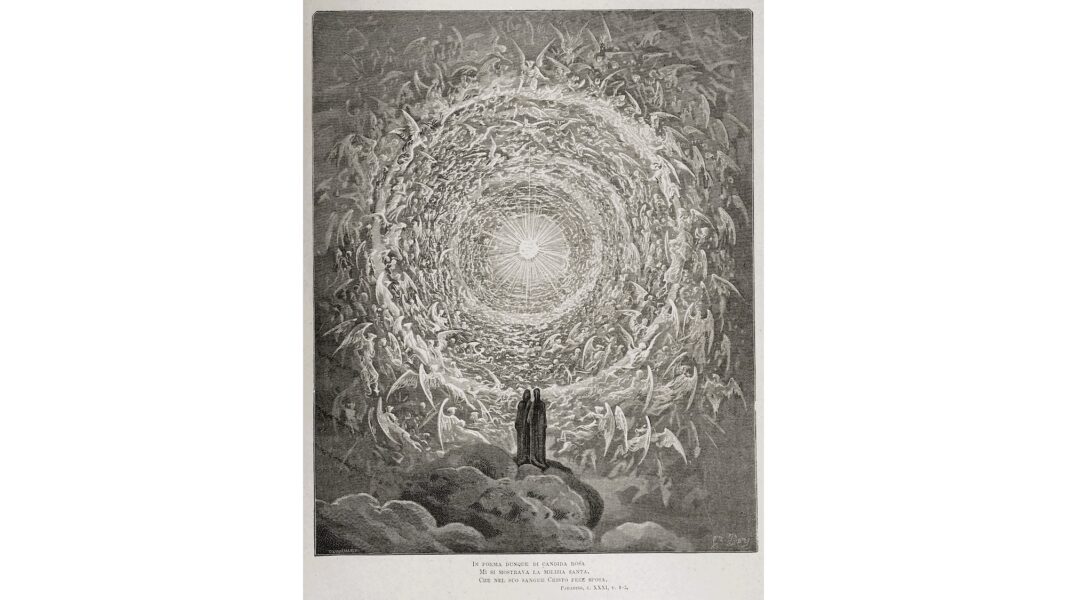
It is Dante Alighieri, as much as any theologian, who captured the embodied joy of Heaven, and of all the pictorial representations of Heaven I could find, Gustave Doré’s illustration for Canto XXXI seems the best: the Rose of the Empyrean. It conveys the sense of the blessed surrounding the throne of the Almighty and joining in the angels’ praise. “In fashion of a snow-white rose / there was offered then to my sight the holy multitude.” [Note that Doré chose to place Beatrice beside Dante when, perhaps, it should have been Bernard of Clairvaux].
As Augustine said in the final lines of The City of God: “There we shall rest and see, see and love, love and praise.” All this happens at once, in the company of all who are there: all our loved ones and, probably, some of our former enemies.
About the Author
Brad Miner is senior editor of The Catholic Thing and senior fellow at the Faith & Reason Institute. A former literary editor of National Review, he had a long career in publishing. His books include Sons of St. Patrick, written with George J. Marlin, and his best-seller The Compleat Gentleman, also available in audio format (read by Bob Souer). Mr. Miner has served on the board of directors of Aid to the Church in Need USA.