


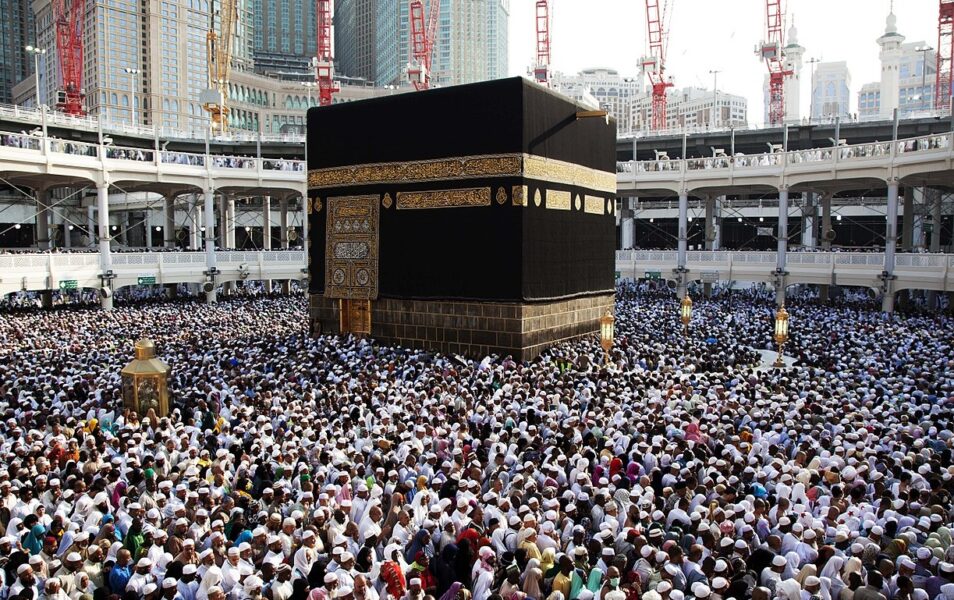
Saudi Arabia executed on Wednesday, October 14, in the Mecca region, two Bangladeshi cleaning workers, Nazrul Islam Abdul Basir and Sweety Akter (Siti Akhtar, in the official spelling), sentenced to death for an “immoral act” inside a mosque that the Saudi authorities have not described. Their own government learned of it through the official Saudi agency. Six days later, the Holy See, which in the same week had harshly condemned the announced execution of a prisoner in the United States, has said nothing about the case.
An act without a name
The statement from the Saudi Interior Ministry, reproduced in full at the end of this report, states that both committed an immoral act in a mosque in Mecca and that a court imposed the death penalty as a tazir punishment—the sentence the judge sets at his discretion when Islamic law does not prescribe a fixed penalty—for “the violation of the sanctity of time and place.” It adds that the sentence was confirmed on appeal and that a royal order authorized its enforcement. It does not specify what they did, in which mosque, or how they were executed.
The rest has been learned afterward through diplomatic channels. At the meeting held on October 19 in Jeddah between the Bangladeshi consul general and a senior Saudi Foreign Ministry official, according to Prothom Alo, the Saudi side explained that the two were arrested in August 2023, sentenced by a lower court, and the penalty confirmed by a panel of thirteen judges, and that the execution was carried out separately, in the men’s prison and the women’s prison. Nazrul was arrested on August 1 and Sweety the following day; both had remained since then in the prisons of Jeddah. On the list of detainees that Riyadh provides to Dhaka, he was attributed with a computer crime and she with adultery, with no record of any conviction. They had been working as cleaners for the same contractor since late 2022.
The consulate in Jeddah acknowledges that no one notified it of the execution. Dhaka summoned the Saudi ambassador on October 18, and the State Minister for Foreign Affairs, Shama Obaed, admitted the following day that her government has still not received a copy of the sentence. Bangladesh is now asking whether the two had the opportunity to defend themselves.
The families
Social media circulated the story of a newly married couple executed for a kiss, illustrated with the photograph of an Egyptian couple taken in 2024. Nazrul’s father, Abdul Basir, who worked twenty-four years in Saudi Arabia and went into debt to send his son there, denied it to Jago News: “That woman was not Nazrul’s wife. We do not even know her.” His mother, Rahima Begum, maintains that the accusations are false, and the family attributes the complaint to a dispute with a Pakistani coworker. Nazrul last called home on October 11. Three days later they received news of his death, and a 65-year-old aunt of his died that same night of a heart attack.
Sweety, divorced and the mother of a four-year-old girl, had left a village in Mirzapur, Tangail, with a loan from her father, a day laborer. Five months after arriving she reported that she was in prison and that she had been incriminated after an argument with other workers. Fifteen days before the execution she told her father that she might be released in two months. She never spoke of a trial. Her family still has no official communication.
Double standards
On October 9, Cardinal Pietro Parolin described as “truly incomprehensible” the televised execution of Nidal Hasan, the perpetrator of the Fort Hood massacre, recalled that “the Church’s position is totally opposed to the death penalty,” and announced a formal statement from the Holy See. The following day, World Day Against the Death Penalty, Leo XIV wrote that capital punishment “is inadmissible because it violates the inviolability and dignity of the person.”
Hasan killed thirteen people, was tried in a public process, and his execution has not yet taken place. Nazrul and Sweety, two poor immigrants with no known defense, were tried behind closed doors for an act that no one has described and executed without notice to their country. For the former there was a secretary of state, a papal message, and an announced statement. For the latter there has been nothing, neither from the Secretariat of State nor from the Press Office. Saudi Arabia executed at least 356 people in 2025, according to Human Rights Watch, most for non-violent drug offenses, and that figure has never elicited a reaction comparable to the one each execution in the United States provokes.
Assisi, next week
The silence coincides with the eve of the meeting that Sant’Egidio is holding in Assisi from October 25 to 27 under the motto “Unarmed and Disarming Peace,” with 384 representatives from 53 countries and the Pope’s presence on the 27th. The organization has not published the list of Muslim delegations. Its register of speakers, which includes those who have spoken at its meetings over the years, includes names very close to the Saudi power structure, beginning with Sheikh Mohammad bin Abdulkarim al-Issa, secretary general of the Muslim World League, an organization based in Mecca and funded by the Saudi state. Al-Issa was the kingdom’s minister of justice and delivered the Arafat sermon during the 2022 pilgrimage. The same register lists the director general of the Islamic Foundation of Bangladesh.
Sant’Egidio has not confirmed whether any of them will be in Assisi. The Church has maintained for decades that the dignity of human life is a seamless garment, in the image of Cardinal Bernardin, which admits no patches according to who wields the weapon. Next week, in St. Francis Square, it will be seen whether that garment also covers two Bangladeshi cleaners executed in Mecca.
Full statement from the Saudi Ministry of the Interior (October 14, 2026)
Castilian version of the statement issued by the Saudi Press Agency.
God says, exalted be He: “And do not corrupt the earth after it has been set in order” (Qur’an 7:56).
The Bangladeshi citizens Nazrul Islam Abdul Basir and Siti Akhtar, a woman, committed an immoral act inside a mosque in Mecca. The security authorities proceeded to arrest them and, after the investigation was completed, charges were brought and they were referred to the competent court, which found the facts attributed to them proven and handed down a death sentence against them as a tazir punishment, in view of the gravity of what was committed and the violation of the sanctity of time and place. The sentence became final after being confirmed by the competent judicial instance, and a royal order was issued for its execution.
The death penalty was carried out on the said convicts on Wednesday, 3/5/1448 of the Hijra, corresponding to October 14, 2026, in the Mecca region.
The Ministry of the Interior affirms the commitment of the Government of the Kingdom of Saudi Arabia to the maintenance of security, the administration of justice, and the application of Islamic law to those who profane the sanctity of mosques or attack the honor of others, and warns anyone who dares to commit similar acts that they will receive the punishment established by Islamic law.