


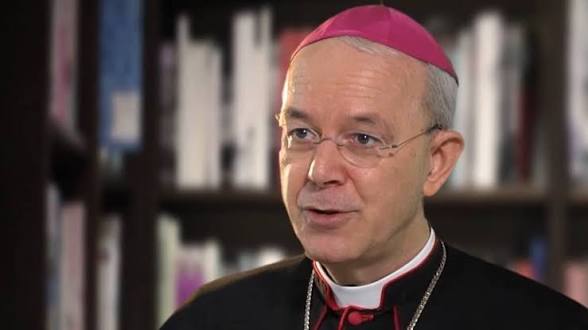
Auxiliary Bishop of Astana (Kazakhstan), Msgr. Athanasius Schneider, has accused European bishops of “cowardice” for, in his view, failing to publicly defend the Christian identity of the continent. The prelate maintains that for decades certain sectors of the episcopate have favored the Islamization of Europe “under the pretext of charity” and denounces that the Church has weakened its evangelizing mission through a mistaken conception of interreligious dialogue.
In statements released by Gloria.tv, Schneider questioned the attitude of pastors who, according to his assessment, have supported Muslim immigration policies without defending the Catholic faith and Europe’s Christian roots with equal determination. His criticisms also targeted European political elites and the directions interreligious dialogue has taken in recent decades.
Schneider reproaches bishops for failing to defend Catholic identity
The bishop argued that numerous ecclesiastical leaders have for decades contributed to promoting the presence of Islam in Europe, justifying their stance by appeals to Christian charity.
Schneider described as “cowardice” the attitude of those bishops who, he charged, do not dare to openly profess their Christian and Catholic identity amid the continent’s religious and cultural transformations.
His remarks focused on the responsibility of pastors to preserve and transmit the faith in societies that have undergone a progressive process of secularization.
For Schneider, charity cannot be used as an argument to abandon the proclamation of the Gospel or to renounce the Catholic identity of European nations.
He accuses European elites of deliberately promoting Muslim immigration
The prelate also questioned the immigration policies implemented in Europe over recent decades, asserting that the arrival of Muslim populations is not solely the result of spontaneous movements of people seeking refuge.
“Generally, these are not refugees, but measures deliberately orchestrated and organized by European political elites to introduce a Muslim population into Europe,” he stated.
With these words, Schneider attributed to European leaders a political will to transform the continent’s religious composition. This is an accusation made by the bishop, without documentary evidence of a coordinated strategy to that end being presented in the information released.
Schneider also described Islam as a “totalitarian” and “anti-Christian” religion, and questioned the construction of large mosques in Europe, considering them a form of public promotion of a religion whose teachings differ from the Christian faith.
His statements are framed within his concern over the loss of European Catholic identity and the attitude that, he denounces, certain ecclesiastical leaders have adopted in the face of this phenomenon.
The Abu Dhabi Document, a “betrayal of the Gospel mission”
Schneider’s criticisms extended to interreligious dialogue and, especially, to the Document on Human Fraternity, signed in Abu Dhabi on February 4, 2019, by Pope Francis and the Grand Imam of Al-Azhar, Ahmad Al-Tayyib.
The bishop described the approach to interreligious dialogue identified with that document as “a betrayal of the mission of the Gospel, which God himself, Jesus Christ, entrusted to us”.
Schneider rejected the presentation of different religions on an equal footing, as if all constituted equivalent paths to God.
To illustrate his criticism, he used the image of a supermarket in which each person can freely choose a religion among several options, without recognizing the uniqueness of Christian revelation.
The prelate has previously expressed reservations about the Abu Dhabi Document, particularly regarding the claim that religious diversity is an expression of the divine will.
In 2019, he directly raised his objections with Pope Francis, who later clarified that religious diversity should be understood in the sense of God’s permissive will.
Read also: The Pope clarifies to Schneider that God does not positively will the plurality of religions
Schneider denounces “sixty years of darkness” after the Second Vatican Council
The auxiliary bishop of Astana also directed his criticisms at the ecumenical and interreligious practices developed since the Second Vatican Council.
Schneider described the last six decades as “sixty years of darkness”, during which, he claimed, mistaken methods employed in ecumenism and dialogue with other religions have contributed to weakening the proclamation of the Gospel.
The prelate believes that certain initiatives have ended up presenting doctrinal differences between religions as secondary matters, to the detriment of the proclamation of Jesus Christ as the sole Savior.
His statements come amid a debate over the interpretation of Nostra aetate, the Second Vatican Council’s declaration on the Church’s relations with non-Christian religions.
In September, the Holy See published a new note marking the sixtieth anniversary of this document, reaffirming the importance of interreligious dialogue and rejecting the idea of establishing a world religion that would blur doctrinal differences.
The defense of Christian identity against religious relativism
Schneider’s statements maintain a line the bishop has defended in numerous public interventions: the need to preserve Catholic identity and to prevent dialogue with other religions from ultimately weakening the Church’s evangelizing mission.
On this occasion, the prelate has linked his criticisms of interreligious dialogue with the actions of certain European bishops regarding Muslim immigration, whom he reproaches for not having sufficiently defended the Christian roots of the continent.
For Schneider, the Church must maintain the explicit proclamation of Jesus Christ and Catholic doctrine, without presenting different religions as equivalent alternatives or renouncing its public presence in society.