


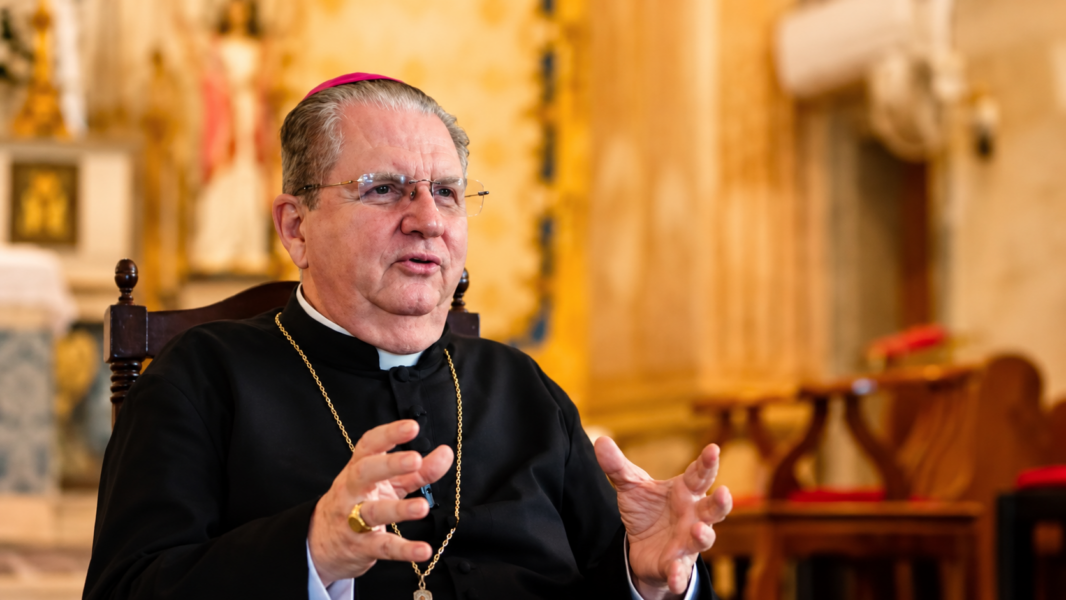
Bishop Fernando Arêas Rifan of Brazil, apostolic administrator of the Personal Apostolic Administration of Saint John Mary Vianney in Campos, has warned about the danger of becoming accustomed to an irregular canonical situation until it is considered part of the normalcy of Catholic life. The prelate, whose traditionalist community reconciled with Rome in 2002, has questioned the distrust of the Priestly Fraternity of Saint Pius X (FSSPX) toward the authorities of the Holy See and has defended the decision of the priests of Campos to regularize their situation.
In an interview granted to AdVaticanum, Rifan reviewed the process of reconciliation with Rome, his relationship with Bishop Antônio de Castro Mayer, and the negotiations that culminated in the creation of the Apostolic Administration in 2002. He also addressed the future of the traditional Mass, the consequences of Traditionis custodes, and the episcopal succession of Campos, still pending a decision by Leo XIV.
«The risk is becoming accustomed to irregularity»
Recalling the conversations held with the Holy See at the beginning of this century, Rifan explained that initially both the priests of Campos and representatives of the Fraternity of Saint Pius X participated. However, the latter subsequently abandoned the negotiations, while the Brazilian community decided to continue the dialogue with Rome.
«Unfortunately, there has always existed among the priests of the FSSPX a common spirit of distrust toward the Roman authorities», he stated.
According to his account, after the Fraternity’s withdrawal, the priests of Campos continued the conversations, which culminated in the lifting of the excommunication of Bishop Licínio Rangel and the creation of the Personal Apostolic Administration of Saint John Mary Vianney in January 2002.
Rifan assured that this decision did not cause them any conflict of conscience. On the contrary, he explained that remaining in an irregular situation constituted a burden for the priests of his community.
«The risk of remaining in an irregular situation is becoming accustomed to irregularity and turning it into a norm of Catholicity», he warned.
The bishop added that, looking back on that process, he considers the recognition received from Rome to be providential. «We gained peace of conscience and the certainty of divine blessing, so that, thanks be to God, we have no regrets», he noted.
He also recalled the decisive role of Bishop Licínio Rangel, the first apostolic administrator of Campos, who supported the negotiations even when they encountered opposition from the FSSPX.
«Our own history has taught us that the seamless garment of Christ cannot and must not be torn under false pretexts of love for the Church», he maintained.
The teaching of Bishop Castro Mayer on fidelity to the Church
Rifan was ordained a priest on December 8, 1974, by Bishop Antônio de Castro Mayer, former bishop of Campos and one of the principal figures of Brazilian Catholic traditionalism.
Castro Mayer participated together with Bishop Marcel Lefebvre in the episcopal consecrations at Écône in 1988, carried out without a pontifical mandate. Rifan, who was also present at that ceremony, now recalled the teachings received from his former bishop.
According to him, Castro Mayer insisted on the need to remain faithful to the Magisterium of the Church in the face of the theological currents that emerged after the Second Vatican Council.
«He taught us not to be followers of persons, but of the Church, because individuals can go astray», he stated.
Rifan assured that, in his judgment, Castro Mayer would have supported the reconciliation of Campos with Rome. He recalled that the bishop maintained a filial devotion to the successor of Peter and considered that the decisions made in 1981 and aggravated in 1988 constituted a regrettable episode that was later corrected.
«To err is human; to correct oneself and to forgive is Christian; to persevere in error is diabolical», he declared.
Traditionis custodes has not restricted the apostolate of Campos
The interview also addressed the situation of the traditional liturgy after the publication of Traditionis custodes by Pope Francis in July 2021.
Rifan explained that the restrictions established by that motu proprio did not modify the situation of the Apostolic Administration of Campos, which is governed by a particular law recognized by the Holy See.
«There was no change in our particular situation, since the Apostolic Administration is governed by a particular law», he noted.
The prelate added that they also encountered no restrictions in developing their apostolates outside the territory of Campos, where their priests celebrate the traditional liturgy with the authorization of the diocesan bishops.
According to Rifan, bishops usually welcome these initiatives favorably when they see that the faithful maintain a true spirit of communion and a sincere adherence to the Church and the Pope.
Asked about the future of the traditional Mass, he defended its preservation and called for overcoming the divisions that currently exist in the liturgical sphere.
«I believe that the preservation of the Mass of Saint Pius V is a great good for the Church, but I recognize that, above all, we must overcome polarization in the liturgical sphere in order to return to an authentic liturgical peace», he stated.
The debate over restrictions on the traditional liturgy remains open. In an interview granted to AdVaticanum, Cardinal Arthur Roche, prefect of the Dicastery for Divine Worship, had addressed liturgical tensions and the relationship of traditionalist groups with the authority of the Church.
Rifan hopes that Leo XIV will appoint a new bishop for Campos
Another matter addressed was the episcopal succession of the Apostolic Administration of Saint John Mary Vianney.
Rifan turned 75 in October 2025 and submitted his resignation in accordance with the provisions of the Code of Canon Law. However, Leo XIV asked him to continue temporarily at the head of the jurisdiction while his succession is being prepared.
Asked specifically whether the Apostolic Administration will have another bishop of its own to continue governing the community and celebrating according to the traditional liturgy, he replied: «That is what we firmly hope for».
Nevertheless, he acknowledged that the appointment of a bishop requires a complex process of discernment and consultation.
«We are therefore waiting. Everything depends on the Holy Father, the Pope», he explained.
The Apostolic Administration was created by Saint John Paul II through the decree Animarum bonum, of January 18, 2002, as part of the canonical regularization of the traditionalist priests of Campos. Its particularity consists in allowing its priests and faithful to preserve the traditional liturgical books within an ecclesiastical structure recognized by Rome.
Read also: The Pope grants Mons. Rifan an 18-month extension to prepare his succession
Synodality cannot be used to demand doctrinal changes
Rifan also spoke about the synodal process and proposals seeking to broaden the participation of the laity in the governance of the Church.
The bishop acknowledged that greater participation of the faithful does not in itself pose difficulties, but he recalled that the Church possesses a hierarchical structure and that certain governing functions belong to ordained ministers.
«Those who make synodality an attempt to democratize the Church are mistaken», he stated, recalling that Pope Francis himself had rejected democratic or populist interpretations of synodality.
The prelate added that «synodality cannot be used to demand doctrinal changes in the Church».
To support his position, he cited the Holy See’s 2022 declaration on the German Synodal Way, in which Rome warned against the unilateral creation of new official structures or doctrines that could compromise ecclesial communion.
Rifan assured that this position of the Holy See continues to be that of the Apostolic Administration of Campos as well.