


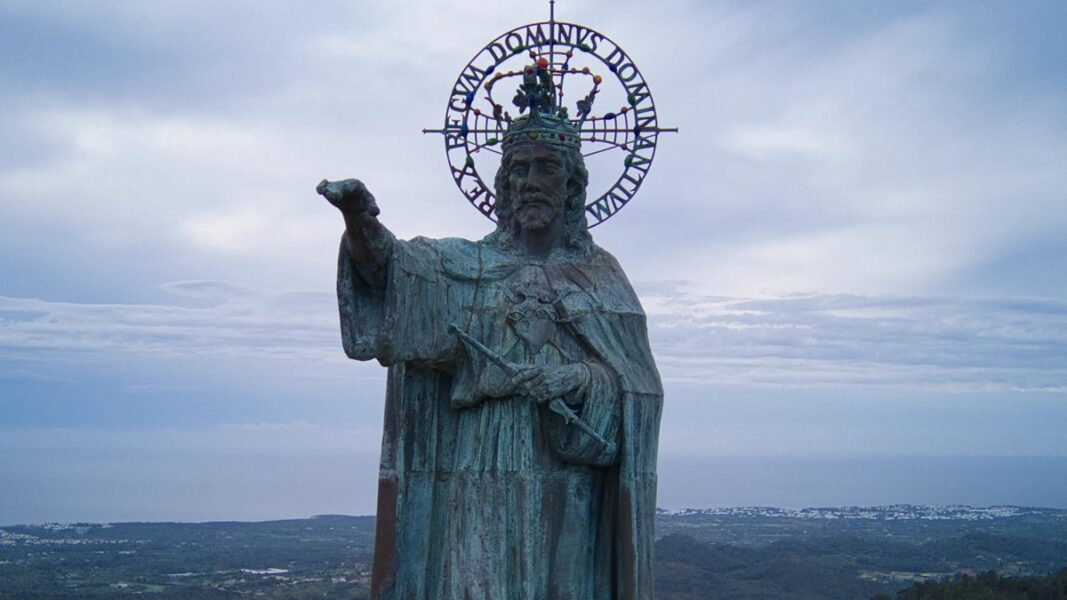
The Government has admitted for processing the request to include the statue of the Christ the King of Puig de Sant Salvador, in Felanitx (Mallorca), inaugurated on July 1, 1934, two years before the Civil War, in the state catalogue of symbols contrary to democratic memory. The application, submitted on October 2 by local writer and researcher Bartomeu Mestre Sureda, known as Balutxo, with the support of 33 residents and the association Memòria de Mallorca, calls for the figure to be catalogued so that the competent administration can proceed with its removal or demolition. It argues that the outstretched arm of Christ reproduces the Roman salute and that the image is therefore a fascist symbol.
According to Mestre himself told Ultima Hora, the Ministry notified him a week later that the request had been admitted for processing and that it would be studied in depth. “They had six months to respond and they did so within a week,” he said. Admission does not imply any removal order: the case is in its initial phase and the Ministry of Territorial Policy and Democratic Memory must analyze the documentation, gather reports and hear the parties before issuing a ruling.
The applicants’ thesis rests on a change of project. The monument was promoted and financed by canon Mateu Alzamora Tauler, who directed the works until his death in 1933. The planned image was, according to Mestre, a simple Sacred Heart, with hands outstretched. After Alzamora’s death, the rector of Felanitx, Antoni Mora, would have discarded it when only its placement remained and would have commissioned a different figure, a crowned Christ the King with his arm raised. The dossier, with some fifteen photographs and documents from the period, attributes that change to three people whom it presents as Falangists, including the rector himself, according to El Debate.
The argument clashes with the timeline of the law itself. El Debate recalls that the 2022 Democratic Memory Law refers to the period from the coup of July 18, 1936 to the 1978 Constitution, and the statue dates from 1934. Historians consulted by that newspaper deny that the monument has Falangist intent or constitutes an apology for Francoism, and suggest that the gesture can be read as a blessing upon the people. That some of those involved in the design later supported the rebels, they add, does not turn the work into a political symbol. The Christ was also not included in the census of Francoist symbols drawn up in 2019 by the Balearic Government of Francina Armengol, which listed some 95 elements in 28 municipalities, among which Felanitx was not found.
The statue stands on land belonging to the Diocese of Mallorca, which, according to Canal 4 Diario, defends its permanence “in accordance with current legislation” and recalls that it was not considered a contrary symbol in the regional inventory. The same medium warns that state legislation also allows action on symbols located on private or religious property with public projection, so ownership alone is not sufficient to protect it.
In Felanitx, the municipal government opposes removal. The mayor, Catalina Soler (PP), who governs with El Pi, has said that the figure is a religious representation of Christ blessing the municipality and that “this unites all the people of Felanitx”. She has announced that, if the Government requests a report, the Town Council will consult residents and promote a signature drive to keep the statue in place. The local PP has gone further: “If necessary, we will camp beneath the monument”.
The history of the monument also includes an episode of hostility from its own era. On the morning of its inauguration, during the Republic, the access road to the sanctuary was found strewn with nails that punctured the tires of several cars heading to the ceremony, including the bishop’s. The local magazine El Felanigense described it at the time as “an outrage.”
The Felanitx case joins others opened under the same law, such as the removal of the inscription to José Antonio Primo de Rivera in Murcia Cathedral or that of the Cross of the Fallen in Cáceres. This time the piece singled out is not an inscription or a monument to the fallen, but an image of Christ the King predating the war, and the Ministry took one week to agree to study it.
Read also