


By: A (Formerly) Perplexed Catholic
Kennedy Hall is a Canadian Catholic, father of a large family, and parishioner of the FSSPX. We have spoken about him on several occasions here, as his articles and books are very valuable material for formation in the faith and for understanding what is happening in the Church.
On one occasion, I asked him to translate excerpts from his book Charismania, which we have already discussed here, and he granted me permission to translate into Spanish anything from his pen that I thought might be helpful.
So today we are going to talk about the risk of burnout among traditional Catholics, with the translation of an article by Kennedy Hall that appeared in Crisis Magazine in August 2025, which you can read in the original version here (https://crisismagazine.com/opinion/beware-of-traditional-catholic-burnout):
Discovering the traditional Catholic faith can be like drinking from a fire hose full of wonder and fervor; but after that initial fervor, one must live it without reaching burnout. And that is not easy under the current circumstances.
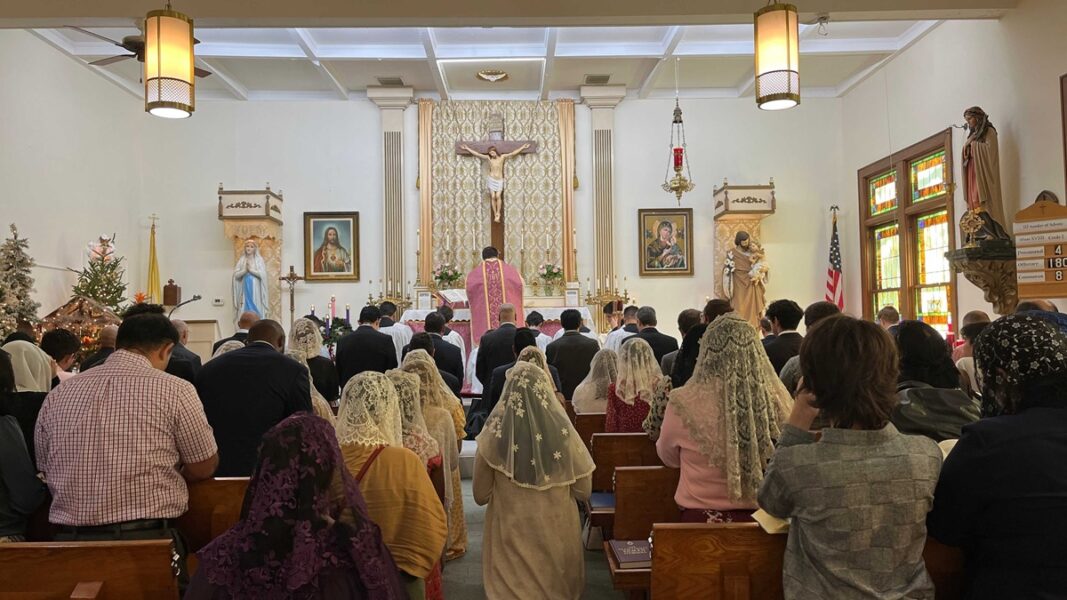
Numerous Catholics have discovered the Catholic Tradition in recent years, many of them as a result of the 2020 lockdowns, which forced them to think creatively if they wanted to have access to the sacraments. The Mass was broadcast online throughout Holy Week, so many Catholics who had never considered the traditional Mass found themselves practically immersed in a ritual that was so Catholic and yet so foreign and different from what they had seen until then in their parishes.
As a result, traditional parishes and chapels around the world have been overwhelmed by the influx of new faithful, and the Latin Mass, along with everything that surrounds it, continues to gain momentum.
First experiences with the ancient Mass vary from person to person: some people encounter a grand solemn Mass for the first time and, at first sight, are transported to a new spiritual plane; others enter the Catholic Tradition through reading and attend their first low Mass in a mission chapel at 3 p.m. on a Sunday, and feel confused when they look up from their hand missal—which they still do not understand—only to realize that the Mass has already passed the halfway point and they are not even sure when it began.
That first period in which one immerses oneself in the Tradition is usually experienced as a whirlwind; we might say it is like drinking from a fire hose. There is so much to learn, and it is so pleasant to discover so many things about which we may have had an intuition, but which we had never heard explained in depth from a theological point of view or from the pulpit. Practically everyone who discovers the Tradition comes to understand the gravity of the crisis in the Church and learns things such as the Third Secret of Fatima—whether it has been fully revealed or not—and a host of topics that would otherwise be taboo or forbidden in the conventional parish setting.
There are also many difficulties that accompany immersion in the Tradition, which most of us experience. I remember that when I discovered so many wonderful things about our history and our liturgies, all I wanted was to share them with my friends. I was naïve and thought that everyone would be as happy to learn what I had learned as I was. However, I soon realized that not a few of my brothers with whom I had attended the local “new Mass” for years were not exactly enthusiastic to hear what I had to say. Now, these people were not liberals, but very conservative in general; but when I crossed the proverbial Rubicon by moving from the “New Mass” to the “Traditional Mass,” suddenly the Catholics I admired began to use words like “extreme” and “schism” to describe the path I was on. And my experience is not unique.
Over time, the “honeymoon” phase that comes with discovering the Catholic Tradition fades, and we move from a stage of overwhelming discoveries to one of putting into practice and living in our lives the newly discovered devotions and rituals. That is when things get complicated. At first, driving an hour or more to attend Mass does not seem like a big deal; but then those roads start to freeze as winter progresses. There comes a time when you realize that your old friends really are not going to change their minds and see things from your point of view, and that hurts. You also realize that being a “trad” can mark you with a scarlet letter, and that getting along with the institutions of your diocese often becomes more difficult.
Some parents have already been raising their children for more than ten years and now have to rethink issues such as modesty and, in conscience, need to pull their teenagers out of the local youth group or the parish, which was always modernist, but they did not realize it before.
It is also difficult for novice “trads” to figure out how “trad” they should be in their family life. Should we attend all the liturgies of Holy Week with our small children, who cannot be expected to sit still during a four-hour liturgy on Good Friday? How many devotions should a traditional Catholic family have at the same time? Do we fast from midnight before Mass? And what about Lent? Is it enough to fast like post-war Catholics, or should we try to live an “old-fashioned” Lent, as in the Middle Ages? And so on.
We find ourselves at a unique moment in history for Catholics, in which we are forced to fight not only against the culture, but also—unfortunately—against much of the hierarchy, in order to live a Catholic life like that of the saints we read about. Traditional Catholics find themselves in a constant struggle against wind and tide; and, unfortunately, many of us are in a situation where the only recourse is a “do-it-yourself” approach. All of this makes things arduous and exhausting, and the risk of burnout is real.
Our family embraced the Catholic Tradition in 2018 and, although we are not veterans compared to many traditionalists who have been fighting the good fight for decades, there are some things we have learned that I think may be useful:
- Do not exhaust yourself or overexert yourself trying to prove the value of Catholic tradition to all your acquaintances, especially if it falls on deaf ears. Yes, we must all share the faith when asked, but it is not your task to argue with everyone or convince other Catholics of things they do not want to hear.
- Trust in the wisdom of the Church regarding fasting and penance. Yes, the fasting rules were stricter in past centuries, but you do not live in those centuries. Of course, test yourself, but if you are an average Catholic, it is foolish—and perhaps a sign of pride—to think that you can go from snacking and eating like any normal person to attending pre-1955 Holy Week emaciated and on an empty stomach.
- Catholic tradition is not the same as a “Catholic conspiracy.” I do not use the word “conspiracy” in a pejorative sense, but it is worth remembering that obsessing over every jot and tittle of messages from an apparition or revelation that predicts the crisis in the Church may not help your spiritual life. When you stand before Christ at death, you will not be asked whether the Third Secret of Fatima was truly revealed, however important that topic may be.
- You are a traditional Catholic in 2026, not in 1026. You live in the “modern world,” which means you use electricity, screens, cars, etc. Much of what modernity offers us is not good; that is true. But God created you to live now, so do not try to readjust aspects of your life that make things unnecessarily arduous. Living in a state of grace and embracing Catholic Tradition is already a sufficient challenge.
- Be lenient with yourself and your children. In the past, Catholics used to not bring their small children to Mass until they reached the age of reason. Towns had parish churches with multiple Masses within walking distance of home. People lived in multigenerational households, and parents would often go to Mass and leave the little ones at home, with grandparents going later. Also, when reading old manuals, one discovers that it was common practice for nursing mothers and pregnant women to be exempt from attending Mass. If you have had a long night with the baby, please keep in mind that the Mass is not going anywhere and will still be there next week. Accept advice, but think for yourself. In the world of traditional Catholicism there are many opinions on practically any topic, but you must make your own decisions and not simply do what others tell you to do. There are many ways to educate your children, to incorporate seasonal devotions in your home, etc. Do what works best for your family.
- Avoid trying to live up to the model traditional family. Some families pray all the mysteries of the rosary every day; others struggle to find time to complete a set of mysteries with crying babies and small children hanging from the ceiling fans. Someday you will be a full-fledged traditional Catholic, like the people you admire in your parish, but you have not seen the decades of hard work they have put in to get where they are. Like you, twenty years ago they were lost, confused, and exhausted.
- Do not assume that traditional Catholicism is going to fix your personality. If you are like me, you can be a real jerk, and not even a million rosaries will turn you into a better husband, father, and person in general if you do not do what is necessary to become more virtuous. Catholicism is about loving Our Lord and spending eternity with Him, and Pharisees have a hard time getting to heaven. If traditional Catholicism has any meaning, it is to attain holiness, and adopting a lifestyle that tells the world you are a “trad” in an external sense will do you no good if you do not do the hard work of becoming a saint.
- Do not take it personally when Catholics reluctant about Tradition look at you strangely. We must remember that being a traditional Catholic is countercultural and, in a way, abnormal. Of course, it should be the norm, because it should never have reached the point where praying ancient prayers and attending ancient rituals makes you the odd one out. Unfortunately, the mainstream left Tradition behind half a century ago, so for now, you are the odd one out to them. Do not become bitter, because those who seek holiness should not become bitter. Live your faith, love your neighbor, and remember that sticks and stones may break your bones, but being called a “rigid schismatic” should not hurt you.
- Have fun! Tradition is more than old catechisms and the Traditional Mass. It is art, music, and dance—the good kind—laughter, great books, parties, and wonderfully innocent children running around in pretty dresses. It is the best; and, despite all the difficulties, it is a life worth living. Red wine is as Catholic as incense, and the body is a temple of the Holy Spirit, so it should be incensed from time to time with a little wine. If traditional Catholicism is not bringing you a kind of happiness and inner peace you have never had before, then please reread this, because you must make sure you are not burning out.
***
And for this last point that Hall makes, I would like to add that we need a healthy traditional community. Let us not live atomized lives, but seek out communities. With the horizon of a St. Irenaeus of Arnois in our prayers. Even if for now they are small or catacomb-like.