


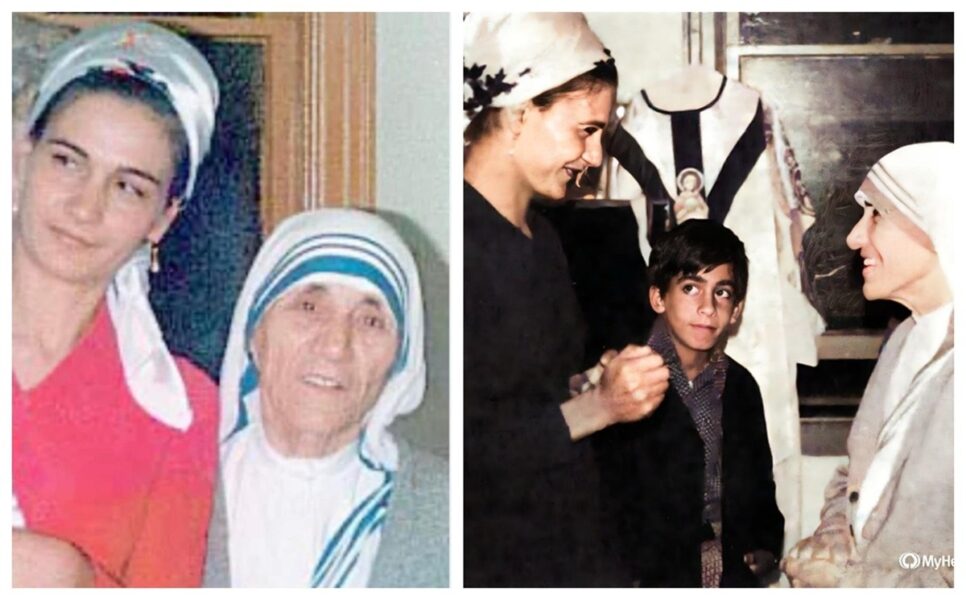
Invoking Saint Teresa of Calcutta in favor of Garabandal produces an understandable effect: the name of a woman whose life was heroically devoted to Christ in the poor seems to lend the account a credibility that no historical discussion could achieve. However, precisely out of respect for her holiness, it is necessary to examine what is documented, what is attributed to her, and what conclusions her words allow us to draw. Friendship, a favorable impression, and ecclesial approval are distinct realities; grouping them under the word “endorsement” may be persuasive, but not necessarily accurate. Rigorous criticism does not require denying every connection between Mother Teresa and the “visionaries,” nor insisting that every favorable statement is an invention. The published documentation provides grounds for acknowledging a close relationship with Conchita and a favorable disposition toward Garabandal. What it does not allow is turning that disposition into conclusive proof of the apparitions, nor presenting it as an authority alternative to the Church’s discernment. The issue is not whether Mother Teresa deserves trust, but rather clarifying what she could testify to and with what scope.
A true friendship does not make an apparition true
There is a particularly useful testimony because it comes from Conchita and allows us to distinguish the personal relationship from interpretations added later. In the transcription of her interview with Msgr. Francisco Garmendia, dated 1981 in the literature consulted in New York, Conchita states that she knows Mother Teresa and sees her when the latter travels to the United States, where Conchita, married to an American, had already settled. In response to the interviewer’s remark that the religious visits her, she clarifies: she is the one who goes to see her. She speaks of her affection and support, but adds an episode that matters much more for determining the meaning of that relationship: when she explained that the bishop of Santander had forbidden her to speak about the apparitions, Mother Teresa replied that she should respect that instruction. This clarification does not destroy the friendship, but prevents it from growing in step with its apologetic use. Conchita offers testimony of affection, accompaniment, and respect for episcopal authority. In that passage she does not describe an investigation carried out by Mother Teresa nor a supernatural revelation that would have confirmed what supposedly happened in the Cantabrian village.
Something similar occurs with reports about the godparenthood of one of her children. Some publications present Mother Teresa directly as godmother; others specify that it was a religious of the Missionaries of Charity acting on her behalf. The difference may be secondary for recognizing spiritual closeness, but not for scrupulously reproducing the facts. A real relationship does not authorize always choosing its most impressive version.
In any case, neither a photograph, nor godparenthood, nor a prolonged friendship retrospectively authenticates visions. They attest to an encounter or a personal bond; they do not by themselves bear witness to the origin of a prior experience. A person can deeply appreciate Conchita, recognize her Christian life, and accompany her in her difficulties without certifying every statement made during her adolescence.
This distinction does not require suspecting bad faith in the protagonists. Between deliberate falsehood and the supernatural accuracy of an account there exist possibilities that an investigation must consider: modified memories, sincere but mistaken interpretations, experiences whose nature has not been clarified, or human elements added to what is recounted. Charity requires not excluding all those possibilities in advance.
Therefore, the reasoning that moves from “Mother Teresa esteemed Conchita” to “the Virgin appeared in Garabandal” contains a leap that the saint’s prestige cannot justify. If the goodness of the listener and the sincerity of the narrator are relevant, they are not enough to determine the nature of what is recounted.
The letter: a favorable phrase and a transmission that requires precision
The most cited piece is a letter attributed to Mother Teresa, usually dated November 10, 1987, and addressed to Msgr. Juan Antonio del Val, bishop of Santander. The published excerpt places her first knowledge of Garabandal in 1970 and contains this statement: “From the beginning I felt that the events were authentic.” It would not be honest to treat those words as if they were unfavorable or meaningless: they express a positive evaluation of the events, albeit on the level of the merely sensible and subjectively intuitive, without having seen anything. Moreover, a phrase repeated in numerous places does not equal numerous independent testimonies; it may be the same transcription passed from one book to another and from one publication to another. The abundance of reproductions demonstrates diffusion; to demonstrate documentary authenticity it is important to know the original, its full text, its date, its provenance, and the conditions of its preservation.
The search reveals a concrete difficulty. In Garabandal: a la luz de la historia, the account mentions a letter of November 10, 1987 concerning the offering of prayer for the priests of Santander; it then places the well-known declaration on the authenticity of the events in 1988. The note supporting the latter refers to Memorias de un cura en Garabandal, by José Ramón García de la Riva, page 438. In addition, the fragment contains the expression “in 1970, eighteen years ago,” which naturally fits with 1988. This discrepancy does not prove that the phrase is false: it may be due to a chronological imprecision, a transcription, or the conflation of different communications, but it prevents presenting as definitively resolved the identification between the favorable fragment and the November 1987 letter. Before drawing a conclusion about it, it would be necessary to compare the complete documents. In the sources examined it has not been possible to verify a full and sufficiently identified reproduction of the original that resolves this difficulty. This does not mean that the original does not exist; it means that the public verification carried out does not allow all its aspects to be considered clarified. Methodology requires stating this limitation without turning it, through excessive enthusiasm or suspicion, into something else.
There is, moreover, a second distinction. A letter can be authentic and not prove what it is invoked for. Authenticating a writing would demonstrate that Mother Teresa expressed an opinion; it would not automatically indicate the truth of the facts about which she opined. The authenticity of the document and the accuracy of its content are different questions.
Nor is it appropriate to artificially weaken the phrase with an explanation too favorable to the critical thesis. By its context, it is reasonable to understand that it refers favorably to Garabandal, not solely to the sincerity of the girls. Claiming that “authentic events” only means “sincere persons” would require a justification that the fragment does not provide. Criticism does not need that reduction: it can recognize a favorable private conviction and show, with greater solidity, why it does not constitute definitive proof.
The verb “felt” does not by itself demonstrate superficiality. In ordinary language it can express a firm conviction, not a passing emotion. What is decisive is that the fragment does not set forth the grounds of that conviction: it presents no investigation, identifies no revelation received by the author, and offers no examination of the historical difficulties or of the prophecies attributed to the apparitions. A declaration of trust does not replace the demonstration of that in which one trusts.
The 1980 episode: helping meant consulting the bishop
The account of the preparation of a BBC documentary in 1980 is especially revealing. According to the published testimony of Barry Hanratty, a collaborator in that production, Conchita initially understood that some words from the bishop of Santander allowed her to participate. Upon learning of the project, Mother Teresa inquired about the episcopal authorization and did not consider the response received sufficiently clear. Therefore she requested a new consultation and wrote the question Conchita was to ask, centered on making the film for the honor and glory of God. The account adds that the bishop allowed the participation and asked to keep that note. It is an account attributed to someone involved in the preparations, and deserves to be considered as such. It should not be degraded without reason to mere rumor; nor should it be confused with an independent verification of every conversation or with the direct reading of the corresponding episcopal document. Its meaning, however, is quite clear: Mother Teresa did not claim the power to resolve the question by herself. Neither her prestige, nor her favorable conviction, nor the interest she might have in spreading the account seemed sufficient to her to dispense with the bishop. Her intervention was aimed at obtaining an unequivocal response from the competent authority.
Literature favorable to Garabandal expressly recognizes that trait. An excerpt from a study disseminated on the page of a film about the apparitions insists that Mother Teresa advised Conchita’s submission to the prelate and states that the note was kept in the bishop’s office. That preservation is presented as testimony of obedience and interest, not as a decree of supernatural recognition. Here lies the difference: authorizing an interview means permitting a specific act under specific conditions; approving apparitions means issuing a judgment on their nature. The object of both decisions is not the same. An authorization to speak does not turn every statement of the interviewee into teaching endorsed by the one who authorizes.
The 1978 norms of discernment, corresponding to the time of these episodes, expressly distinguished between permitting certain manifestations of devotion and approving the supernatural character of the facts. They required a rigorous investigation and attributed to the Ordinary of the place the initial responsibility for vigilance and intervention. If even a permission related to worship had to avoid abusive interpretations, with greater reason one must avoid transforming permission for an interview into recognition of apparitions.
Nor does the deposit of a note in an ecclesiastical archive modify the nature of its content. An archive preserves correspondence, testimonies, consultations, and reports of very different authority. Custody can help establish the provenance of a document; it does not make all its statements become the bishop’s judgment.
There is another similar displacement in the use of the offering of prayer for the priests of Santander. The published transcription presents an initiative of spiritual accompaniment: a religious would offer her prayer for each priest. That beautiful gesture does not contain, in the reproduced text, an approval of Garabandal.
It may be supposed that the relationship with Conchita influenced the choice of that diocese; but a possible explanation of the motive must not be confused with what the letter actually declares, and much less does it allow turning the episcopal acceptance of an offering of prayer into acceptance of apparitions.
A saint may hold an opinion without becoming a tribunal
Mother Teresa learned of Garabandal, according to the fragment attributed to her, in 1970: after the period of apparitions, placed between 1961 and 1965. Her knowledge of those events did not, therefore, come from having witnessed them during that period. This does not make her opinion irrelevant, but it determines what kind of knowledge she could offer: that of a person who receives accounts, later meets their protagonists, and forms a judgment about them. An indirect testimony can be valuable, but it needs to clarify its sources and its reasons. It is not stated in the documentation examined that Mother Teresa had carried out a complete evaluation of the dossier, systematically contrasted the versions, or received the ecclesial commission to judge the facts. Affirming that absence of verification is more accurate than asserting that she never studied anything or that she only knew one version: neither of those absolute negations has been proven.
The same caution must be applied to spiritual discernment. That a person is holy does not mean that each of her impressions is a divine illumination. God’s gifts cannot be presumed to supply what is lacking in the documentation; if a special supernatural knowledge is invoked, that claim also needs foundation; it is not enough to introduce it as a convenient explanation of a favorable opinion.
Canonization does not incorporate into the magisterium all the historical opinions of the one canonized. The Church presents the saints for veneration and imitation; it does not thereby turn their private correspondence into a collection of infallible judgments on events foreign to them. The heroism of charity and the impossibility of being mistaken are different things.
Therefore, admitting that Mother Teresa could have been mistaken about Garabandal does not diminish her holiness. Nor does it allow one to affirm, merely on the basis of that possibility, that she actually was mistaken. The argument is more precise: her opinion was fallible and, consequently, cannot close an investigation or dispense with examining the evidence. The possibility of error destroys the claim to infallibility; it does not by itself demonstrate the falsity of the apparitions.
Even private revelations recognized by the Church, the Catechism recalls, do not belong to the deposit of faith and must be received through a discernment guided by the magisterium. It would be strange to grant to the particular opinion of a saint on a disputed revelation a force that does not even correspond to recognized private revelations.
The conclusion can therefore be formulated without denying what the sources allow us to admit. There is a basis for speaking of personal closeness and a favorable evaluation attributed to Mother Teresa. The transmission of the most cited fragment presents documentary questions that it is advisable to resolve; but, even accepting it entirely as authentic, it would still accredit her opinion, not the supernatural character of Garabandal.
Consequently, it is not solid to affirm that all support was invented. What lacks justification is transforming that support into ecclesial approval or into conclusive proof. If by “endorsement” one means a favorable personal disposition, the documentation offers elements to sustain it; if one means a definitive guarantee of the apparitions, one is attributing to the testimonies a scope they do not possess.
Mother Teresa must also be respected within the limit she herself recognized: she could accompany, advise, pray, and express confidence, but she referred Conchita to the bishop. Using her name afterward to dispense with that discernment means preserving her favorable impression and relegating her obedience. Besides the fact that her holiness does not amount to a verdict, which belongs to the Church, and this has already given it many times, although, because of the delicacy of its formulation, it is distorted usque ad infinitum by those who have an incomprehensible a priori judgment: Non constat de supernaturalitate.