


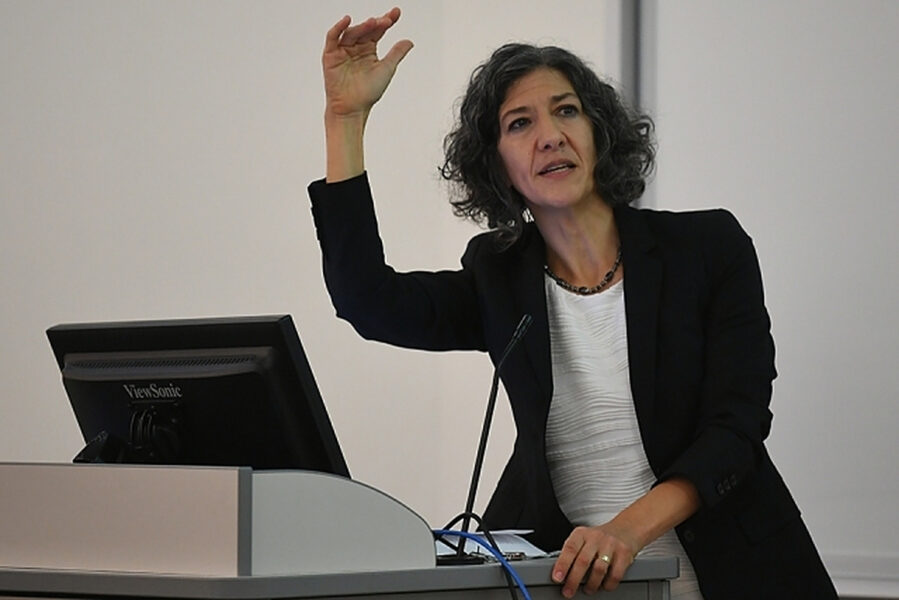
The meeting «Ten Years after Amoris laetitia: Proclaiming the Gospel with Families Today» concludes this Wednesday. Leo XIV inaugurated it on October 7 in the Paul VI Hall with the presidents of the episcopal conferences and the heads of the Eastern Churches. According to the official program, Monday the 12th was dedicated to accompanying families in complex situations. That morning, Cardinal Pablo Virgilio David of the Philippines and Julie Hanlon Rubio, Professor of Christian Social Ethics at the Jesuit School of Theology at Santa Clara University, spoke.
The full text of her lecture, titled Amoris Laetitia’s Vision and Praxis: Ten Years Later, is published on the official website of the meeting. The bulk of it is a diagnosis of the marriage crisis, which was echoed by Vatican News. «In the U.S., in 1980, only six percent of 40-year-olds had never been married. Today the figure is 25 percent», Rubio recalled («In the U.S., in 1980, only six percent of 40-year-olds had never been married. Today the figure is 25 percent»).
A footnote
The most far-reaching statements do not appear in the body of the text, but in the notes. The theologian recalled some words from number 296 of the exhortation: «Francis told us, “No one can be condemned forever! It is not the logic of the Gospel!,” and this logic should be extended to “everyone”» («Francis told us, “No one can be condemned forever! It is not the logic of the Gospel!,” and this logic should be extended to “everyone”»).
In note 19 she specifies to whom this refers: «Today this surely includes divorced persons, single parent families, blended families, cohabiting couples, and persons identifying as LGBTQ» («Today this surely includes divorced persons, single parent families, blended families, cohabiting couples, and persons identifying as LGBTQ»).
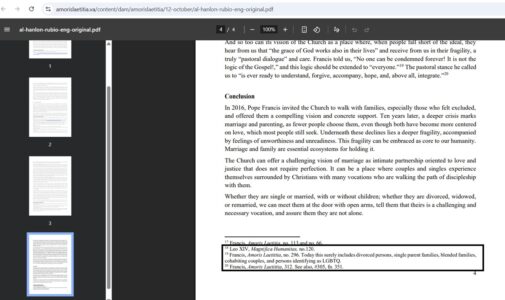
Number 296 belongs to chapter VIII, the most debated section of the document. Rubio also refers to number 305 and its note 351. That note states that help for those living in objectively irregular situations «in certain cases, could also include the help of the sacraments». In 2016 it prompted the dubia of Cardinals Brandmüller, Burke, Caffarra and Meisner, which Francis never answered.
Communion and «traditional» families
«I do not want to suggest that the problem of marginalization that concerned Pope Francis has been solved», the speaker warned («I do not want to suggest that the problem of marginalization that concerned Pope Francis has been solved»). She said she had heard «heart breaking stories» («heart breaking stories») and recounted the case of an elderly woman with dementia who, when offered the Eucharist at Mass, shouted «No!» and covered her mouth. She did so, according to Rubio, «because one thing she remembered was that, because her husband of fifty years had been previously married, she was not worthy to receive the Body of Christ» («because one thing she remembered was that, because her husband of fifty years had been previously married, she was not worthy to receive the Body of Christ»).
In another passage she contrasted Francis’s vision with that of families on social media: «In an era when influencers on social media show off their seemingly perfect “traditional” families complete with homemade bread and chickens, Francis’s integration of weakness is crucial» («In an era when influencers on social media show off their seemingly perfect “traditional” families complete with homemade bread and chickens, Francis’s integration of weakness is crucial»). The quotation marks around «traditional» are the author’s own.
The references in the lecture
Among the bibliography with which Rubio grounds her vision of marriage is Personal Commitments, by religious sister Margaret Farley. In 2012, the then Congregation for the Doctrine of the Faith issued a notification on another work by the author, Just Love, for its theses on masturbation, homosexual acts and unions, the indissolubility of marriage and divorce.
The speaker also invoked Leo XIV’s encyclical: «Magnifica Humanitas as well insists that human fragility is not a problem to be solved but a fundamental element of our humanity to be integrated» («Magnifica Humanitas as well insists that human fragility is not a problem to be solved but a fundamental element of our humanity to be integrated»). In any case, this is the intervention of an invited theologian, without magisterial value.
What the meeting concludes, however, will not be known for now. In a communiqué issued on Monday, Cardinals Kevin Farrell and Mario Grech warned, after the Pope’s operation: «We should not expect a concluding address from him» («We should not expect a concluding address from him»). Regarding the synthesis report, they added that, «contrary to what was previously announced, it will not be made public» («contrary to what was previously announced, it will not be made public»).