


By Stephen P. White
The death of Pope Paul VI on August 6, 1978—the feast of the Transfiguration—was not a great surprise. The Pope had been in poor and declining health for some time. A month earlier he had withdrawn to the papal summer residence at Castel Gandolfo, and he had been bedridden for several days when he suffered a massive heart attack.
Twenty days later, the patriarch of Venice, Cardinal Albino Luciani, was elected to succeed Pope Paul. The death of Pope John Paul I, after barely 33 days in office, was a tremendous shock to a Church already reeling from some very turbulent years.
The Church, especially in the developed world, had been shaken in the wake of the Council. It had been more than a decade since the last papal encyclical, Pope Paul VI’s Humanae vitae. The reception (or lack thereof, as the case may be) of that papal teaching was emblematic of the times. The Church seemed to oscillate between the self-inflicted irrelevance of total accommodation to the spirit of the age, on the one hand, and the obsolescence that comes from stubbornly refusing to have anything to say to a rapidly changing modern world, on the other.
For Catholics of a certain age, these are well-known facts of a well-known story. For those with faith, or at least the advantage of hindsight, it may be clear that neither was likely the Church’s final destiny. When the second conclave of 1978 opened in Rome, one can imagine the uncertainty and unease that hung over the Church and the world in those tumultuous days.
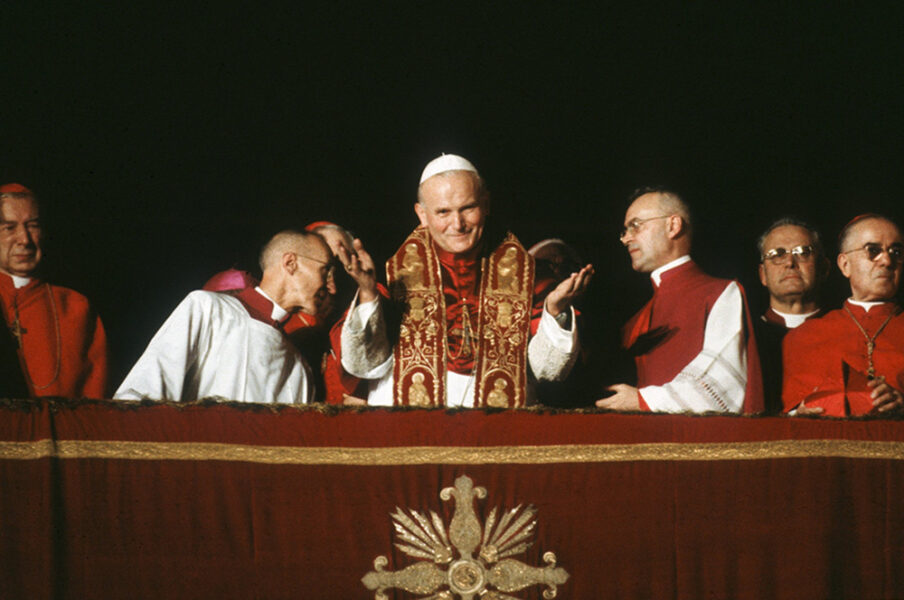
Yet it was precisely at that moment in history that Karol Wojtyla, a man “from a far country” behind the Iron Curtain, was elected to the See of Peter, and the story of the late twentieth century and the post-conciliar Church took an unexpected and dramatic turn.
I have these events in mind right now because of the proximity of the dates of Pope John Paul II’s election and his feast (October 22), but also because I recently reread the masterful first installment of the Polish Pope’s biography by George Weigel, Witness to Hope.
If you have never read Weigel’s magnum opus, or if it has been many years since you last read it, I encourage you to pick it up again. For one thing, if you start now, you might finish it (along with the second installment, The End and the Beginning) in time for the 50th anniversary of Pope John Paul II’s election in October 2028.
On a more serious note, those of us who know the story so well do well to be reminded from time to time of how dramatic and improbable the series of events was that formed the man, Karol Wojtyla, and led to the election of Pope John Paul II. For those who do not know the story—and most Catholics, at least in the United States, are too young to remember it—the life of John Paul II is a powerful testimony to Divine Providence.
Which brings us back to those early autumn days of 1978. I do not know whether Karol Wojtyla slept well or not after the first day of the second conclave of the year. He probably sensed what the next day would bring. Was it a premonition? Fear? Resignation? Peace?
What is clear, and what Weigel so skillfully unpacks, is how well the man and the moment corresponded. John Paul II did not fall into history like some kind of ecclesial superhero. He had been formed by a very particular, though extraordinary, set of circumstances.
Here was a Pole who understood to his core the role of culture in shaping history, at a level deeper than politics or economics. Here was a man who understood the roots of human freedom through the searing experience of living under successive totalitarian regimes.
Here was a man with experience as a laborer, a university chaplain, a parish priest, an intellectual, a mystic, a polyglot, and a bishop—all before the age of forty. Here was a man formed in the foundations of Thomism and yet convinced that one must engage modernity on terms it could grasp and understand. Here was a man of traditional, almost rustic, Old World piety who at the same time helped shape the depth of the Second Vatican Council and embraced it.
Karol Wojtyla had not set out to become all these things. For all his remarkable talents and the hard work with which he developed them, he was not a “self-made man.” He was formed into the man he became, like a diamond formed under tremendous pressure, to use Weigel’s apt metaphor.
John Paul II understood the drama of his life, of all life, which unfolds in the space between “who I am” and “who I ought to be.” He was a radically converted disciple of Jesus Christ who understood—and staked his entire life on—the fundamental reality that Jesus Christ, crucified and risen, is the only answer to the question that beats in the heart of every human life. That is the essence of the man whom God called to the See of Peter on October 16, 1978.
As improbable and providential as the life of St. John Paul II may seem, perhaps the most astonishing thing about his witness is this: the same invitation to greatness is extended to each one of us. The Church is always in deep waters; the times are always difficult. And the Lord never ceases to invite us to become precisely the men and women whose witness the world needs, right on time.
Holiness is always timely. The holy life is urgent every day. John Paul II knew, and showed, that this is how God calls each of us to greatness, if only we have the courage to respond.
About the Author
Stephen P. White is the executive director of the Saint John Paul II National Shrine and a fellow in the Catholic Studies Program at the Ethics and Public Policy Center.