


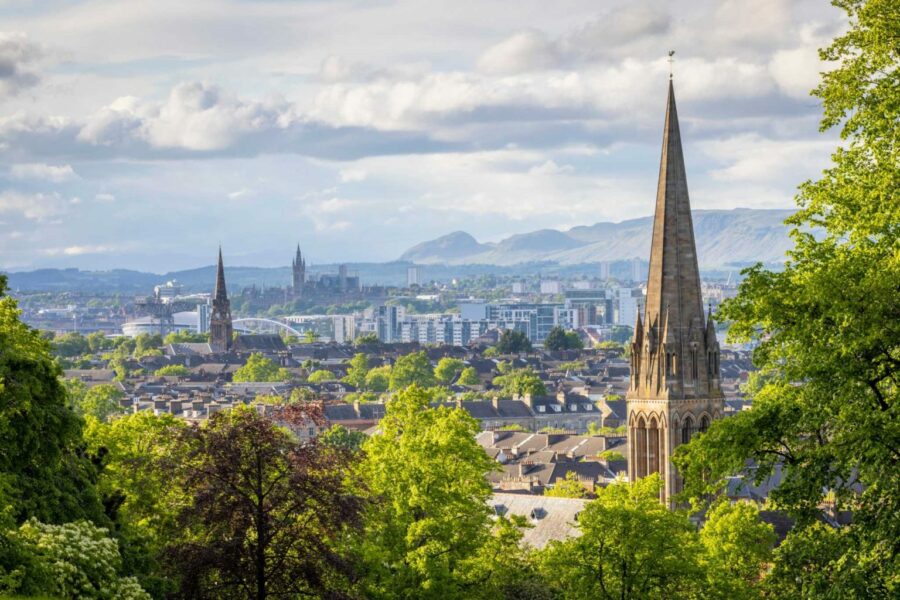
In a letter addressed to the faithful, Archbishop William Nolan explains that the need to restructure the parish map had been under consideration for years. The archdiocese presents the proposals as the most extensive reorganization it has ever undertaken. They are the result of several years of consultations with the deaneries, and the archbishop and the Council of Priests have already approved them in principle. They affect parishes in Dunbartonshire East, Dunbartonshire West, Glasgow South, Glasgow West, and Glasgow East & North.
«There are too many parishes and too few parishioners, too many churches and too few priests», the prelate summarizes. Nolan recalls that far fewer people attend Mass today than when these parishes were founded. He also points out that some of the largest churches are located in areas with very low population.
An aging and increasingly scarce clergy
The figures provided by the archbishop describe an aging clergy. Since he took office in February 2022, the number of active priests has fallen by a third. Only one in four is under 45, and the majority are over 60. Nolan acknowledges the presence of foreign priests and religious, without whom, he admits, the situation would be «even more critical than it is».
The archdiocese’s director of communications, Ronnie Convery, offered an even harsher forecast on BBC Scotland’s Drivetime program. According to his calculations, with the current approximately 80 parishes, only eight active priests could remain in twenty years. Convery highlighted two underlying problems: churches located in areas that have become depopulated and declining attendance. However, he described the vocations crisis as the «final blow».
Many of the changes will mean that two parishes will share the same building. According to the archdiocesan magazine Flourish, a large portion of the closures will occur within five years and others within five to ten years. Before implementation, the measures will be debated in the parish and deanery pastoral councils.
The canonical procedure
The archdiocese emphasizes that mergers and closures will not occur on a single date. Each case will follow the procedure required by canon law. The Code reserves to the diocesan bishop the suppression or significant modification of parishes, after consulting the presbyteral council (canon 515 §2). The reduction of a church to profane use is regulated by canon 1222. This canon requires grave causes, consultation with the same council, and the consent of those who hold legitimate rights over the church. It also requires that the good of souls not suffer detriment.
The archbishop uses the evangelical image of the vine-dresser who prunes the vine «so that it may grow». He asks the faithful for «a spirit of cooperation and willingness to make sacrifices, to look at the past with affection, but to let it go so that a new future may take shape».
Scotland facing a general decline
The announcement coincides with the debate opened by the Bishops’ Conference of Scotland on the future of its dioceses. The bishops are considering two scenarios: strengthening cooperation and sharing resources within the current structure, or merging dioceses. According to their statement, it is not only about «boundaries» or «administrative adjustments», but about how to «proclaim the Gospel better».
The 2022 census showed for the first time that the majority of Scots declare themselves to have no religion. In Glasgow, 20.74 % of the population identifies as Catholic, compared to 13.3 % for Scotland as a whole. Even so, the number of Catholics has decreased by more than 117,000 people in a decade.
The phenomenon is not exclusive to the Catholic Church. DJ Johnston-Smith, director of Scotland’s Churches Trust, told the BBC that 456 churches have closed across Scotland since 2020. His organization expects between 400 and 500 more closures before the end of the decade.