


By Robert Royal
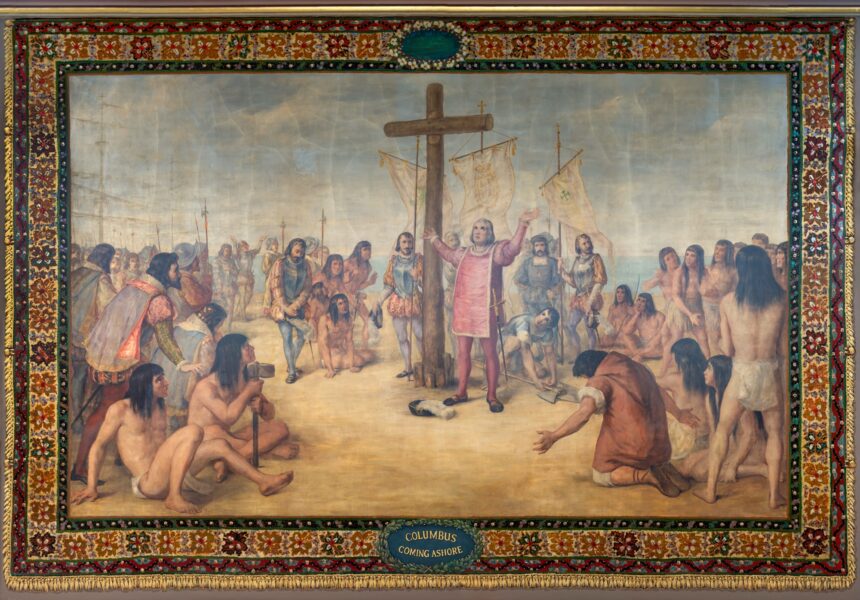
I would not have taken any more interest in Christopher Columbus than the average person if misinformed—and sometimes ill-intentioned—people had not made it necessary. Fairfax County, Virginia, where I have lived for more than thirty-five years, eliminated Columbus Day as a paid holiday in 2020, but today the schools close anyway to celebrate “Indigenous Peoples’ Day.” The state legislature did the same for all of Virginia, as have other states, in effect replacing our Western Christian heritage with… frankly, they themselves do not know what. Columbus, like all of us, was an imperfect human being. But unlike most of us, he was also a great human being who carried out one of the boldest feats in history, a feat that continues to hold central importance for the Americas, for the Church, and for the entire world. The more one learns about him, the clearer this becomes.
It is a symptom of the present moment that few people bother to learn—or to teach—anything about him beyond blanket condemnations of Columbus as the source of virtually everything bad that has happened in the Americas since 1492. (Curiously, by the same lack of logic, he receives no credit for anything good that has happened on these shores.) While there is much to admire in some native groups and much to lament in the treatment they have received, there is also much to deplore. Columbus was driven in part by the desire to “preach the Gospel to all nations.” He did well.
One need not invoke the Maya, Aztec, and Inca cultures, built on human sacrifice, to understand this. Anyone who looks, for example, at how the martyrs of North America (as Catholics and others used to do, and should do again) were brutally tortured and killed—just as several tribes of the Northeast treated all prisoners, native and European—may wonder why Europeans are cast as brutal villains and indigenous peoples as peaceful ecologists.
So a necessary question: why are indigenous peoples celebrated today? Columbus did not bring slavery to the Americas. It was already here and widespread. So were indigenous forms of imperialism and colonialism. As for the recognition of “stolen lands,” here is a sobering case for those who wish to know the truth beyond today’s ideological battlefield.
As I recount in my book Columbus and the Crisis of the West (a new edition of my very first book, 1492 and All That), Native Americans themselves were guilty of genocide and “stolen lands.” Consider the controversy over the U.S. presidents on Mount Rushmore and even over the U.S. government’s ownership of the site. The history of the place tells a melancholy story; in fact, several.
In 1776, the year the American colonies declared their independence, the Lakota Sioux conquered the Black Hills, where Mount Rushmore stands. They exterminated the Cheyenne, who had occupied them before; the Cheyenne had taken them from the Kiowa, who had taken them from… undoubtedly some other tribe.
As one historian noted: “The Lakota Sioux came west after losing a war with other tribes in Minnesota at the end of the eighteenth century… They waged genocidal war on other tribes before seizing the Black Hills from the Cheyenne… They did exactly what the United States did to expel the Lakota.”
And this was only one example of a series of “stolen lands” among indigenous peoples themselves.
So how should we untangle these historical knots?
Secretary of State Marco Rubio was in Athens last week and delivered a stirring speech on the value of our Western civilization. He highlighted the impetus Greece gave to philosophical and scientific thought, which sought to know the nature of the world, as well as to democratic institutions. He even pointed to Plutarch—not to figures of the modern Enlightenment—as the writer most cited by the authors of The Federalist Papers, the essays that influenced the adoption of the U.S. Constitution.
All of this needed to be repeated, and not merely as a history lesson, but to remind a world that has forgotten the irreplaceable heritage of Greco-Roman culture. And the importance of the Western heritage today:
Today we find ourselves at a crossroads… The course we take will determine whether the West maintains its place at the head of the world or resigns itself to a future of atrophy, servitude, and decline. Either we choose to act now, or we will lose the very possibility of choosing to act.
Kudos (in Greek) to Rubio for bringing a broad vision to a world now dominated almost entirely by brief videos on cell phones.
It may not have been the right moment, but Rubio omitted something crucial: the role Judaism and Christianity played in spreading, correcting, and developing the good but imperfect beginnings of the West in ancient Greece. When the European Union adopted a constitution in 2004, it likewise left out the Christian element, as if it were too “controversial” to mention the central religion of the West.
The world has largely forgotten that, after Columbus, a fundamental debate arose in Spain about the newly discovered peoples. Some argued that they were “slaves by nature,” an Aristotelian phrase designating persons incapable of governing themselves.
But the great Dominican philosopher Francisco de Vitoria, together with the “defender of the Indians” Bartolomé de las Casas, maintained that these peoples clearly had their own institutions and laws, and that both they and the Spaniards needed to be shown a better way. This was not immediately effective; ideas rarely are. But it was the beginning of international human-rights law and of the Christian-inspired movement to abolish slavery.
It is worth giving thanks that Christians had “reconquered” Spain by around 1492; if Islam had still been in power there, the Americas—the entire world—would be, to say the least, very different today.
History is complicated, but it tells hard truths. So celebrate Indigenous Peoples if you wish (preferably on another day). Christians believe that all peoples are made in His image and likeness. But reject the current replacement of our Western tradition. Columbus, and we as well, deserve more than a little respect.
About the author
Robert Royal is editor-in-chief of The Catholic Thing and president of the Faith & Reason Institute in Washington, D.C. His most recent books are The Martyrs of the New Millennium: The Global Persecution of Christians in the Twenty-First Century, Columbus and the Crisis of the West, and A Deeper Vision: The Catholic Intellectual Tradition in the Twentieth Century.