


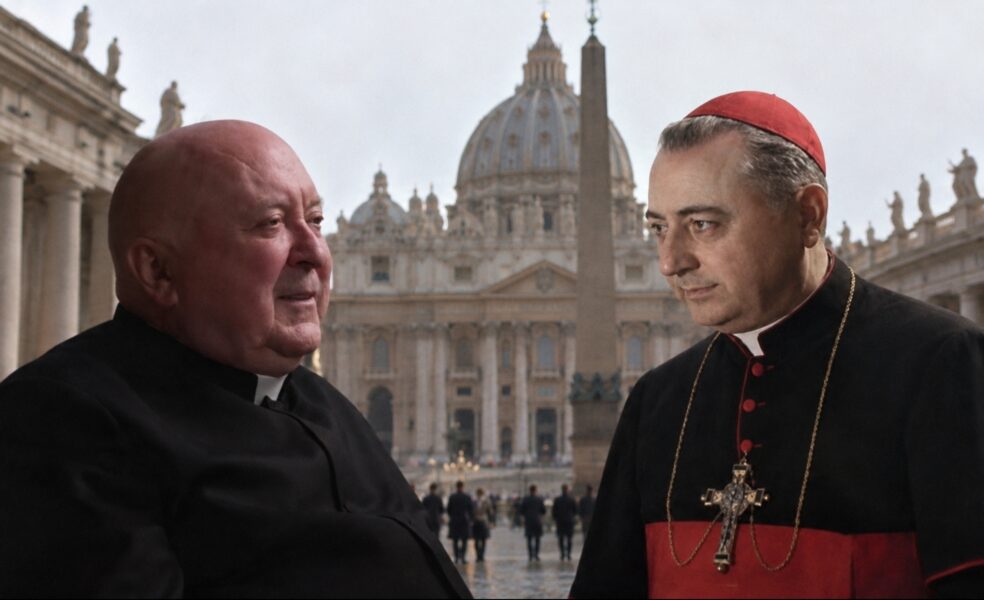
Of the two-hour conversation that Father Charles Theodore Murr held with Pedro Buerbaum on WORLDCA$T, which InfoVaticana already reported in its chronicle on the death of John Paul I, there is a passage that deserves separate reading. It is the one dedicated to Monsignor Annibale Bugnini, the Vincentian religious who designed the post-conciliar liturgical reform and who, according to the testimony of the former collaborator of Archbishop Édouard Gagnon, was the spark that ignited Paul VI’s major investigation into Freemasonry in the Curia.
An envelope on Staffa’s desk
Murr places the origin in 1974. A priest, whose name he himself claims not to know, appeared before Cardinal Dino Staffa, Prefect of the Apostolic Signatura, with a folder of documents pointing to Bugnini as a member of Italian Freemasonry.
«Someone arrived with some documents, very serious documents. They were handed to Cardinal Staffa accusing someone in particular: Annibale Bugnini, a bishop in charge of the reform of the Mass and the sacraments. Remember, we are in the post-conciliar years, when everything began to change. Well, the architect of all that was Bugnini. He arrived, supposedly a priest, with documents that said Bugnini was a Mason».
Staffa, a first-rate canonist and supreme judge of the Church, did not trust his first impression.
«Cardinal Staffa, who was no fool, called Interpol and various investigative bodies to see whether the documents were true or not, authentic or not. And yes, they were authentic. Then he and another cardinal, Cardinal Oddi, went to see Paul VI with the documents to tell him: “Look, Your Holiness, you have a Mason at the head of the new liturgy and of all the sacraments”».
The Substitute of the Secretariat of State, Giovanni Benelli, a man of full confidence to the Pope, examined the documentation again. From that review came the decision to inspect the Curia from top to bottom, nearly a thousand men, under the direction of Gagnon.
«More Mason than Catholic»
The gravity of the matter, Murr insists, lay in the position held by the accused: nothing less than the office from which the prayer of the entire Church was being rewritten.
«Think what that means. If it were true that he was a Mason, if it were true that the documents were authentic, it means that the one who was inventing the new Mass was more Mason than Catholic. His philosophy, his motivation behind all the changes was liberty, equality, fraternity, instead of Christ, of Jesus Christ and the Gospel. I don’t say instead of, but certainly very much in the background. It was rather a free expression, which we still see today in liturgical matters. And in my personal opinion, the reason why many, most of our churches are empty is because we have lost the sense of the sacred».
To help the interviewer, a young man born in 1995, grasp the scale of the scandal, the priest resorted to a domestic comparison that is not easily forgotten.
«It would be as if you found out that there is a man visiting your wife. To know that in the Vatican there was someone who was a member of Freemasonry. Freemasonry condemned, and everyone who entered Freemasonry, excommunicated ipso facto. And an archbishop, and the archbishop in charge of how we are going to pray. It was an enormously serious matter».
From the altar of sacrifice to the table of assembly
Murr links the Bugnini file to a purpose he attributes to the Freemasonry of those years: to empty the Church of its faith without tearing down the building, to keep the network and inherit the structure. And he points to the liturgy as the place where that purpose has triumphed most clearly.
«They wanted to destroy the Church, but not to demolish it. They wanted to replace the faith with their liberal doctrine, but to maintain the system, the network. What must be destroyed is the faith. And to a great extent they have succeeded. Much, very much of the sense of the sacred has been lost. An example: the Mass is no longer a sacrifice, the holy sacrifice of the Mass. No, no, no. It is a gathering with the brethren. There is no altar, there is a table. The table does not face God, it faces the people; the priest, with his back to God, usually looking at the people».
«The high point of the Mass has always been the consecration of the bread and wine into the Body and Blood of Christ. We believe that. You may agree or not, it makes no difference to me. What I am saying is that we do believe it and we defend it to the death. That is no longer so important. Do you know what is important? The sign of peace, which in some parishes I have seen last ten, fifteen minutes. Hello, So-and-so. What peace? This is absurd. The liberals are delighted with all this. And that is what they were looking for. And it began with Bugnini, who was a Mason».
Promoted in order to be eliminated
Bugnini’s departure, in Murr’s account, followed the old curial method of rewarding the inconvenient person in order to remove him.
«They removed him from the Congregation for Divine Worship and the Discipline of the Sacraments and sent him as nuncio to Iran. Nuncio in Iran: he must have been very good at playing cards, because during the day there is nothing to do. The Catholics in Iran are very good, very pious, but not very numerous. That is a philosophy the Vatican has, and that all governments have had with their high officials: they did not kill them, they did not simply strip them of their power, they promoted them in order to eliminate them. It was a promotion to get him out of the Vatican. They took him out of the game».
The documented facts fit this pattern. In July 1975 Paul VI merged the Congregations of Divine Worship and of the Sacraments, and Bugnini, who had been secretary of the Consilium since 1964 and of the Congregation for Divine Worship since 1969, was left without a post. In January 1976 he was appointed pronuncio in Tehran, a posting that over the years became synonymous with ecclesiastical exile, as InfoVaticana recalled when reporting that the mythical posting of Bugnini had become vacant. He died in Rome on 3 July 1982.
Bugnini always denied any link with Freemasonry, and in his memoirs on the reform he attributed his fall to an anonymous dossier brought to the Pope. His name, however, appeared on the famous list of alleged ecclesiastical Masons that journalist Mino Pecorelli published in 1978, and the shadow of that accusation never faded. Nor did his way of working: Paul VI himself, according to the diaries of the master of ceremonies Virgilio Noè collected by Sandro Magister, approved the reform, but liked it little, and eventually understood the falsehood of the “the Pope wants it” with which his secretary silenced experts who disagreed.
An open wound
For Murr, the Bugnini file illuminates the present. The man whom Staffa and Oddi denounced before Paul VI left the Vatican half a century ago, but his work continues to be celebrated every Sunday in almost every parish in the world, and the American priest, who today celebrates his daily Mass in a corner of Andalusia, does not hide what he thinks of it: a liturgy that has lost the sense of the sacred and that has emptied the churches.
The Gagnon report, which was meant to clarify these and other infiltrations, was delivered to three Popes and has never been published. Murr hinted at this with a weary smile when speaking of the copy that John Paul I received: «Many things mysteriously disappear like that».
To learn more
Anyone who wishes to know in depth the figure of Bugnini now has in Spanish the biography dedicated to him by the French historian Yves Chiron, author of the lives of Pius IX, St. Pius X, John XXIII and Paul VI: Annibale Bugnini. Reformador de la liturgia, published by Homo Legens. Chiron reconstructs, document by document, with the archives of his congregation, his private correspondence and the acts of the Consilium, the twelve years in which that Vincentian from Umbria changed the way the Church prays. He recounts how he pressed on when the 1967 synod denied him the two-thirds majority, when two cardinals asked the Pope to abrogate the new rite and when 1,233 bishops voted against communion in the hand, and how he was dismissed in July 1975, on a summer Sunday in a deserted Vatican, with a farewell that says it all: «It is better that he go far away, so we will not see him again».