


By Brad Miner
At the end of last year, my wife began carefully and meticulously planning a week-long trip to Paris for the whole family. She did so, as she pointed out to the other eight of us, because she wanted to celebrate her upcoming “significant” birthday in style. She wisely chose late September: the weather would be cooler and the crowds smaller. Thus, flights and the hotel were booked, and restaurants and tours were arranged.
And then it was announced that, during our dates, Leo XIV would be in Paris; the Paris Fashion Week would begin; and Céline Dion would begin her “residency” at the Plenitude Arena. All of that meant a plenitude of people in Paris. Well…
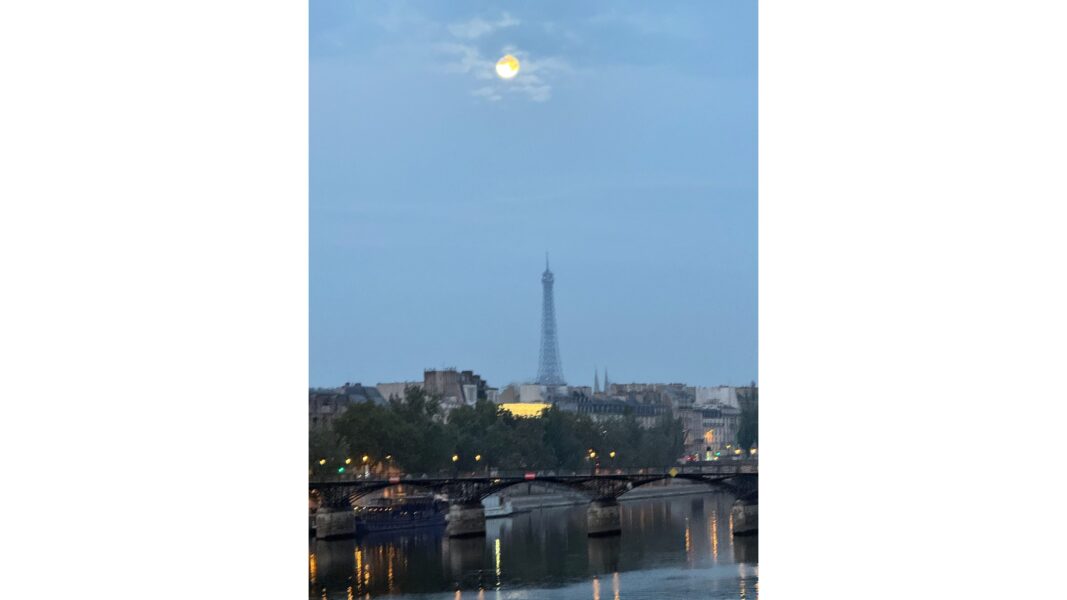
Even so, the only real difficulty this caused us was on a private boat ride along the Seine. It was a glorious Friday afternoon, and the Eiffel Tower was as dramatic as one could imagine against the bright blue sky. But just as we were about to reach Notre-Dame and the Île de la Cité, a police boat appeared and ordered us to turn back. (Nothing dramatic, mind you: just a signal that our “captain” understood.) The Pope would soon be at the cathedral.
Indeed, on the 24th, 25th, and 26th of September, many places in Paris were designated périmètres de sécurité. Guides, drivers, and others often told us: “It’s the Pope’s fault.” But that, of course, was false. He was a guest and a great blessing to Catholic France. And Paris appeared as it must have before the institution of laïcité in 1905. In principle, that means France is (and so declares the 1958 constitution) un État laïque, a secular state, though I am told it is better to say that France is neutral toward all religions.
But that is the government, and the French people seem enthusiastic about Catholicism. The papal Mass in the Place de la Concorde filled the area around the Avenue des Champs-Élysées with between 700,000 and 800,000 people. That is an impressive number, although in 1997 the closing Mass of the World Youth Day of Pope Saint John Paul II (at the Longchamp racecourse) drew more than a million.
Before, during, and after the papal visit, one saw groups of Dominican sisters, various priests of different levels of ecclesiastical dignity, and many images of the Holy Father, so that Paris seemed once again, if only briefly, the capital of the “Eldest Daughter of the Church.”
That expression has its roots in the late fifth century, when Saint Remigius baptized King Clovis. Throughout later history, France’s Catholicism went unquestioned until the French Revolution of 1789–1799, and the nation has been sliding toward ever deeper levels of secularism ever since.
That is why John Paul II, during his first papal visit to Paris in 1980, asked: “France, fille aînée de l’Église, es-tu fidèle aux promesses de ton baptême?” (“France, eldest daughter of the Church, are you faithful to the promises of your baptism?”). In 2026, it remains an important question, one I cannot answer. But in recent days, we certainly saw reasons for hope.

I took a morning for myself, partly to visit churches and partly to wander the streets that Ernest Hemingway frequented in the 1920s.
Hemingway had become a Roman Catholic but, by his own admission, was not a very good Catholic. He was, after all, part of what his friend Gertrude Stein called the “Lost Generation,” a remark made directly to Hemingway. He had become a Catholic (apparently after receiving catechetical instruction) so that he could marry Pauline Pfeiffer, a devout Catholic from Arkansas.
Here, of course, begins the “difficulty” of his Catholicism. He had previously been married in a civil ceremony, and it is unclear whether his union with Pauline was strictly canonical, according, ironically, to the Pauline Privilege (in English, Pauline Privilege).
Hemingway was a tormented person, no doubt. He would divorce Pauline and have two more wives after her. He was a distant father to his three children. He would commit suicide (as his father had), and a Catholic priest would officiate at his funeral, although that cleric, Father Robert J. Waldmann, believed (as the press had reported) that the writer’s death was an accident while Hemingway was cleaning one of his shotguns.

It is axiomatic that no one is perfect, but some are more imperfect than others. Fair enough. But Hemingway’s Catholicism was, in its way, genuine. He was devoted to the Blessed Virgin, believing that her numerous apparitions proved that Catholicism is the only true faith.
In his 1926 roman à clef, The Sun Also Rises, written when he was twenty-six, Hemingway writes:
I knelt and started to pray and prayed for everybody I had ever known, Brett and Mike and Bill and Robert Cohn and myself, and . . . and all the others, and then I prayed for myself again, and while I was praying for myself I found I was getting sleepy . . . I was kneeling with my forehead on the wood in front of me, and thinking about myself praying, I was a little ashamed, and regretted being such a rotten Catholic, but realized there was nothing I could do about it, at least for a while, and maybe never, but that anyway it was a grand religion, and I only wished I felt religious and maybe I would the next time . . .
The novel has two epigraphs: Stein’s “une génération perdue” and another from Ecclesiastes: “One generation passeth away, and another generation cometh: but the earth abideth for ever.”
I wonder: Am I a rotten Catholic? I think not, though I am a sinner, but that is not the same thing. I suppose Pope Leo would say that he is a sinner, and why not? Aren’t we all?

About the Author
Brad Miner, husband and father, is senior editor of The Catholic Thing and senior fellow at the Faith & Reason Institute. He was literary editor of National Review and had a long career in the publishing industry. His most recent book is Sons of St. Patrick, written with George J. Marlin. His best-selling The Compleat Gentleman is now available in a third revised edition and also as an Audible audiobook (read by Bob Souer). Mr. Miner has served on the board of Aid to the Church In Need USA and also on the board of the Selective Service System in Westchester County, NY.