


By Joanna Bogle
The Catholic cemetery of Mortlake, in southwest London, has a pleasant rural air and is well worth a visit: it is about 20 minutes from Waterloo, on the line that runs down toward Richmond, and a short walk from the station. It is best known for the large tent-shaped stone tomb of the nineteenth-century explorer Sir Richard Burton, which attracts numerous tourists and historians each year. Among other personalities buried here is the architect John Francis Bentley, who designed Westminster Cathedral.
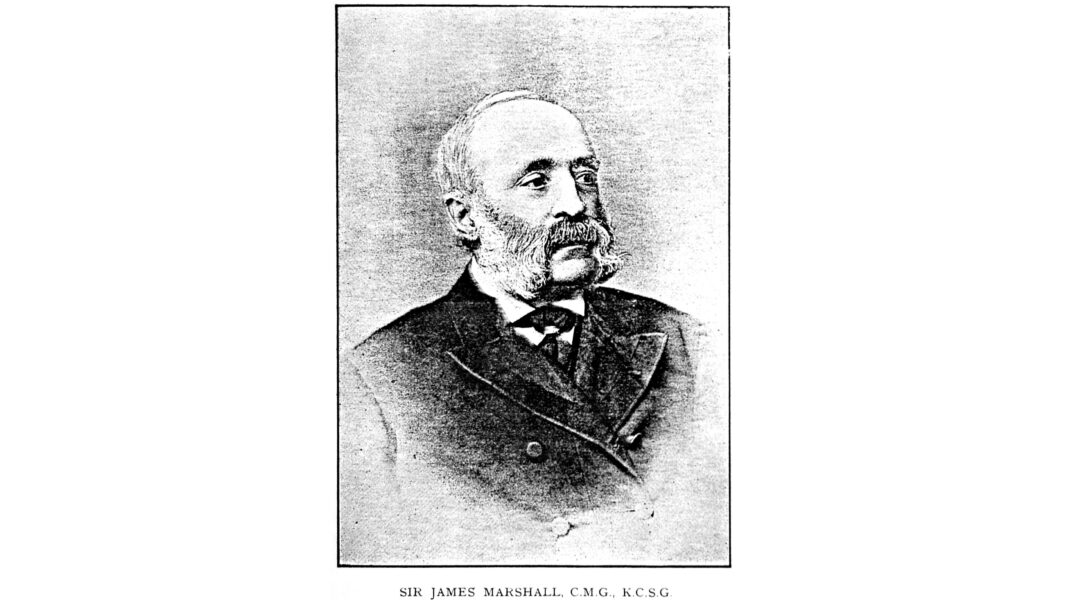
There is one grave, however, whose story has special relevance today. Sir James Marshall (1829-1889), through his voluntary work and great generosity, helped to secure Catholic missionary work in Africa. But perhaps his no less great achievement was as an official in a secular post.
Appointed Chief Justice of the Gold Coast and the neighboring territories—the present-day Ghana and Nigeria—he was responsible for ending a particularly cruel form of slavery and for freeing large numbers of men, women, and children.
Severely disabled from a young age—his right arm had to be amputated after a boating accident—Marshall had to abandon his plans to join the Army and instead followed in his father’s footsteps and was ordained in the Anglican Church. After some years of ministry and much study, he joined the Catholic Church and went on to teach classical languages at the Oratory School founded by John Henry Newman.
It was Newman who suggested he study Law, and in time he became a barrister. In 1873 he was appointed Chief Magistrate of the Gold Coast and, later, in 1887, of Nigeria. In Asaba he encountered a gruesome local custom whereby a tribal chief would acquire large numbers of slaves who, when the time came, were publicly sacrificed during a great gathering, amid a noisy ceremony. This was rooted in the belief of the tribal chiefs that the slaves would thus be at their disposal to serve them in the next life.
In Ghana, Marshall had become a respected and popular figure, able to deal with the local communities and their leaders, and his appointment to Asaba had come precisely because the issue of slavery needed to be resolved.
In a letter to his family, Marshall recounted how he had told the tribal chiefs that the savage practice of ritual killing had to end, “that the most vigorous measures would be taken to suppress it; that I would make it known among the slaves that they could count on our protection, and that, whenever a murder was known to be about to be committed, soldiers would be sent at once and the chiefs… would be liable to be hanged.”
He spoke with all the authority of the law. Not only had slavery been abolished throughout the British Empire as early as 1833, but murder itself was a crime and would be treated as such, with the severest penalty. Among the slaves awaiting slaughter, held in atrocious conditions and captured in tribal fighting, were women and small children.
Relating how he addressed the chiefs, Marshall wrote that he told them: “‘You believe that the great God, who made the white man and the black man, and the whole world, and who willed that we should all live happily together here, will keep for you those slaves whom you murder so that they may be your slaves in the other world… bah!’ Then I raised my finger before them and said: ‘You must all die, and when you die you will see who is right.’”
Backed by military force, Marshall was able to enforce the law, and those hateful practices were finally crushed. Meanwhile, in addition to his official post, he had become actively involved in the small missionary church that was being established. And, in time, it was his efforts, including a personal petition to the Pope, that brought a considerable number of missionaries to the Gold Coast.
Victorian Britain honored the men who served in the emerging colonial empire. Judges and administrators who worked to achieve the abolition of slavery were rightly regarded as champions of the noblest and best of law and Christian civilization. Meetings and rallies held in London raised funds for projects that would help free slaves and, at the same time, establish—especially through churches and volunteers—schools and hospitals in territories where new and civilized ways of life were being offered.
Today it is necessary to tell the truth about all this. Children in British schools are told a series of myths about the nineteenth century, the relationship between Britain and Africa, the role of Christianity, and other issues. (I imagine that in the United States and other Western nations things are similar.)
The Church of England is currently contributing to those myths with its attempts to rewrite history and to hand over money in “reparations for slavery” through the official bodies of several countries, while neglecting its parishes in its own country. Perhaps the story of Sir James Marshall can serve as a starting point for talking about what really happened in Victorian times. It may also be worth pointing out that the Catholic revival was a major factor in the development of much of what was achieved.
Meanwhile, in Ghana and Nigeria—and in several Catholic parishes in London with large numbers of Ghanaian and Nigerian faithful—the Knights and Dames of Marshall flourish. This admirable Catholic lay organization, founded in the 1920s, plays a prominent role in Catholic life and, among many other things, has been working toward the possible canonization of Sir James Marshall.
Each year, on the anniversary of Marshall’s death, the Knights and Dames gather in large numbers at Mortlake, where prayers are offered at his grave and flowers and wreaths are laid. And, in the meantime, daily, in London and throughout Britain, priests from Ghana and Nigeria are in charge of parishes, teaching the faith and evangelizing the country: now they are the missionaries in the country that once sent missionaries to them.

About the author
Joanna Bogle is the author of some 20 books, including several historical biographies and A Book of Feasts and Seasons, with information on the traditions and customs that mark the liturgical year. Her most recent book is John Paul II: Man of Prayer, written with her colleague Clare Anderson, which explores the spiritual life of St. John Paul the Great. She regularly appears on EWTN programs and launched the popular “Catholic History Walks” in London.