


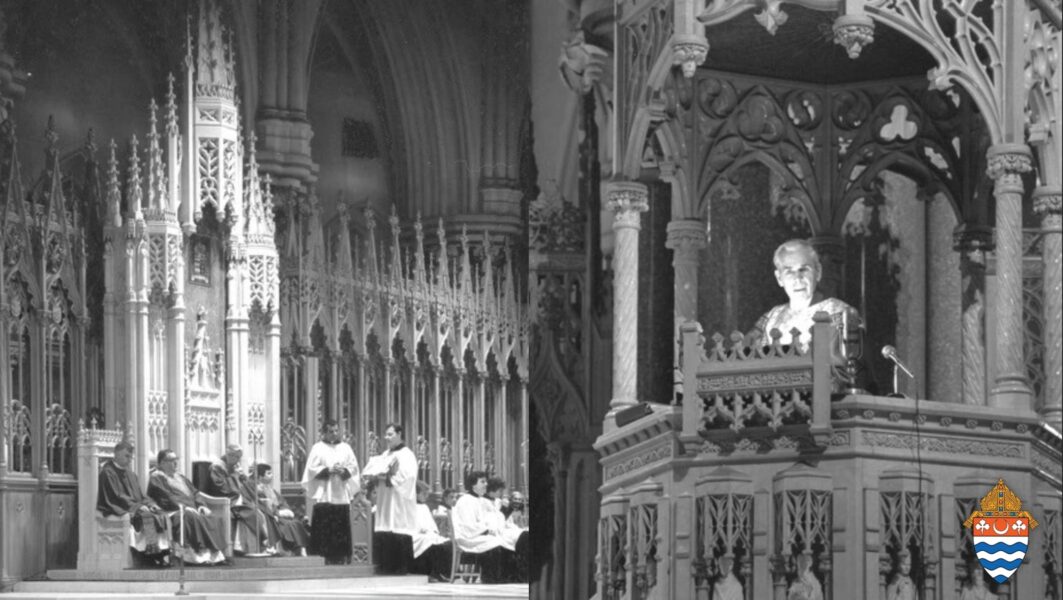
A recording made almost half a century ago has made it possible to recover a homily by Fulton Sheen in which the celebrated American preacher warned of the danger of a Church “completely given over to action,” disconnected from prayer, fasting, and the supernatural life. Faced with that extreme, Sheen did not propose a Church shut away in contemplation either: his answer was to begin in Christ and then go out into the world.
The recording corresponds to a Mass celebrated by Sheen on March 6, 1977, the Second Sunday of Lent, at the Cathedral of the Sacred Heart in Newark, New Jersey. According to Jersey Catholic, the man who recorded that celebration kept the audio for decades and recently delivered a digital copy to the current rector of the cathedral, Father Matthew Gonzalez.
The discovery coincides with the beatification of Fulton Sheen, celebrated last September 24 in St. Louis. Newark Cathedral has also recovered photographs and documentation of that visit and has located the chasuble Sheen used during the celebration, now displayed as a second-class relic of the new blessed.
But the interest of the recording is not merely historical. Heard almost fifty years later, the preaching contains a diagnosis of the post-Conciliar Church that retains a striking relevance.
“The Church is to some extent divided”
Sheen was then 81 years old and lived in retirement in New York. He had come to Newark at the invitation of Archbishop Peter Leo Gerety, who even allowed him to occupy the cathedra during the celebration.
The preacher took the opportunity to joke: “I am in no way occupying your place. It simply is too big for me.”
But he soon changed his tone.
Sheen explained that he traveled between 10,000 and 15,000 miles a month and that this constant contact with U.S. dioceses allowed him to observe the situation of the Church throughout the country.
“In my travels, it seems as though the Church is to some extent divided. Great changes have taken place,” he stated.
His diagnosis was not simply the existence of “traditionalists” and “progressives.” Sheen observed a much deeper shift.
“Thirty or forty years ago, almost all the emphasis of the Church was placed on individual sanctification. Today it is placed on social development,” he explained.
And he saw, alongside that correction of old imbalances, a new extreme emerging: “There has arisen the feeling that, if one is socially and politically concerned about the world, one’s individual sins do not matter.”
Sheen carried the warning even to the reception of the Eucharist itself.
“That is one of the reasons why today we find that those who receive Communion are not always prepared for Holy Communion: they think that their individual sins are of little importance as long as they are concerned about the social,” he asserted.
On one side he placed those who understood the Church fundamentally as a call to the spirit and to personal sanctification. On the other, those who conceived it above all as a call to action, to development, and to social improvement.
“The two are not meeting.”
For Sheen, the problem was not the Church’s concern for justice, human dignity, or temporal needs, but in turning that action into a substitute for personal sanctification. A Church turned toward the world, but disconnected from prayer and from the awareness of sin, ended up losing precisely what it could offer the world.
A “vertical” Church and a “horizontal” one
Sheen summarized that fracture with two images.
“On the one hand there is the vertical Church, which says that the task of the Church consists simply in having a vertical relationship with God. On the other there is the horizontal Church, which holds that our only task is in this world.”
The answer, he maintained, was found in the Gospel of the Transfiguration and, especially, in what happens immediately afterward.
On the mountain, Peter contemplates the glory of Christ and wants to remain there: “Lord, let us stay here. Why ever come down from this mountain?”
Sheen saw in Peter the image of “the Church of the mountain”: “the spiritual Church, the Church of contemplation, the Church of ecstasy, the Church of vision.”
But Christ does not accept the proposal.
“Our blessed Lord did not answer Peter, but led him from the mountain down into the valley.”
Below were disease, need, poverty, and “a weakened humanity.” There a desperate father waited with his tormented son.
The other nine apostles had remained in the valley and had not been able to cast out the demon.
For Sheen, they represented the opposite extreme.
“You are completely given over to action”
Those nine apostles symbolized “the Church of the valley,” dedicated to “social development, political improvement, human rights, and dignity.”
But they had failed.
When they asked Christ why they had not been able to free the boy, Sheen reconstructed the answer thus: “Because you have no faith. This kind can be cast out only by prayer and fasting.”
And he added an especially incisive interpretation:
“You are completely given over to action. There is no vertical communication with God, nor is there, through fasting, that separation of the spirit from the world.”
From this he drew the central diagnosis of his homily.
“Thus we have two parts of the Church that have failed: the Church that wanted to remain on the mountain and the Church that remained in the valley without prayer or fasting and without the inspiration of Christ.”
And it was then that he used the categories that almost half a century later still form part of the ecclesial debate:
“These two extremes that we find in the Church, the so-called traditionalists and the so-called progressives, are both imperfect.”
Sheen was not establishing a doctrinal equivalence between tradition and progressivism. The comparison he develops immediately afterward allows his argument to be clarified: what he considers incomplete is separating contemplation from apostolate, remaining on the mountain without descending into the world, or attempting to transform the valley after having lost the relationship with God.
“If there is no mountain, there will never be vision”
The formula with which he explained that relationship constitutes one of the most accomplished passages of the recovered homily:
“If there is no mountain in our lives, there will never be vision. If there is only the valley of work without vision, there will only be monotony. Our blessed Lord wanted His Church to have both.”
Christ Himself offered, according to Sheen, the synthesis.
“What was the first word of Our Lord’s public life? Come. Come to me. Learn from me. Love me. Receive the sparks of my fire. And what were the last words of Our Lord’s public life? Go. Go into the world.”
The order was not accidental:
“First we come to Him; then we go.”
For Sheen, the problem began when the Church multiplied the “comes” while forgetting the sending, or multiplied the “goes” without having first gone to Christ.
“If you are divided, if you are among those who cling to the mountain or among those who cling to the valley, remember that you have an incomplete Christ, an incomplete Church.”
Mother Teresa, the mountain and the valley
Sheen found a concrete example of that union in Mother Teresa of Calcutta, still alive when he delivered the homily.
He recalled an interview in which she was asked how she could dedicate herself to gathering thousands of the dying, the sick, and the abandoned from the streets of Calcutta.
The religious sister’s answer was simple: “I receive Communion every morning and make a Holy Hour. And I discover that the people I touch during the day are an extension of the Body of Christ.”
For Sheen, that was the lesson.
“She unites the mountain and the valley. The call to the spirit and the call to action. But we begin with the mountain. Then we go to the valley.”
It was not, therefore, a matter of choosing between prayer and works, contemplation and apostolate, personal sanctification and charity toward one’s neighbor.
There was an order.
First Christ. Then, the world.
A warning recovered almost fifty years later
The recording remained out of the public’s reach for decades. Its recovery led Father Gonzalez to investigate the archdiocesan archives, where he found photographs and documentation of the celebration, as well as locating the chasuble Sheen had used that day.
“I felt as though I were listening to something sacred, almost as if a moment from our past had suddenly come back to life,” the rector explained when recalling his first hearing of the audio.
Almost fifty years later, some of Sheen’s words are difficult to reduce to a mere archival curiosity.
A Church absorbed by social action to the point of relativizing personal sin; another tempted to shut itself away in contemplation without descending to those who need Christ; apostles unable to act because they have abandoned prayer and fasting.
Faced with both extremes, Sheen proposed the same movement he found in the Gospel: to ascend the mountain to encounter Christ and then descend into the valley carrying with him what he has received.
The final sentence of that preaching condensed the entire idea:
“We begin with Him, our beginning and our end. God love you.”
Complete Homily of Fulton Sheen at Newark Cathedral
March 6, 1977
Your Excellency, Most Reverend Archbishop, and dear friends in Christ:
I accept your applause at the beginning as an expression of faith. If there is any during the talk, it will be hope; and at the end, certainly, charity.
Your good archbishop has permitted me to sit in his throne and use his cathedra. I am in no way occupying his place. It simply is too big for me.
Yesterday morning, at this very hour, I was preaching in Los Angeles, California. I tell you this because, traveling as I do between 10,000 and 15,000 miles a month, I can observe the Church throughout the entire country.
And in my travels it seems as though the Church is to some extent divided. Great changes have taken place.
For example, thirty or forty years ago, almost all the emphasis of the Church was placed on individual sanctification. Today it is placed on social development.
Thirty or forty years ago, practically no priest ever heard in confession a sin against social justice. I wonder, for example, if any priest ever heard in those days a penitent confess to paying an insufficient wage to an employee. I think not.
Today, with the emphasis on the social, the other extreme has arisen: the feeling that, if one is socially and politically concerned about the world, one’s individual sins do not matter.
That is one of the reasons why today we find that those who receive Communion are not always prepared for Holy Communion: they think that their individual sins are of little importance as long as they are concerned about the social.
So a kind of division has taken place.
On one side are those who want to belong to the Church of ecstasy: the call to the Spirit, the call to personal sanctification. On the other are those who consider that they have been called to action, to development, to social improvement.
The two are not meeting.
On the one hand there is the vertical Church, which says that the task of the Church consists simply in maintaining a vertical relationship with God. On the other there is the horizontal Church, which holds that our only task is in this world.
I would like to suggest to you that in today’s Gospel we have the answer to this division.
Not only in what has been read, but in this Gospel of Luke. The Church today reads only a part of chapter 9. Immediately after what has been read appears the description of the other Church, what occurred immediately after the Transfiguration, when Our Blessed Lord came down from the mountain.
I am going to describe both Churches to you.
The first Church is the one that appears in the Gospel we have heard. Our Blessed Lord had just been in Caesarea Philippi, where Peter made the confession: “You are the Christ, the Son of the living God.”
From there He went to the mountain and took with Him Peter, James, and John: the three whom He would later take with Him to the garden, the three who were present at the resurrection of Jairus’s daughter.
When He ascends to the top of the mountain, He is transfigured. That is, His body begins to shine like the sun and His garments become white as snow.
I wonder if this would not really have been the “natural” state of Our Lord. And I put “natural” in quotation marks: the natural state of Our Lord.
If, for example, you introduce an electric light inside an alabaster vase—if it is expensive, it is a vase; if it is cheap, it is also a vase—if you introduce an electric light inside an alabaster vase, it will shine. It becomes iridescent.
Place innocence inside a child and it will shine through the child.
Place divinity inside humanity and it is transfigured.
I wonder if Our Blessed Lord, during His public life, did not have constantly to restrain the manifestation of His divinity.
Now He allows it to appear.
And Moses and Elijah appear with Him.
Elijah never died. He was taken up to heaven. And this is probably also true of Moses, because Scripture tells us that Moses went up the mountain and no one knows the place of his burial. It must be so, because now both Moses and Elijah appear glorious.
What do Moses, Elijah, Our Lord, and the heavenly Father speak about?
The Gospel we have heard speaks of departure or liberation. The Greek word used is exodus.
They speak of the death of Our Lord.
Of death under the image of the Exodus.
Just as the Israelites left Egypt, crossed the desert, and arrived at the Promised Land, so too Our Blessed Lord would have His exodus.
He would bring us out of the Egypt of sin, cross Himself the desert of Calvary, and arrive afterward at the glory of the Resurrection.
When Peter beheld all that glory, he said: “Oh, how good it is for us to be here.”
In other words: “Lord, let us stay here. Why ever come down from this mountain? Here we are in all this glory and we are contemplating that in which Moses and Elijah now live, having passed from death to life.”
“Let us build here three tents: one for You, another for Moses, and another for Elijah.”
In other words, Peter became the symbol of the Church of the mountain.
The spiritual Church, the Church of contemplation, the Church of ecstasy, the Church of vision.
This is the role of the Church. Why bother to leave it for the world?
And the Gospel says of Peter that he did not know what he was saying.
Why did he not know what he was saying?
Now we come to the other half of Luke’s Gospel, which has not been read.
Our Blessed Lord did not answer Peter, but led him from the mountain down into the valley.
And those of you who have been in Rome have seen Raphael’s masterpiece, in which Christ is seen simultaneously on the mountain and, below, in the valley, the anguished father with his demon-possessed son.
While Peter was saying: “Let us simply lead a spiritual life,” Our Lord is saying: “No.”
Below there is disease. There is need. There is poverty. There is a weakened humanity.
So Peter leaves the mountain.
He descends into the valley and there finds a father who has a grave need and a son whose need is even greater.
When Our Blessed Lord descended into the valley with His apostles, there was another part of the Church.
Peter, James, and John had been with the Church of exaltation; the other nine were with the Church of the valley.
They were in the realm of social development, of political improvement, of human rights, and of dignity.
And that Church—because they were the nine apostles—curiously, was unable to cast out the demon from the young man.
The father, representing humanity, said to the Lord: “I asked your apostles to cast out the demon and they could not.”
And Our Lord said: “O faithless and unbelieving generation! How long must I bear with you?”
And Our Lord cast out the demon from the young man.
Then the apostles asked Our Lord: “Why could we not cast it out? Where is our failure? We are concerned about humanity.”
And Our Blessed Lord says: “Because you have no faith. This kind can be cast out only by prayer and fasting.”
You are completely given over to action.
There is no vertical communication with God and there is not, through fasting, that horizontal separation from the spirit of the world.
And so we have two parts of the Church that have failed.
The Church that wanted to remain on the mountain and the Church that remained in the valley without prayer or fasting and without the inspiration of Christ.
These two extremes that we find in the Church, the so-called traditionalists and the so-called progressives, are both imperfect.
They are like those who are on the mountain and those who are in the valley.
The Gospel suggests, therefore, that if we truly wish to influence society, we must begin with ecstasy. Then we will be prepared for the valley.
If there is no mountain in our lives, there will never be vision.
If there is only the valley of work without vision, there will only be monotony.
Our Blessed Lord wanted His Church to have both.
What was the first word of Our Lord’s public life?
“Come.”
Come to me. Learn from me. Love me. Receive the sparks of my fire.
And what were the last words of Our Lord’s public life?
“Go.”
Go into the world.
First we come to Him; then we go.
That is why we tend to have, in some eras, too many “come, come” and, in others, too many “go, go,” and we do not remain sufficiently united.
So, if you are divided, if you are among those who cling to the mountain or among those who cling to the valley, remember that you have an incomplete Christ, an incomplete Church.
See how wonderfully Mother Teresa unites both things.
I heard her in an interview in New York about a year ago.
The interviewer said to her:
“Mother Teresa, you have gathered from the streets of Calcutta 25,000 of the dying. They were poor, emaciated, dirty, and sick. How could you give yourself to that work? It must be very difficult to work with their bodies.”
Mother Teresa replied:
“I never thought of that. I receive Communion every morning and make a Holy Hour. And I discover that the people I touch during the day are an extension of the Body of Christ.”
When she arrived at her house in New York, at the new house to which her community had recently moved, she found garbage, dirt, papers, and rags in the street.
She took a broom and began to sweep the street.
And the women who were on the other side, those who lived in the apartments and threw garbage into the street, took their brooms, came down, and swept the street until it was clean.
She has become a lesson for the modern world.
She unites the mountain and the valley.
The call to the spirit and the call to action.
But we begin with the mountain.
Then we go to the valley.
During the days of the Crusades, Robert Bruce, king of Scotland, had desired to go to the land sanctified by the feet of Our Lord. He fell ill and could not go.
He then called his friend, Lord Douglas, and said to him:
“Douglas, when I die, remove my heart and take it with you to the Crusades so that it may rest in the land of our Savior.”
Douglas placed Robert Bruce’s heart in a silver chest and carried it with him toward the Holy Land.
Lord Douglas was fighting against the Moors and was losing the battle.
Then, remembering the heart of Bruce that he carried with him, he turned to his soldiers and, lifting that heart, said to them:
“Where the heart of Robert Bruce used to go, go you.”
And he threw Bruce’s heart among the enemy.
The soldiers, eager to recover the heart of their king, rushed after it and won the day.
And so it is that we begin: with Christ.
And then we go into the world.
That is why your dear archbishop, uniting both things, has as his motto: In omnibus, in all things, Christ.
We begin with Him, our beginning and our end.
God love you.