


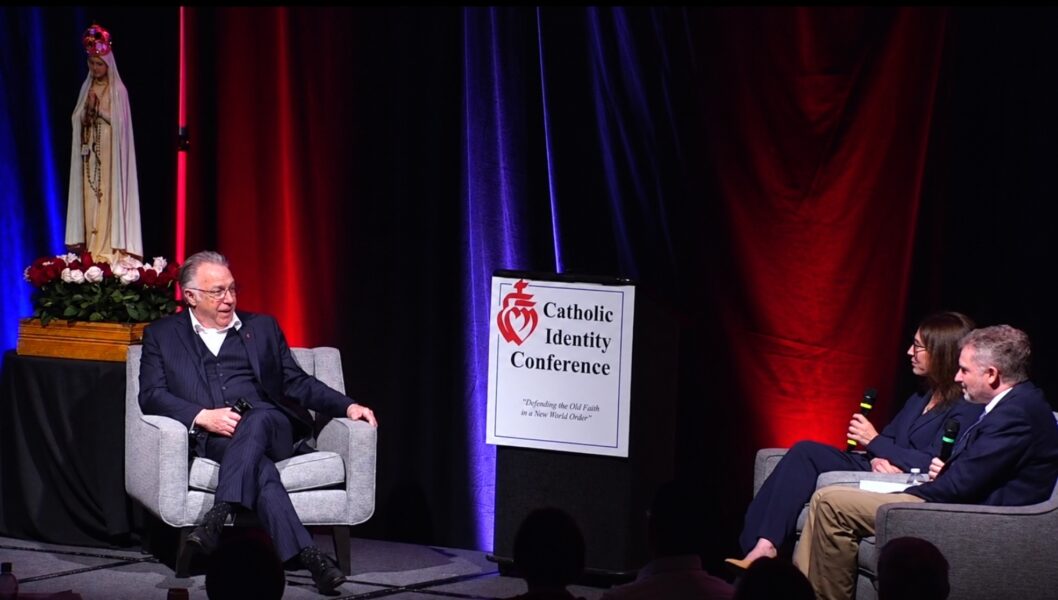
The Catholic Identity Conference held its 2026 edition from Friday, October 2 to Sunday, October 4 at the DoubleTree Hotel in Green Tree, on the outskirts of Pittsburgh (Pennsylvania), according to the official program. It is organized by The Remnant, a traditionalist weekly founded in 1967 by Walter Matt and directed since 1994 by his son Michael J. Matt, co-founder of the congress and master of ceremonies. Sessions are broadcast live via subscription and videos are made available for sale afterward, making the event the most followed in North American traditionalism outside the United States.
The congress coincided with a delicate moment for the traditional Mass in the host diocese. As InfoVaticana reported in August, Bishop Mark Eckman decided not to request renewal from Rome of the permission to celebrate the ancient rite at St. Titus Church in Aliquippa, whose last Mass took place on September 4. Since then, the only traditional celebration in the diocese has been at the personal parish of Most Precious Blood of Jesus, served by the Institute of Christ the King Sovereign Priest.
The Program
The cycle of lectures opened on Friday with Peter Kwasniewski, philosopher and liturgist, presenting “The Traditional Mass: What Truly Unites All the Clans,” in reference to the motto with which Matt has presented the congress for years, “uniting the clans”: bringing together in the same room diocesan traditionalists, faithful of the Ecclesia Dei institutes, and the Society of St. Pius X, represented this year by James Vogel, communications director of its U.S. district.
Saturday featured the main names. At 9:30, Vaticanist Edward Pentin moderated a panel on “The Vatican of Leo and the African Missionaries of the Traditional Mass,” with the participation of Fr. João Silveira. At 14:00, Bishop Robert Mutsaerts, auxiliary bishop of ’s-Hertogenbosch (Netherlands), spoke on “The Catholic Response to a (Synodal) Church in Crisis.” At 15:30, Eduard Habsburg-Lothringen, Hungary’s ambassador to the Holy See, spoke on “The Traditional Mass and the Last Catholic Emperor,” dedicated to Blessed Charles of Austria. The keynote address, at 19:30, was delivered by Bishop Athanasius Schneider, auxiliary bishop of Astana (Kazakhstan), under the title “The Victory of Christ over the Hostile Takeover within the Church,” an expression that Cardinal Gerhard Müller once applied to the Synod on Synodality.
The lineup was completed by Vaticanist Diane Montagna, pro-life activist Abby Johnson, historian John Rao, Jacob Imam, president of the College of St. Joseph the Worker, Sr. Mary Anne of the Slaves of the Immaculate Heart of Mary, David Sonnier, and Capuchin Bishop Donald Lippert, missionary in Papua New Guinea. Joseph Strickland, bishop emeritus of Tyler and present at the previous edition, was not among the speakers this year.
Mutsaerts, from the Letter to Leo XIV to the Pittsburgh Podium
Mutsaerts’s intervention was the most anticipated given the context. In August he addressed an open letter to Leo XIV in which he calls for Christ, conversion, the Eucharist, evangelization, and the salvation of souls to return to the center of the Church’s life, and asks whether the synodal process has in fact brought anyone closer to Christ. In it he recalls that Jesus’ preaching began with “repent and believe in the Good News” and not with a consultation on ecclesial structures.
He is also a bishop who has returned to the podium after a traffic accident suffered in May, when returning from hearing confessions, with a dislocated hip, pelvic fracture, and broken elbow.
At the 2025 edition, in this same hall, Mutsaerts maintained that beneath the political and economic crises of the time lies another spiritual one that the modern world has neglected, that the human thirst for meaning persists even when Christ is rejected, and that neither blind faith in the market nor the cult of science nor esoteric experiences can replace Him. He summarized the thesis in a phrase: “Where Christ is not king, chaos reigns.” The Remnant presented it as one of the best-received speeches of the congress, with a standing ovation of more than three minutes.
Schneider and the 2025 Act of Reparation
Schneider is the only speaker who has participated in every edition since the congress gained international projection. In his 2025 lecture, delivered on October 4, he stated that the first commandment is rejected today even within the hierarchy and urged the faithful not to offer incense to contemporary idols, among which he cited political correctness, “Mother Earth,” icebergs, and LGBT ideology, adding that a Catholic cannot participate even indirectly in another religious cult.
That edition included a public act of reparation for the pilgrimage of LGBT groups to St. Peter’s Basilica during the Jubilee, presided over by Schneider, Mutsaerts, Strickland, and Marian Eleganti, bishop emeritus auxiliary of Chur, followed by the recitation of the rosary.
A Congress without Diocesan Endorsement
The Diocese of Pittsburgh has never endorsed the event. In 2022 it made clear that it did not encourage Catholics to attend, when the program announced “articles of resistance” against the pontificate of Francis and the agenda of the “Great Reset.” The congress has since maintained the same format and the same hotel, with capacity sold out in recent editions; in 2021 it exceeded 700 attendees.
Michael Matt set the tone with which the organization views the new pontificate in one of his recent broadcasts, in which he reviews the trajectory of Cardinals Suenens, Bea, and Danneels, of Helder Câmara, and of the Pact of the Catacombs up to the conciliar documents that, in his view, Leo XIV is reactivating. The 2026 edition was therefore held in a spirit of observation: the traditionalist movement has not yet passed judgment on Pope Prevost and is waiting to see what he does with Traditionis custodes.