


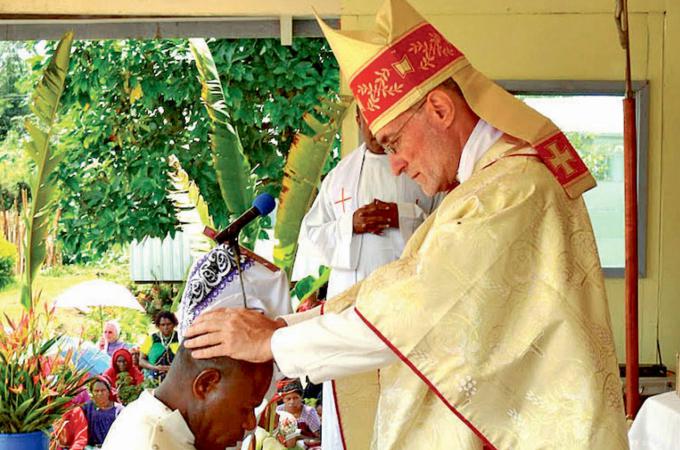
The bishop of Mendi, in Papua New Guinea, Bishop Donald Francis Lippert, has expressed his desire for the traditional Mass to become an option for the faithful of his diocese, after personally experiencing what he describes as “a kind of conversion” toward the traditional Roman liturgy over the past year.
In an interview given to AdVaticanum, the American Capuchin explains that he does not intend to pit the two uses of the Roman rite against each other and stresses that he regularly celebrates the Novus Ordo, but believes the traditional liturgy has a particular capacity to convey a sense of the sacred. “I hope and pray that the Church will open up that possibility,” he says when addressing his desire to introduce it more regularly in Mendi.
“I have come to see the beauty and power of the traditional Mass”
Lippert recounts that his approach to the traditional Roman rite has occurred only recently.
“Over the past year or so, I myself have had a kind of conversion to the traditional Latin Mass,” he explains. The bishop notes that he continues to live primarily within the Novus Ordo, “because that is the reality in which I live and the Church to which I have been called to serve at this time,” but he claims to have discovered “the beauty and power of the traditional Mass” in his own spiritual life.
The prelate insists that he does not question the validity of the ordinary form: “I have no problem with the Novus Ordo. I celebrate it every day.” His interest in the traditional liturgy focuses especially on the reverence it conveys, in his view.
“Celebrated well, the traditional Latin Mass has a mysticism and a reverence that can touch people’s hearts and draw them closer to God in a world where there are so many distractions that pull them away from Him,” he maintains.
This concern is not new in Lippert’s pastoral governance. In 2025 he officially proclaimed a Year of Reverence in the diocese of Mendi, from the solemnity of the Sacred Heart of Jesus that year until Corpus Christi 2026, with the aim of restoring adoration, holiness, and a sense of the sacred among the faithful. The initiative was published by the Episcopal Conference of Papua New Guinea and the Solomon Islands themselves.
A Solemn Mass in Mendi
In that context, Lippert wanted his faithful to experience a solemn Mass according to the traditional Roman rite. The experience also had a historical dimension for him: he recalled that it was precisely the ancient Roman liturgy that the first Catholics in the region encountered during the evangelization of Papua New Guinea in the mid-twentieth century.
“It was the traditional Latin Mass—though it wasn’t called that then—that really evangelized Papua New Guinea in the mid-1950s,” he notes.
The bishop recalls that some of the older faithful recognized the liturgy of their childhood. “They came to see me afterward and recited some of the responses they remembered from when they were children.”
The diocese later also offered the faithful the celebration of the Holy Qurbana according to the Syro-Malabar tradition, taking advantage of the presence of priests and religious of this Eastern rite. According to Lippert, both experiences allowed local Catholics to perceive reverence before the sacred from different liturgical traditions of the Church.
“I want to do what I can to strengthen this appreciation of reverential fear before what is holy, before God, because being so casual and informal is, I believe, devastating to people’s spiritual lives. I also believe it is an offense to God,” he says.
“I believe our people would welcome it”
The bishop believes the traditional liturgy can be especially understandable to a society that retains a strong sense of the sacred and of symbols.
Contrary to the idea that the ancient Roman rite can only appeal to educated Western circles, Lippert maintains that it may even be “more acceptable and more powerful for our simple people, who understand symbols and understand the mystical world better than many Westerners.”
“I think people would welcome it if the Church gave them the opportunity to do so, perhaps alongside the Novus Ordo,” he explains.
Lippert clarifies, however, that there is currently no regular celebration of the traditional Mass either in the cathedral or anywhere else in the diocese and presents his project as a long-term possibility.
“What I would like to do is make it an option in the diocese,” he says. The prelate states that he has spoken about these matters with priests and seminarians, though not yet formally, and rules out wanting to provoke liturgical confrontations.
“It would have to be something natural and respectful. From my own experience, and considering what it has meant for me, I would like to be able to share it more widely with the diocese,” he explains.
He acknowledges, however, the limits currently imposed by Church discipline: “It seems that, at this time, that is not a possibility, but I hope and pray that at some point it will be more so.”
From Pittsburgh to the missions of Papua New Guinea
Donald Francis Lippert was born in Pittsburgh in 1957 and belongs to the Capuchin Franciscans. He arrived as a missionary in Papua New Guinea in 2007, where he initially devoted himself to the formation of young Capuchins and to teaching Philosophy.
Benedict XVI appointed him bishop of Mendi on November 22, 2011. Prior to his appointment, he had held various responsibilities for formation and governance within the Capuchins and was a counselor of the vice-province of the order in Papua New Guinea.
In the same interview, Lippert also addresses evangelization, the missionary crisis in the West, and synodality. On the latter issue, he warns against models that, in his view, exceed legitimate ecclesial consultation. Referring to the examples he does not want for the Catholic Church, he sums up his concern in “two words”: “Anglicanism and Germany.”
“Germany is going off the rails. I don’t want that for the Catholic Church. I don’t want that for Mendi. I don’t want that for the universal Church,” he says, before warning that following those paths “would be disastrous for the universal Church.”