


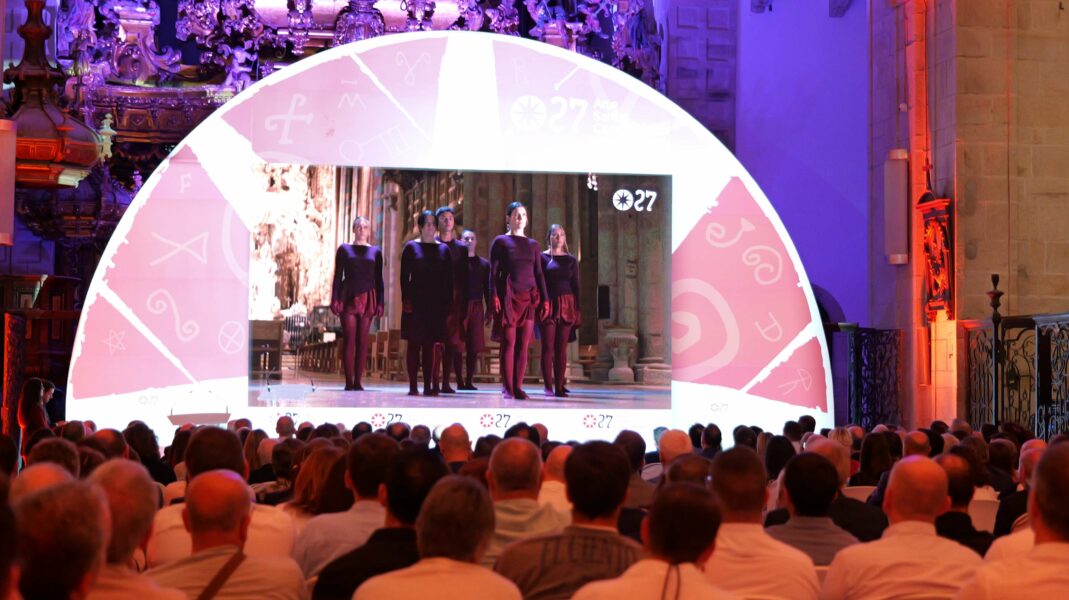
The Archdiocese of Santiago de Compostela has presented the image and soundtrack of the Compostela Holy Year 2027 with a proposal that combines explicitly Christian and Jacobean references with the codes of a contemporary audiovisual production. Among the images in the music video for Un campo cheo de estrelas, several sequences stand out featuring dancers performing a choreography inside the Cathedral.
The proposal was officially presented by the Archdiocese itself on September 24 at the monastery of San Martín Pinario, during an event presided over by the archbishop, Mons. Francisco José Prieto Fernández. The motto chosen for the Jubilee comes from the Gospel of Saint Matthew: “When they saw the star, they were filled with immense joy” (Mt 2:10). Prieto presented it as an invitation to live the Holy Year as a time of encounter with Christ, forgiveness, hope, and welcome for pilgrims.
We are not dealing with a secular music video to which the Cathedral has been lent. Nor are these images comparable in content to other productions that have used Spanish churches as settings. It is the Archdiocese itself that has commissioned and disseminated a piece with a pastoral purpose, deliberately adopting the language of the contemporary music video.
Precisely for this reason, it is worth raising a question that goes beyond a one-off controversy: Does a Cathedral need to become a choreographic stage in order to communicate the Gospel in a contemporary language?
A pop-folk hymn for the internet and pastoral gatherings
Un campo cheo de estrelas is a composition by Galician musician Carlos Martínez Movilla, presented through an audiovisual production by Hugh McGinley. The Archdiocese unveiled it alongside the new visual identity of the Holy Year.
The diocesan information distinguishes two musical proposals. Óscar Valado, director of the Diocese’s Music Department and coordinator of the Jubilee’s musical works, explained that one will be specifically intended for liturgical use, composed for choir and organ, and is scheduled to premiere in December, possibly during the opening of the Holy Door.
The other, in a pop-folk style, is conceived for promoting the Holy Year “in the digital environment or pastoral gatherings.” It is available in Galician and Spanish, and the music video will also be offered with and without subtitles.
Dancing inside the Cathedral
The music video combines images linked to the Camino with sequences filmed inside the church. In them, several dancers perform a choreography using different spaces of the Cathedral as the setting for the production.
The content accompanying the images is, however, explicitly Christian. According to the Archdiocese’s own explanation, the lyrics and the music video present the apostle James as “guide and intercessor to reach Christ.” Óscar Valado noted that this connection constitutes “one of the central messages of the hymn.”
The second audiovisual piece presented during the event also makes use of the interior of the Cathedral. A long red cape crosses the church, leaving a trail that draws a path. The image establishes a parallel between the star that led the Magi to Bethlehem and the one that guides pilgrims to Compostela.
The graphic identity also draws on elements from the church itself. The eight-pointed star comes from the mechanism of the Botafumeiro; the number 27 reinterprets the marks left by stonemasons on the Cathedral’s stones, and the Santa Compostela typeface takes references from cathedral manuscripts, medieval marks, and wrought iron.
A cathedral is not a film set
The Church does not prohibit any artistic activity within its churches. Music and the arts have found in churches one of their great places of development throughout Christian history. But a consecrated church cannot be treated like any other monumental building.
Canon 1210 of the Code of Canon Law establishes that “only what serves the exercise and promotion of worship, piety, and religion may be admitted in a sacred place,” and prohibits anything not in keeping with the holiness of the place. The Ordinary may permit other specific uses provided they are not contrary to its sacred character.
The question is not resolved, therefore, by simply asking whether dancing is good or bad. Nor can it be claimed that a production is improper merely for using contemporary language.
The criterion is more demanding: whether what happens inside the church fosters worship, piety, or religion or, at least, truly remains in keeping with the holiness of the place.
In Santiago, the responsible ecclesiastical authority has evidently considered that this production meets that criterion. That does not prevent questioning the advisability of turning the interior of one of the great shrines of Christendom into the stage for a choreographed production.
The shadow of C. Tangana and Toledo Cathedral
The images inevitably recall the precedent of Toledo Cathedral, although equating the content of both productions would be unfair.
In October 2021, C. Tangana and Nathy Peluso released Ateo, a music video partially filmed inside the Primatial Cathedral that included scenes of marked sensuality. The authorization of the shoot provoked a strong reaction among the faithful.
The Archbishop of Toledo, Mons. Francisco Cerro Chaves, publicly lamented what had happened and apologized to those who felt “justly wounded” by the use made of the church. He later presided over a penitential act. The then-dean, Juan Miguel Ferrer, who had authorized and defended the filming, eventually submitted his resignation.
The controversy revealed that Toledo Cathedral had served months earlier as the setting for another music video, Cuando sale la luna, by María Toledo. Its content was radically different and much more respectful than that of Ateo, but the case raised a question that did not depend on the provocation of C. Tangana’s video: “Is it appropriate to turn it into a film set, however good the intentions […] of the applicants may be?”
Five years later, Santiago presents a different and more difficult variant to resolve with an immediate answer. There is no sexual provocation, anticlericalism, or irreverent use of Christian symbols. There is a production driven by the Church itself that seeks to evangelize and that speaks explicitly of Christ.
But there are also cameras, set design, and dancers performing inside a Cathedral.
Prieto calls for preventing the Camino from becoming a product
The best criterion for analyzing the audiovisual choice may not lie in the initial reactions on social media, but in the very words spoken by the Archbishop of Santiago during the presentation.
Mons. Prieto called for preserving “the Christian origin, the spiritual horizon, and the apostolic goal of the pilgrimage” against the risk of reducing the Camino to a tourist product or a succession of experiences.
The archbishop presented the Holy Year as a great evangelizing opportunity and warned that its fruitfulness will not depend mainly on the number of events organized, but on the communities’ ability to show the face of Christ and make the Gospel visible.
When specifying how to do this, he spoke of unhurried conversation, “a church open to silence,” “a carefully prepared liturgical celebration,” a priest available for reconciliation, and a volunteer who discreetly helps the pilgrim.
Daniel Lorenzo, director of the Cathedral Foundation, emphasized the same idea during the presentation. The content of the Jubilee, he explained, cannot be reduced to an advertising campaign, because its deepest meaning lies in proclamation and witness.
A message that seems to contradict what the images and choreography chosen to “promote” this holy year offer.
Read also: Santiago de Compostela invites Leo XIV for the Holy Year 2027