


Pope Leo XIV has pointed to the recovery of the «true missionary spirit» as a response to the deep decline facing the Catholic Church in Germany. During the press conference held this Monday, September 28, aboard the return flight from France, the Pontiff expressed his conviction that there are still «a great many people» in the country willing to live the Catholic faith and cited as an example what occurred in France during the four days of his trip.
The question was raised by Ludwig Ring-Eifel of the German Catholic agency KNA, who asked the Pope about the loss of faithful experienced by the German Church and the growth of far-right movements in the country. Leo XIV addressed both issues and also confirmed that he has received an invitation to visit Germany, although no date has yet been set.
«There are still a great many people in Germany who want to live their faith»
Faced with the description of a German Church in retreat, Leo XIV drew precisely on the experience he had just lived in France.
«In the past, the same was said of France, and yet we have seen what has happened in the last four days,» he replied.
The Pontiff pointed directly to evangelization as the response to the crisis: «I believe that if we recover the true missionary spirit and the right way of acting, there are still a great many people in Germany who want to live and celebrate their Christian and Catholic faith.»
The observation comes at a particularly delicate moment for German Catholicism, marked for years by the loss of faithful, the collapse of religious practice, and a synodal process that has led to successive disagreements with Rome.
Leo XIV did not ignore that reality. He acknowledged «the problems» and «the various causes that have severely affected the Church,» although he noted that the phenomenon also reaches Protestant communities and German society.
Despite this, he stated: «I am optimistic about it.»
The Pope also expressed his willingness to work with the leaders of the German Church to find responses to a crisis for which his proposal, at least in this intervention, did not involve new structures, but rather recovering the missionary impulse.
France, the contrast highlighted by Leo XIV
The Pope’s reference to France is especially significant after a trip in which he was able to witness manifestations of Catholic vitality difficult to reconcile with a reading based exclusively on the advance of secularization.
On the plane, Leo XIV himself highlighted the meeting with some 80,000 young people and spoke of their «enthusiasm,» «joy,» and «sense of hope.»
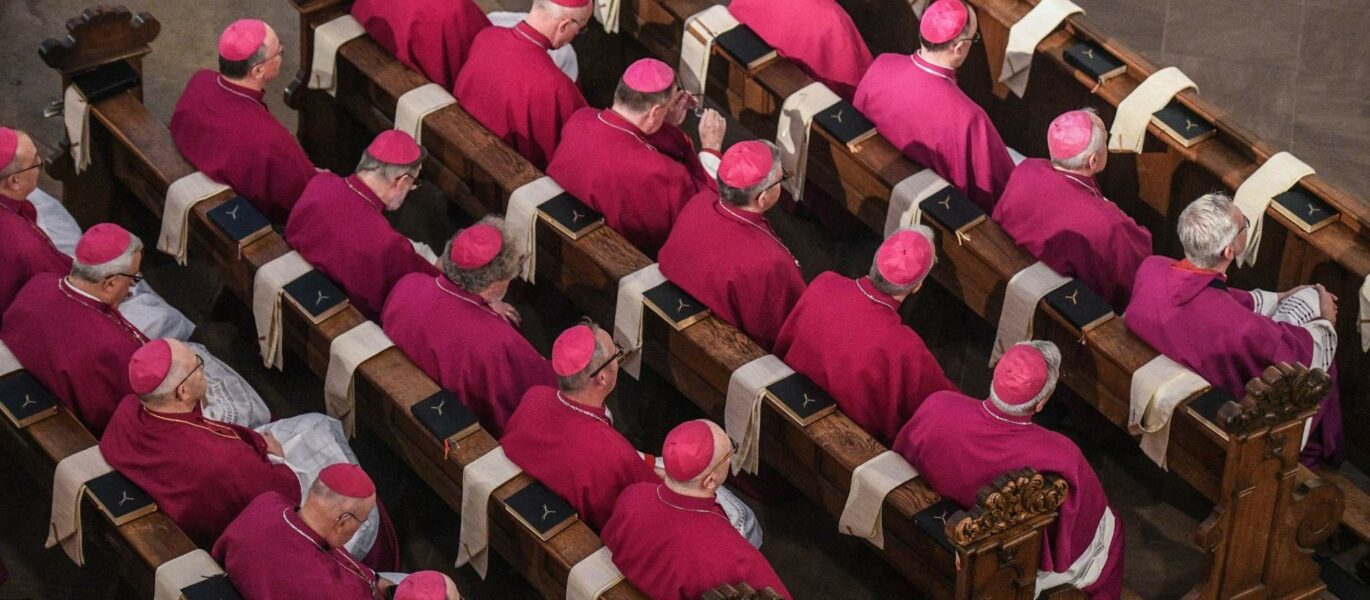
The president of the German Bishops’ Conference (DBK), Heiner Wilmer, offered a similar reading this Monday. At the opening of the bishops’ autumn plenary assembly in Fulda, he described France as «the laboratory of an awakening Catholicism» and even spoke of a «tectonic shift.»
Wilmer especially highlighted the role of young Catholic influencers who speak openly on social media about prayer, angels, the Pope, or relations with other religions, describing them as quick, humorous, and «very spiritual.»
The contrast is particularly relevant for Germany: while a large part of German ecclesial structures have for years focused on institutional reforms through the Synodal Path, Leo XIV pointed out on the plane another criterion for addressing the decline: recovering the «true missionary spirit.»
Precisely the episcopal assembly gathered these days in Fulda continues to await the recognitio from Rome for the statutes of the projected Synodal Conference. Wilmer stated that he expects a response from the Vatican before the end of the year. The first meeting of the new body, initially scheduled for November, has already had to be postponed.
Leo XIV addresses the growth of the «far right»
The second part of the question posed to the Pope referred to the growth of far-right groups in Germany and the relationship that some of these currents maintain with certain religious expressions.
Leo XIV avoided presenting a causal relationship as proven and considered that «it would be interesting to study and analyze whether there is, and in what way, a correlation» between both phenomena.
The Pope did question the combination of certain far-right positions with «a certain type of religion» that the leaders of the German Catholic and Protestant Churches, he recalled, consider «does not represent an authentic expression of Christianity.»
Leo XIV contrasted those currents with «the values of the Gospel,» which, he affirmed, «have nothing to do with hatred and division, but with understanding, compassion, and accompaniment.»
The Pontiff also expressed his desire that citizens participate politically in seeking the common good and avoiding «extremist ideas that could cause much more serious harm than we realize at this moment.»
Wilmer acknowledges that there are Catholics who vote for AfD
Leo XIV’s words coincided with the debate that the German bishops themselves are holding about their relationship with Alternative for Germany (AfD).
This Monday, Wilmer again expressed his concern about the political shift to the right in Germany and Europe and reaffirmed the declaration approved by the Bishops’ Conference in 2024 according to which «ethnic nationalism and Christianity are incompatible.»
However, the president of the DBK expressly acknowledged a reality that poses a pastoral challenge to the bishops: there are Catholics who vote for AfD.
Wilmer therefore maintained that there must be spaces in which the Church can listen to those faithful without limiting itself to directing «slogans» at them. The statement introduces a relevant nuance in a relationship marked by the hard institutional position adopted by the German episcopate toward the party.
Marx brings the debate to the future of Europe
The issue also took on a European dimension during the Pope’s visit. Cardinal Reinhard Marx, Archbishop of Munich and Freising, published together with former Italian President Mario Monti, Jean-Baptiste de Franssu, and former French Minister Sylvie Goulard an article in La Croix in defense of the European integration project.
The signatories maintain that Europe is gripped by doubts, divisions, and nationalist tendencies and call on European leaders for greater political ambition.
The text also criticizes the Administration of Donald Trump and the Government of Vladimir Putin for appealing, according to the authors, to Christianity while promoting approaches they consider contrary to Gospel values. This is the interpretation expressed by Marx and the other signatories, who call for recovering the legacy of Robert Schuman and Jean Monnet in the face of what they describe as a «narrow nationalism.»
The publication coincided with Leo XIV’s visit to Metz, a city closely linked to Robert Schuman. There, the Pope recalled the Christian roots of the continent and maintained that «one cannot speak of Europe without mentioning Christianity.»
An invitation to visit Germany
Leo XIV’s response also left open the possibility that the Pontiff may personally verify the situation of the German Church.
«I have received an invitation. I truly hope to return there; that is, I have already been there, but not as Pope,» he explained.
Leo XIV expressed his desire to make the visit, although he specified that there is still no schedule and that he continues working on the travel program for the coming year. For the moment, he indicated, the only confirmed trip is the one corresponding to World Youth Day in Korea.
Until a possible visit, the message he left to German Catholics was fundamentally missionary. Faced with a Church battered by secularization and the loss of faithful, Leo XIV maintained that there are still many Germans who wish to live the faith and placed the response in recovering the capacity to proclaim and celebrate it.