


By Fr. Raymond J. de Souza
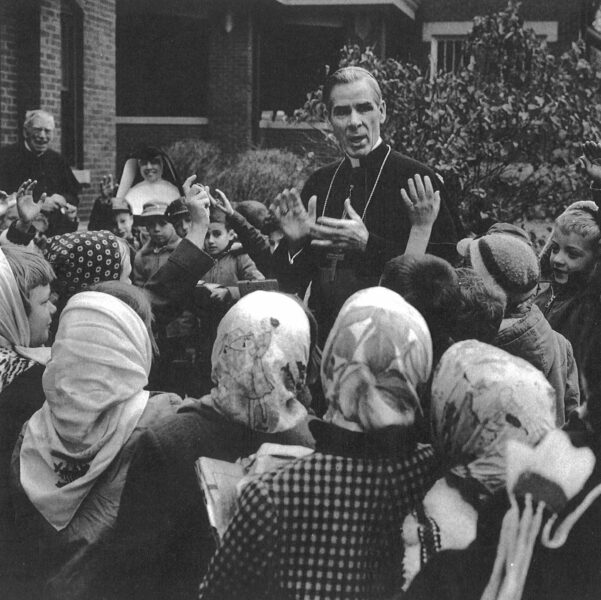
The saints are always greater, because the Gospel is always greater. Greater than our usual categories, than our accustomed ways of thinking. Archbishop Fulton Sheen was precisely that, as his beatification in St. Louis on Thursday illustrated. The homily of the papal legate, Cardinal Luis Tagle, highlighted the blessed Fulton as a man animated by a special love for the poor and by a passion for alleviating poverty.
Fulton Sheen was many things, so many things could be said of him—and many, very many things were said in recent days. He was the imaginative evangelizer, the mesmerizing preacher, the television star, the brilliant teacher, the penetrating philosopher, the faithful eucharistic disciple, the priest who intimately knew the sacrifice he offered. He was even more, as the Catholic faith is always more.
Consider just one example. In July 1967, from the pulpit of his cathedral in Rochester, the blessed Fulton was the first American bishop to call for the withdrawal of American forces from Vietnam. That the most famous bishop in America was a firm opponent of that calamitous war was the solvent of a possible stain on American Catholic history.
In October 1966, Sheen was named bishop of Rochester, which was widely interpreted as Cardinal Francis Spellman’s way of expelling him from New York, for the two had, as is well known, been at odds.
In December 1966, Spellman told American troops in Vietnam—to the great consternation of the Vatican—that “they were holy crusaders. . .in Christ’s war against the Vietcong and the people of North Vietnam.”
It was not exactly analogous to Patriarch Kirill’s support today for Putin’s war against Ukraine, but it was uncomfortably heading in that direction. Sheen, no longer serving under Spellman as auxiliary bishop of New York, was a figure large enough to rescue the Catholic Church from being understood as blessing the war. Moreover, Sheen was a character large enough to know that one could be fervently anti-communist and, at the same time, condemn the lethal madness then unfolding.
Conservative and progressive at once? Proudly orthodox in his teaching, Sheen himself said, upon resigning as bishop of Rochester in 1969: “I move too fast, I am a bit too progressive.” (“Progressive” then was not quite the same as that word implies today).
Indeed, his troubled tenure in Rochester was marked by Sheen moving too fast in donating Church land for low-cost housing and by a tax he imposed on new church construction to provide alms for the poor.
Cardinal Tagle, doubtless aware of how much was known about the blessed Fulton—from daily Holy Hour to Marian devotion and celebrated preaching throughout the world—chose to highlight Sheen’s single speech at the Second Vatican Council, delivered on November 9, 1964, and quoted it at length. Sheen urged the conciliar fathers to manifest a preferential love for the poor.
“Put your finger on the 30th parallel and run it around a globe,” Tagle quoted from Sheen’s speech. “What do you find? Practically all prosperity is above the 30th parallel, and most poverty is below. . . .Just as only a wounded Christ could convert a doubting Thomas, only a Church wounded by poverty can convert a doubting world.”
The vast congregation in St. Louis applauded that line, and Tagle himself seemed a bit surprised that solidarity with the poor provoked it, adding “Wow!” The very Catholic assembly present also knew that the faith is always greater.
The blessed Fulton drew so many to the Catholic faith because he was a model of so many distinct aspects that proved attractive. What appeals? The aesthetics of sartorial splendor? The confessional in shadow? Dramatic oratory? Silent prayer before the Blessed Sacrament? A passionate commitment to racial equality? The denunciation of communism? The Holy Mass photographed in splendor by Yousuf Karsh? A sublime sermon at St. Patrick’s? Preaching on the sun-scorched savanna of the missions? A learned treatise? A simple reminder of God’s love? Sheen offered it all.
Tagle highlighted Sheen’s personal generosity. Long before reaching the height of his fame, Sheen received in 1938 the considerable sum of some $70,000 from the bequest of a Catholic benefactress. He dispensed it in a week, sending most of it to Alabama so that the Sisters of Mercy could build a maternity hospital for Black women in segregated Mobile. There are dozens of examples like that. Sheen’s pastoral charity began with the concrete charity of the pastor.
The man who made “God love you!” his characteristic phrase would doubtless have rejoiced that Pope Benedict XVI entitled his first encyclical God Is Love. What the Holy Father wrote there about the Church could have been written about Fulton Sheen personally.
“The Church’s deepest nature is expressed in her threefold responsibility [munera]: proclaiming the word of God (kerygma-martyria), celebrating the sacraments (leitourgia), and exercising the ministry of charity (diakonia),” Benedict wrote. (n. 25) “These tasks presuppose each other and are inseparable.
For the Church, charity is not a kind of welfare activity that could equally be left to others, but belongs to her nature and is an indispensable expression of her very being.”
The preaching of the word and devotion to the sacraments were indispensable to Sheen’s life and mission, and so were the practical measures of diakonia for the poor and the suffering.
When Saint John Paul the Great told the blessed Fulton at St. Patrick’s Cathedral in 1979 that he was a “faithful son of the Church,” he had that threefold mission in mind. He may have recalled that 1964 speech on poverty at Vatican II. John Paul, for his part, echoed it in one of the fiercest homilies of his long pontificate in Edmonton in 1984, with his voice trembling with righteous anger, warning that “the poor south will judge the rich north!”
Blessed Fulton Sheen, friend of the poor, pray for us.
About the author
Fr. Raymond J. de Souza is a Canadian priest, Catholic commentator, and Senior Fellow at Cardus.