


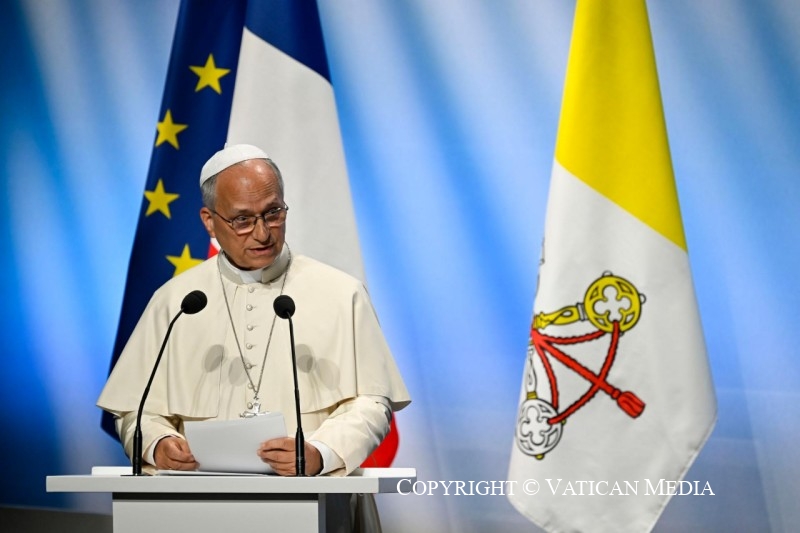
Pope Leo XIV has claimed this Monday in Metz the Christian roots of Europe and has maintained that the continent’s civilization cannot be understood without the imprint of the Church, monasticism and openness to transcendence. “One cannot speak of Europe without mentioning Christianity,” the Pope affirmed before Emmanuel Macron, before defending a secularism that respects the freedom of the Churches, calling for the integration of immigrants to include their entry “into the spirit of the house that welcomes them” and warning European governments against “the illusion of rearmament.”
The speech took place at 11:30 a.m. at the Robert Schuman Congress Center, during the meeting “At the Roots of Europe for Peace and Unity,” one of the final engagements of Pope Leo XIV’s apostolic journey to France. The Pontiff was received by the President of the French Republic and by Cardinal Jean-Marc Aveline, President of the French Episcopal Conference, after participating that same morning in an interreligious meeting in Metz.
The setting and the title of the event allowed the Pope to structure his address around Robert Schuman, venerable of the Church and one of the fathers of the European project. Pope Leo XIV presented the French statesman not merely as one of the architects of the European institutions, but as a politician whose Christian formation proved decisive for his conception of Europe, the reconciliation among peoples and respect for international law.
“One cannot speak of Europe without mentioning Christianity”
Pope Leo XIV began by going far beyond the current European institutions. Europe, he noted, is “a cultural and historical reality before a geographical one,” shaped over the centuries by Hellenistic civilization, the Roman Empire, the spread of Christianity and the subsequent incorporation of Germanic, Slavic and other peoples.
Within that process he reserved a central place for Saint Benedict, proclaimed patron of Europe by Paul VI in 1964. The Pope listed the influence exercised by the Benedictines in the care of the poor, the sick and the elderly, education, universities, hospitals, medicine, architecture, engineering, the sciences, law and the very political and urban organization of the continent.
“Without this monastic heritage, European civilization as we know it would not exist,” he stated.
Pope Leo XIV also brought the reference to the very place where he was delivering the speech. He recalled the work of Saint Crodegango in Metz and how from this region Gregorian chant spread throughout the Carolingian territories, “bringing harmony and beauty to the entire continent.”
The conclusion was explicit: “One cannot speak of Europe without mentioning Christianity.”
The Pontiff supported that statement with Robert Schuman himself, for whom Christianity had taught the natural equality of all men as children of the same God and redeemed by Christ, and with Alcide De Gasperi, who identified among the elements of the “common European legacy” evangelical fraternity, law, beauty and the pursuit of truth and justice.
Pope Leo XIV rejected the notion that recognizing this historical debt amounts to imposing a confessional criterion. In his view, it allows us to understand that “openness to the transcendent is always a constitutive dimension of the human person and a living source of civilization.”
Secularism does not consist in sidelining the Churches
From that affirmation about Europe’s roots, the Pope returned to one of the issues that has run through his trip to France: the public place of religion in secularized societies.
Pope Leo XIV expressly cited Article 17 of the Treaty on the Functioning of the European Union, which provides for an “open, transparent and regular” dialogue between the Union’s institutions and the Churches.
“The secularism that governs the life of states not only implies the non-confessional character of civil institutions, but presupposes a genuine collaboration between the parties,” he noted. That collaboration requires, he added, that the authorities respect the autonomy of the Churches and promote their freedom of organization, expression and worship.
The statement extends what was said on Friday before the French authorities, when Pope Leo XIV called for a “just secularism” that does not expel religion from public life.
The Pope also linked the survival of European values to the rediscovery of their roots. Freedom, democracy, peace and unity, he affirmed, only retain real meaning when the centrality of the person is recovered and the balance between rights and duties is maintained, as opposed to a conception of individual rights detached from the common good.
Integration also means entering “into the spirit of the house that welcomes”
Pope Leo XIV next addressed the arrival in Europe of men and women fleeing wars and persecution or seeking better living conditions. He recalled his recent visit to the Canary Islands, during which he had called for legal and safe pathways, rescue and assistance, the fight against traffickers, protection of victims and serious processes of reception and integration.
In Metz he added an element concerning the meaning of that integration. “To welcome a person means to integrate them as into one’s own family,” he explained.
This entails offering them the possibility of developing their talents, capacities and sensibilities, but also allowing them to “enter into the spirit of the house that welcomes them.”
The Pope described the current situation as an “unprecedented encounter between peoples and cultures” that obliges Europe to carry out two movements simultaneously: “a creative rediscovery of our roots” and “an attentive listening to the other.”
He did not, therefore, present dialogue as an abandonment of European identity. That same morning, during the interreligious meeting held in Metz, he had insisted that “to dialogue does not diminish our identity,” but rather allows it to be expressed truthfully while recognizing the difference of the other.
Pope Leo XIV warns against “the illusion of rearmament”
The second part of the speech was dominated by war and Europe’s political future. Pope Leo XIV recalled Schuman’s experience after the Second World War to remind the audience that the European project was born precisely from the will to make a new war materially impossible between peoples who had confronted one another for generations.
The Pope lamented that war has returned to the continent and defined it, drawing on the words of Benedict XV during the First World War, as a new “useless slaughter” that daily causes numerous civilian victims.
He called for “patient dialogue,” boldness in negotiation and a willingness to sacrifice certain positions for the higher good of peace. At the same time, he clarified that this pursuit cannot be confused with “naïve irenicism.”
It was then that he issued one of the most forceful warnings of the address: “One must beware of the illusion of rearmament.”
Pope Leo XIV recalled that increases in military spending are usually justified by the danger posed by other states and posed a direct question about Europe’s course: “Are we truly making ‘creative efforts’ to promote peace in the world, or are we simply trying to ‘stop the hemorrhage of war’ and prepare ourselves better for those we assume are still to come?”
The concern had already surfaced at the beginning of the trip. Before Macron and the French authorities, Pope Leo XIV had called for betting on disarmament, diplomacy and multilateralism and rejected the idea that the accumulation of armaments could by itself constitute a guarantee of peace.
“Human and interstate relations are becoming increasingly barbaric”
The Pope’s diagnosis of international politics was especially severe. Against the logic of force, he upheld international law and the principle pacta sunt servanda, according to which agreements must be honored.
Pope Leo XIV noted that international law and multilateralism recognize the effective equality of states and constitute “the best antidote against the will to dominate, which is the root of all conflict.”
“Today, human and interstate relations are becoming increasingly barbaric. The value of the given word is scorned; rather, lying and deceit are presumed,” he denounced.
Against that drift, he presented the European experience of the last eight decades as proof that it is possible to assert divergent interests and positions “by meeting rather than confronting one another.”
“Do not be afraid to form a family, to have children”
Pope Leo XIV reserved the final part of the speech for young Europeans. He asked them not to submit “to the logic of violence and oppression” and to personally assume the building of peace in their relationships, families, schools, universities, cities and political communities.
But the exhortation went beyond peace. The Pope explicitly linked Europe’s future to the family, birth rates, political participation and the defense of human life.
“Love life at every moment and do not fear the future!” he urged.
“Do not be afraid to form a family, to have children, to defend the dignity of every person, from the first instant in the mother’s womb until the last breath.”
The defense of life has been a constant throughout the four days of the journey. From the Élysée to Lourdes and Metz, Pope Leo XIV has insisted before political leaders, bishops, the sick, young people and religious representatives that human dignity does not depend on age, health, autonomy or social utility.
In Metz, the Pontiff placed that defense within an even broader question: what kind of Europe the next generations will receive. His answer involved returning to roots that he did not present as a relic of the past, but as a condition for facing the future: “And alongside you, Europe, firmly rooted, will continue to flourish and inspire the entire world.”
ADDRESS OF THE HOLY FATHER POPE LEO XIV
Mr. President,
Mr. Cardinal,
distinguished civil and religious authorities,
ladies and gentlemen:
I am pleased to be in this historic city, a crossroads at the heart of the continent, to hold this meeting with such an evocative title: “At the Roots of Europe for Peace and Unity.” I thank you for the kind words you have addressed to me.
The proposed title is undoubtedly inspired by the figure of the venerable Robert Schuman, to whom we wish to pay particular homage today in this center that bears his name, and above all here in Moselle, the region where he lived for a long time, where his remains rest and which he represented for many years in the National Assembly. He drew inspiration from this region, with its vicissitudes in the nineteenth and twentieth centuries, to help shape the Europe of today and tomorrow through his celebrated Declaration of 9 May 1950. This text marks both the point of departure and arrival of his commitment to the reconciliation and unity of the European continent, which marked his entire life.
Today we wish to undertake, in thought, a journey that starts from the roots of Europe to arrive at its present and look toward the future. We ask ourselves how Robert Schuman was shaped by the history of this land, of which he was a son, and how he contributed in a fundamental way to shaping modern Europe, to the point of being considered a “founding father.”
It is always difficult to define Europe, both in the present and in the past. Europe, in fact, gradually became aware of itself in the historical epochs of Hellenistic civilization, the Roman Empire and, subsequently, the spread of Christianity, integrating over time new cultures such as the Germanic and Slavic, among others, until it encompassed ever vaster regions.
Europe must therefore be understood as a cultural and historical reality before a geographical one. Over the centuries, it has acquired new borders and new definitions, passing through periods of growth, profound crises and new rebirths. A constant factor, observable in its long and turbulent historical journey, lies in the fact that Europe has developed and progressed when it has been able to assimilate the positive aspects of its past and reframe them in new and creative ways through encounter with the other. Indeed, European civilization is also the fruit of secular encounters, though not always easy. It suffices to think of the presence of Arab culture in the Iberian Peninsula, or the projection of the “Old Continent” toward the “New World,” which generated, sometimes painfully, unprecedented syntheses in the American continent.
To understand this long history, however, one cannot omit another father of Europe: Saint Benedict, whom Saint Paul VI proclaimed patron of Europe in 1964, calling him “messenger of peace, maker of union, master of civilization” [1]. Assistance to the poor, the sick and the elderly; the education of children and universities; hospitals and medicine; architecture and engineering; the development of the sciences; law and the organization of cities and states themselves: so many fields in Europe have been profoundly influenced by Saint Benedict and his monks! Without this monastic heritage, European civilization as we know it would not exist. Here in Metz, thanks to the work, among others, of Saint Crodegango, a Benedictine spirit of fraternity, communion and shared life was breathed. From here, Gregorian chant spread throughout the Carolingian territories, bringing harmony and beauty to the entire continent.
One cannot speak of Europe without mentioning Christianity, as Robert Schuman well knew when he said: “Christianity has taught the natural equality of all men, children of the same God, redeemed by the same Christ, without distinction of race, color, class or profession. It has recognized the primacy of interior values that alone ennoble man. The universal law of love and charity has made every man our neighbor and social relations in the Christian world have since rested upon it” [2].
Another founding father of contemporary Europe, Alcide De Gasperi, echoes him by emphasizing the “common European legacy” [3], that is, “that unitary morality which exalts the figure and responsibility of the human person with its spirit of evangelical fraternity, with its respect for the law inherited from the ancients, with its appreciation of beauty perfected over the centuries, with its search for truth and justice sharpened by a millennial experience” [4].
Rather than being an exclusive confessional criterion [5], reference to the debt of European culture to Christianity allows us to better understand the extent to which openness to the transcendent is always a constitutive dimension of the human person and a living source of civilization.
In this regard, Article 17 of the Treaty on the Functioning of the European Union is of great importance. It promotes “an open, transparent and regular” dialogue with the Churches, always with respect and without prejudice to the “status recognized in the Member States.” The secularism that governs the life of states not only implies the non-confessional character of civil institutions, but presupposes genuine collaboration between the parties, as well as respect, on the part of state and Union authorities, for the autonomy of the Churches and the promotion of their freedom of organization, expression and worship.
It is a matter of returning to the source of the values that constitute the foundation of civil coexistence, that is, to “the universal values of the inviolable and inalienable rights of the person, as well as freedom, democracy, equality and the rule of law” (Treaty on European Union, Preamble).
In the present multicultural context, the affirmation of the universality of these values, which is essential for their survival, also passes through a rediscovery of one’s own roots and openness to dialogue with the other.
This is a social and political necessity to rediscover the central role of the human person and give real meaning to words such as freedom, democracy, peace and unity. To this end, Pope Francis’s invitation to appreciate the complexity of European reality in all the richness of its traditions and sensibilities, emphasizing “the challenge of a constructive harmony, free of hegemonies” [6], is very valuable.
This double movement, of rediscovery and dialogue, will also make it possible to find a just balance between rights themselves, as well as between rights and duties because—as Pope Francis himself recalled—the “concept of right is no longer associated with that of duty, equally essential and complementary, so that the rights of the individual are affirmed without taking into account that every human being is united to a social context, in which his or her rights and duties are connected to those of others and to the common good of society itself” [7].
Indeed, contemporary Europe faces a new stage in its long history of encounters, with the arrival on the continent of so many men and women fleeing war zones and persecution, or seeking a better life away from poverty and misery.
As I said during my recent visit to the Canary Islands, Spain: “Human dignity demands legal and safe pathways, rescue and assistance, real cooperation against traffickers, effective protection for victims, serious processes of reception and integration, and policies that allow each person to live with dignity in their own land” (Meeting with migrant reception realities, 11 June 2026).
All this, however, would not be enough: to welcome a person means to integrate them as into one’s own family, offering them the possibility of developing their talents, capacities and sensibilities, but also of entering into the spirit of the house that welcomes them. One must grasp the historical scope of what is happening, namely an unprecedented encounter between peoples and cultures that calls for a creative rediscovery of our roots and, at the same time, an attentive listening to the other. The universality of Europe’s foundational values assures us that this dialogue is possible and that it can provide a solid foundation for our societies, allowing us to work more effectively for peace and a reconciled world.
This lucidity inspired men like Schuman to overcome the opposition between cultural identities and give life to European institutions, at the end of the terrible tragedy of the Second World War, showing how great is the evil caused by man when he thinks he has no obstacles in the exercise of his power.
Robert Schuman, who knew borders in continuous evolution, contributed to laying the foundations of a Europe aware of the urgency of tearing down the walls that tore it apart. His Christian formation educated him in the value of equality, without distinction of race or social class, and taught him the dignity of work. The succession of various national sovereignties instilled in him the importance of international law and the value of the given word. Having grown up in a context where pride and revenge seemed to prevail, Schuman committed himself to peace and brotherhood among peoples who, after fighting for a long time, finally recognized that they needed one another.
Consequently, what are Robert Schuman’s teachings for Europe and the world today? First, a profound desire for peace. Unfortunately, also in Europe, in this era war has reappeared: a new “useless slaughter” [8] that every day causes countless civilian victims. And still today, as in 1950, the words contained in the Schuman Declaration remain current: “The contribution that an organized and living Europe can bring to civilization is indispensable for the maintenance of peaceful relations” [9]. It is necessary to engage in patient dialogue, to show boldness in negotiation and to be willing to sacrifice some positions for the higher good of peace.
Undoubtedly, the pursuit of peace in Europe, as in the rest of the world, must not be confused with naïve irenicism. On the contrary, Schuman’s words are more relevant than ever: “World peace cannot be safeguarded without creative efforts commensurate with the dangers that threaten it” [10]. However, one must beware of the illusion of rearmament. “It is no coincidence that repeated calls to increase military spending and the decisions this entails are presented by many rulers with the justification of danger with respect to others” (Message for the LIX World Day of Peace, 1 January 2026). Favoring peace is an active work. Today, the question is whether we are truly making “creative efforts” to promote peace in the world, or whether we are simply trying to “stop the hemorrhage of war” and prepare ourselves better for those we assume are still to come.
Schuman’s Europe is a continent in which dialogue is preferred to armed struggle; in which resources are pooled so that “any war […] not only becomes unthinkable, but materially impossible” [11].
According to Schuman, Europe is based on respect for international law which, unlike national legislations, cannot be imposed by force by a state, but is founded on the universally recognized principle pacta sunt servanda. This principle is jealously preserved in the specific legislation of this region, which also encompasses relations between the state and the Catholic Church on the basis of the Concordat of 1801 between the Holy See and France, still in force.
International law and multilateralism emphasize the effective equality of states in their mutual relations and constitute the best antidote against the will to dominate, which is the root of all conflict. Today, human and interstate relations are becoming increasingly barbaric. The value of the given word is scorned; rather, lying and deceit are presumed. Europe can put an end to this spiral through respect for the other, which it has known how to cultivate and preserve, for it has amply demonstrated, in the last eighty years, that it is possible to assert divergent opinions, claims and interests by meeting rather than confronting one another.
Schuman reminds us that we must always be realistic and courageous: “Europe,” he affirmed, “will not be made all at once, nor according to a single plan: it will be built through concrete achievements which first create a de facto solidarity” [12]. We must never lose faith in our capacity to progress, even though the steps we take are sometimes small and almost imperceptible. The modern demand to “have everything, now” does not fit with European history and culture, which, on the contrary, teach the value of time and patience. Only with small steps can this concrete solidarity be brought to life, which implies that no one feels abandoned or forgotten.
Sharing these reflections, I think above all of young people, called to build the Europe of today and tomorrow. As Schuman observed: “May this idea of a reconciled, united and strong Europe be, from now on, the watchword for the young generations desirous of serving a humanity finally liberated from hatred and fear and which, after too long divisions, is learning Christian fraternity anew” [13].
To young people I say: have the courage to live responsibly the mission of building peace, in your heart, in your relationships, in your family, in schools and universities, in the life of your cities, your towns and all of Europe.
Do not submit to the logic of violence and oppression.
Love life at every moment and do not fear the future!
Do not be afraid to form a family, to have children, to defend the dignity of every person, from the first instant in the mother’s womb until the last breath.
Do not be afraid to work tirelessly in the service of the good of your communities, even through political commitment.
Be artisans of community!
And alongside you, Europe, firmly rooted, will continue to flourish and inspire the entire world.
May God sustain you in these decisions and bless and protect all of Europe.
Notes from the official text:
[1] Saint Paul VI, Ap. Letter Pacis nuntius (24 October 1964): AAS 56 (1964), 965.
[2] R. Schuman, Por Europa, Madrid 2006, 42-43.
[3] Cf. A. De Gasperi, La nostra patria Europa. Discorso alla Conferenza Parlamentare Europea, 21 April 1954, in: Alcide De Gasperi e la politica internazionale, Rome 1990, vol. III, 437-440.
[4] Ibid.
[5] Cf. ibid.
[6] Francis, Address to the Council of Europe (25 November 2014).
[7] Francis, Address to the European Parliament (25 November 2014).
[8] Benedict XV, Letter to the Heads of the Belligerent Peoples (1 August 1917): AAS 9 (1917), 423.
[9] Schuman Declaration, Paris, 9 May 1950.
[10] Ibid.
[11] Ibid.
[12] Ibid.
[13] R. Schuman, Por Europa, 36.