


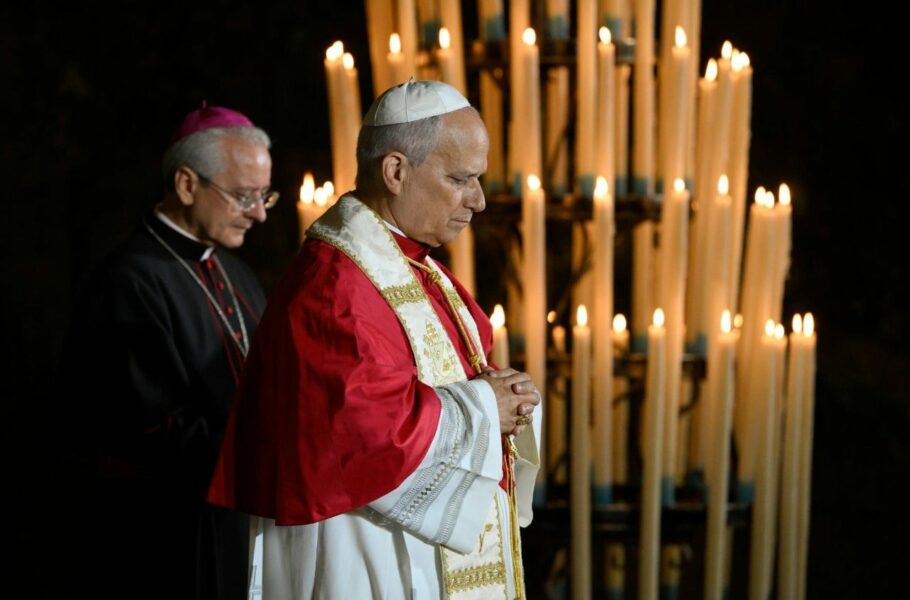
Lourdes left this Sunday some of the most clearly Catholic statements of Pope Leo XIV’s trip to France. Before the bishops, the sick, and some 150,000 pilgrims, the Pope spoke of sin, penance, reparation, and eternal life; he defended the sacredness of life against currents that seek to redefine its value in the face of illness or old age; he called on the Church not to renounce its voice in French society and ended the day by presenting the Virgin as the “new Eve,” whose intercession “is not secondary” in the struggle against evil.
It was the Pontiff’s full Sunday in Lourdes and also the day when several of the issues he had been raising since his arrival in France converged. The defense of life, already present at the Élysée, now appeared on the stage of the sick; concern over the growth of conversions once again became a call for doctrinal formation; and the debate on French secularism led to a direct request to the bishops: the Church has the right to evangelize, educate, worship publicly, and exercise charity in the name of Jesus Christ.
A Church that does not disappear from the public space
The morning began with Leo XIV’s meeting with the French bishops. The Pope acknowledged that the relationship between the Church and the Republic has reached a certain balance after a turbulent history, but warned that it could be questioned again, as is happening elsewhere in the West.
He did not ask French Catholics to retreat in the face of that situation. On the contrary. He called on the bishops for “missionary courage, boldness, and creativity” and maintained that the Church’s word has its full place in public debate, even when it is not heard on issues that affect the very foundations of civilization.
Leo XIV cited the debates on the end of life as an example. Two days earlier he had warned Emmanuel Macron against euthanasia, surrogacy, and genetic manipulation. In Lourdes he encouraged the episcopate to continue intervening and to work alongside those who defend the same values.
He demanded the same clarity for Catholic teaching. Schools may welcome students who do not share the faith and scrupulously respect their freedom of conscience, he noted, but they cannot therefore renounce an educational project centered on Christ. In a Catholic school, he added, it must be natural for opportunities to exist to encounter Jesus Christ and listen to His Word.
He also returned to the notable increase in adult and youth baptisms in France. Faced with the temptation to celebrate the numbers and then leave the new faithful alone, he called for living communities and solid doctrinal formation capable of responding to doubts and objections. This was a continuation of what he had said on Saturday in Paris, when he called for neophytes to receive biblical, theological, doctrinal, moral, and liturgical formation.
“It is today—not tomorrow—that conversion must take place”
But it was during the Mass that the message of Lourdes took on its most defined tone. Before some 150,000 pilgrims gathered in the sanctuary meadow, Leo XIV did not center his homily on a vague invitation to hope. He spoke of conversion and directly recalled the Virgin’s call to Saint Bernadette: “Penance! Penance! Penance!”
“It is today—not tomorrow—that conversion must take place,” the Pope stated. And he posed an uncomfortable question: whether Christians too easily consider themselves free of sin and whether they practice penance sufficiently.
Conversion, he explained, means abandoning the paths of error and directing existence toward its true end. Lourdes thus recalled something that a society focused on progress and material well-being can forget: human life is called to eternity.
From there came one of the central passages of the day. Leo XIV referred to “current currents that seek to redefine the value of human life in the face of illness, suffering, or old age” and contrasted them with the witness of the sanctuary.
“Lourdes is the blessed place of a profession of faith in the beauty and sacredness of life,” he affirmed.
Wheelchairs, crutches, illness, and tears are not lives set aside from view because they have lost utility or autonomy. For Leo XIV, they are precisely the testimony of a dignity that does not disappear with fragility.
Penance and reparation, also within the Church
The Pope went a step further. Penance was not presented solely as an exercise of individual perfection, but as a response of love to God and as reparation: love “with which we wish to repair the wound of His Heart caused by our sins” and love for those who reject conversion.
Nor did he leave the Church outside that examination. “This demand for conversion commits the Church itself in its earthly pilgrimage. It must, above all, have the courage to live that conversion,” he stated.
Leo XIV spoke of “the deep wounds, the infidelities, and the painful errors committed within her” and called for the Church to place herself humbly under the purifying gaze of the Lord.
Hours later, the question ceased to be abstract. At the episcopal residence, the Pope received seven victims of abuse committed by members of the clergy and the Church in France. There were four men and three women. Leo XIV listened individually to their stories, the pain suffered, and their proposals to prevent others from going through the same thing. Some testimonies also included the “complicity or silence” of those who could have helped.
Afterward he gathered them together and reiterated his commitment that “the evil experienced not be repeated.” With some of the victims he had previously spent a few moments in prayer.
“What is legal is not necessarily moral”
Between the Mass and that meeting, the Pope had visited the Accueil Notre-Dame. There, before the sick and healthcare professionals, the defense of life pronounced in the morning took on an even more concrete formulation.
“What is legal is not necessarily moral,” Leo XIV recalled.
The phrase pointed directly to the possibility that a law might make legally permissible what remains morally inadmissible. Against a “compassion” that ends up suppressing the one who suffers, the Pope defended a medicine oriented toward caring, accompanying, and relieving.
For this reason he spoke of palliative care, research, and accompaniment, and asked healthcare professionals to be “passionate servants of life.” The dignity of a person does not depend on their health or autonomy, nor is it at the disposal of a legislative majority.
The insistence was not coincidental in France. The question of the end of life has run through much of the visit, and the Pontiff has taken advantage of very different settings—the Élysée, the Episcopal Conference, and Lourdes—to formulate the same principle from different perspectives.
Families that once again give priests and religious
The crisis of vocations also appeared before the bishops. Leo XIV expressed his concern over the decline in priestly and religious vocations and, in particular, over the closure of ancient monastic communities that for centuries had considerable influence.
The response he proposed was not primarily organizational. For there to be priests again, he maintained, the priest must be expected, welcomed, and loved, and his identity configured with Christ must appear clearly before the People of God.
The question inevitably led to families. The previous night, before the grotto of Massabielle he had asked for families “generously open to life” and new priestly and religious vocations. On Sunday he insisted that a faith truly rooted within the home constitutes one of the keys to responding to several of the crises of the Church and of society.
Mary, the “new Eve”
When night fell, Lourdes returned to its most recognizable image. Thousands of pilgrims walked through the sanctuary with candles while praying the Rosary in the traditional aux flambeaux procession. Leo XIV then recalled the Virgin’s request to Saint Bernadette: “Let them come here in procession.”
His final intervention was not limited to a devotional exhortation. The Pope spoke of the Immaculate Conception and presented Mary as the “new Eve,” preserved from original sin by the merits of the Passion and Resurrection of Christ. In her, he explained, the history of redeemed humanity begins anew.
From that affirmation he drew a consequence for Christian life: the support and intercession of the Virgin “are not secondary” for those who wish to receive the grace of Redemption and combat evil.
Leo XIV finally resorted to the ancient image of the Stella maris. Mary, Star of the Sea, guides the Christian when storms threaten to lead him astray. And with that image ended a Sunday in Lourdes that had begun with words to the bishops about the place of the Church in a secularized France and ended, among candles and pilgrims, looking toward a reality the Pope had recalled throughout the day: human life does not end in well-being, illness, or death, but is called to eternity.