


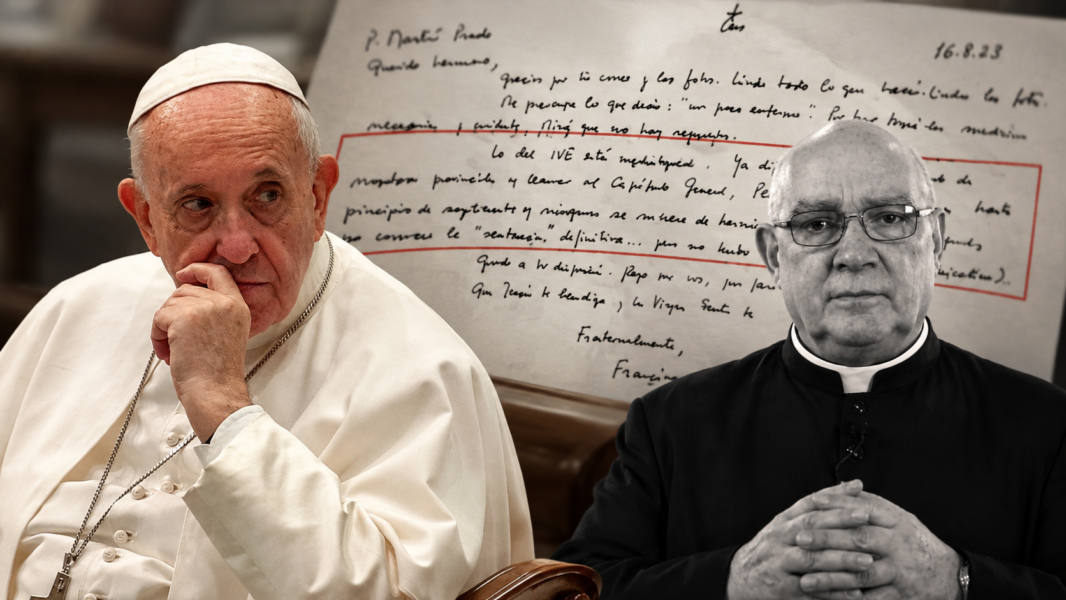
InfoVaticana exclusively publishes the only known document in which Pope Francis refers in his own handwriting to the canonical process against Father Carlos Miguel Buela, founder of the Institute of the Incarnate Word. It is a brief handwritten note dated August 16, 2023, four months after the founder’s death, addressed to Father Martín Prado, IVE, with whom the Pontiff maintained a friendship for years. Father Prado has now circulated it among the members of the Institute, accompanied by a written reflection that we reproduce in full below.
The document is of historical significance because of the magnitude of what is at stake. The Religious Family of the Incarnate Word, born in San Rafael (Argentina) in 1984, is present in 45 countries and brings together more than 3,000 religious among the male branch, the Servants of the Lord and of the Virgin of Matará, and the Third Order Secular. Few charisms that have emerged in the last four decades have produced a comparable number of vocations, and few have experienced such a prolonged Roman intervention: more than seven years without its own government, a founder judged, and a community divided over his memory.
The manuscript is revealed at a delicate moment. Ten days ago we reported that Rome opens a new phase in the IVE intervention, and these days we report on the letter and communiqué from the pontifical delegates that recall the conclusion of the two tribunals regarding the founder’s responsibility. Alongside this exclusive, we are publishing today a report on the legal chronology of the process and an in-depth canonical analysis.
At InfoVaticana we have denounced the stratagems used to close abuse cases without trial, and we have followed the Roman commissariats with critical distance. That same criterion obliges us to recognize that the process against Father Buela was a trial with certain guarantees, in two instances, with an accused, defense, witnesses, and adversarial proceedings, and that the lack of a published sentence was due solely to the defendant’s death twenty-four days after the appeals tribunal voted to confirm the conviction. This is not the Lute case, extinguished without investigation through an instrumental dispensation. Here there was a trial, and the moral certainty of two tribunals does not disappear because the penalty can no longer be carried out. The position of the pontifical delegates is solid and coherent, and the claim to hide behind the lack of a signature to veto any judgment on the founder is a stratagem we cannot endorse. Francis’s note does not alter those facts. The Pope knew in August 2023 that there had been no sentence; he considered it irrelevant and dismissed it as “clericalism.” Father Prado draws different conclusions from it, which the reader may assess for himself. It is worth bearing in mind, when reading them, what lies at the heart of the debate: not the revision of the Constitutions, which the author himself calls for, but the claim that, without a published sentence, no one can prevent the Institute from continuing to publicly honor its founder.
We publish Father Prado’s complete text, including his transcription of the papal note and his footnote. Only obvious typographical errors have been corrected.
Original Handwritten Letter from Pope Francis
As many of you know, for many years I maintained a close and friendly relationship with Pope Francis. On August 16, 2023, the Holy Father sent me a brief handwritten note of a personal nature, which I have kept ever since.
I consider it appropriate to share this note now because some of its expressions take on particular meaning in light of subsequent events. Along with its transcription, I would like to offer some personal reflections on his words and on the conversations we had on other occasions.
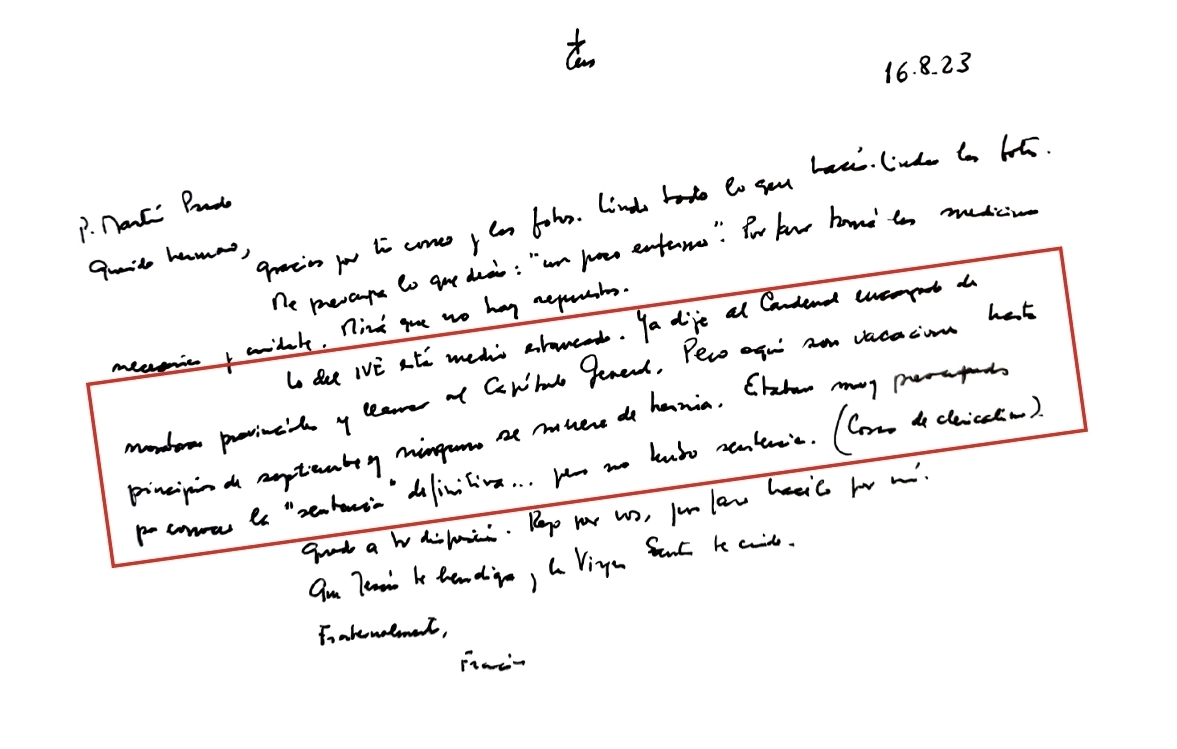
Transcription of the note:
16.8.23
Fr. Martín Prado
Dear brother, thank you for your email and the photos. Everything you are doing is lovely. The photos are lovely. I am concerned about what you say: “a bit ill.” Please take the necessary medicines and take care of yourself. Remember, there are no spare parts.
The IVE situation is somewhat stalled. I have already told the Cardinal in charge to appoint a provincial and to convoke the General Chapter. But here it is vacation time until the beginning of September and no one is dying of a hernia. They were very concerned about knowing the final “sentence”… but there was no sentence. (Clericalism stuff).
I remain at your disposal. I pray for you; please do the same for me. May Jesus bless you and the Holy Virgin watch over you.
Fraternally,
Francis
Clarifications arising from the letter
From this letter, together with other public and private conversations held with Pope Francis, the following reflections emerge:
1. The absence of a sentence. Pope Francis stated directly that there was no sentence. This is central to the present discussion, because now a sentence or concluded trial cannot be presented as a historical fact if such an outcome never existed. It is also known that the case was extinguished by the judge (decree of June 7, 2023), which shows that the judge himself had no intention of writing the sentence.
2. Pope Francis’s participation in the canonical process. Originally, Pope Francis authorized the process concerning Father Buela1. However, toward the end of his life he spoke and acted in a different direction. This raises legitimate questions: Had he come to know Father Buela and his accusers/accusations better? Was he considering the matter more consciously in light of eternity and the judgment of God? Why should one now act against the expressed will of the deceased Pope and against the course that Providence allowed events to take?
3. His desire that the Institute move forward. Pope Francis wanted the IVE situation to be resolved and a General Chapter to be held. He told me so several times. During his visit to Papua New Guinea, he told all of us the same thing and asked the Provincial to prepare, because in a few weeks the Institute would be convoked to a General Chapter. On that occasion he also stated that there were considerable pressures and ill intentions surrounding the affairs of the IVE and Father Buela. He repeated this concern with other expressions, even resorting to a very Argentine way of saying it—“there is a lot of bad blood.” Likewise, in the letter cited above he refers to “clericalism stuff.” These statements make clear that there are other pressures and interventions by people who, far from seeking to help our congregation, seek to influence it in order to introduce changes, even against the Pope’s will. It also shows (together with the latest interventions of the current superiors) that the sole purpose of now condemning Father Buela is to have the freedom to make changes in our charism and Institute, which are nothing other than the gift and work of God carried out through the person of Father Buela.
4. His personal assessment of the accusations. During one of my visits to the Holy Father in Rome, in which we spoke at length, sometimes for up to an hour, after discussing in detail the accusations (whether false or true) against Father Buela, the Holy Father told me that he understood that the accusations against Fr. Buela were not serious. He also spoke of his displeasure with Monsignor Taussig (the same one who sought out and raised the accusations against Father Buela), and how Taussig was obsessed with the matter. And on another occasion when I visited the Pope at Santa Marta, he told me that in Mons. Taussig’s resignation and the sad end he met in the diocese of San Rafael we should see a response to the problems we—the Institute and Father Buela—were going through, because among other things Mons. Taussig had included in the investigation of Fr. Buela accusations and cases that turned out to be false. More than once he also told me that he knew we were not rigid like others, that Father Buela could not be compared to Marcial Maciel, and that the accusations against him were not of such gravity.
Therefore, dear brothers, also in response to the email of last September 23, let us clearly distinguish the judicial situation of Father Buela from the discernment regarding the charism received and transmitted. If it is a matter of reviewing the Constitutions and proper law, let us begin now; we have been at a standstill for more than seven years, without our own government and without chapters, which, among other things, are so necessary for studying, correcting, and improving various aspects of the Institute’s life. Let us do so without ambiguities, from within and not by hearsay, without prejudices and with true knowledge of the IVE; if we hear a complaint or discontent, let us also listen to the vast majority of its members, who live their consecration humbly, happily, and silently. Let us do so with true self-criticism, and not only with criticism toward others or toward the past. If something in our norms or practices departs from the Gospel and the truth of God, manifested in the Incarnate Word, we will be the first to welcome the necessary corrections with joy and to be grateful for them, in order to live with greater fidelity the charism we have received, to foster its maturation, and to deepen the consecration to which we have been called. And thus, surely, we will have in the future better missions and missionaries; more vocations and apostolic fruitfulness; more persecutions, condemnations, and contempt from the world for our greater purification, the glory of God, His Church, and that of our small religious family of the Incarnate Word.
Fr. Martín Prado, IVE.
1 Although at the beginning of his pontificate Pope Francis told Fr. Buela that he knew there was “accanimento” (persecution) against him, he later granted the Dicastery’s request to lift the statute of limitations, which would otherwise have prevented proceeding with the accusations, since all the cases were time-barred. According to my understanding, although he had the authority to do so, this allowed distant events to be reinterpreted, confused, or exaggerated. The Pope also authorized the creation of a special tribunal. This also created a serious problem of impartiality: the same authorities who were pushing the accusations and who had condemned him without a trial, without having heard him beforehand, without having presented the accusations to him, and without having corrected or admonished him in any case—those same authorities who harbored accanimento against the father—were the ones who also chose the judges and established the procedure.