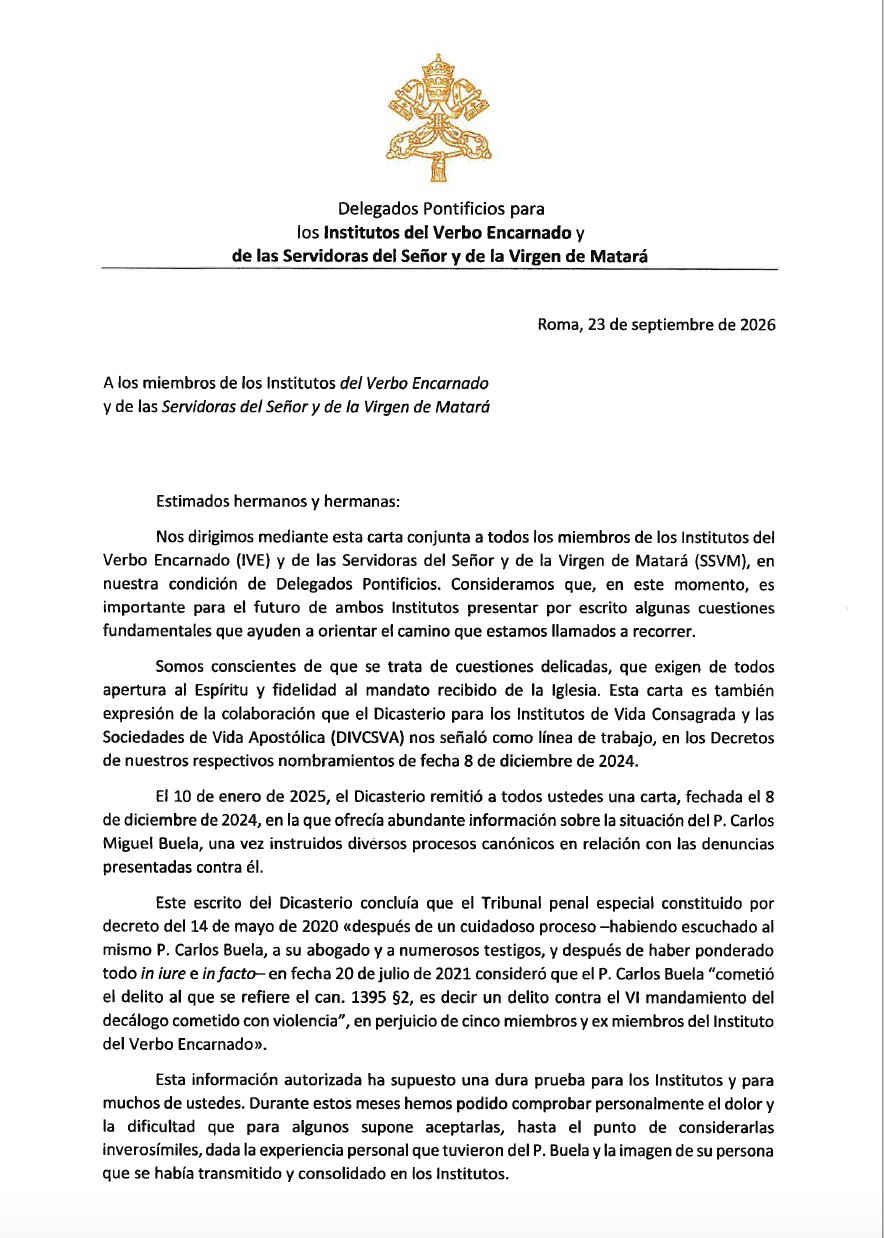
The pontifical delegates of the Institute of the Incarnate Word (IVE) and the Servants of the Lord and the Virgin of Matará (SSVM) have informed the members of both institutes about the resolutions adopted by the ecclesiastical courts regarding the priest Carlos Miguel Buela, founder of the two congregations.
In an official communiqué published on September 24, the delegates stated that both the Special Penal Tribunal of first instance and the Court of Appeal “reached moral certainty regarding Fr. Carlos Miguel Buela’s responsibility” for committing “an offense against the sixth commandment, perpetrated with violence” against several persons, in accordance with canon 1395 §2.
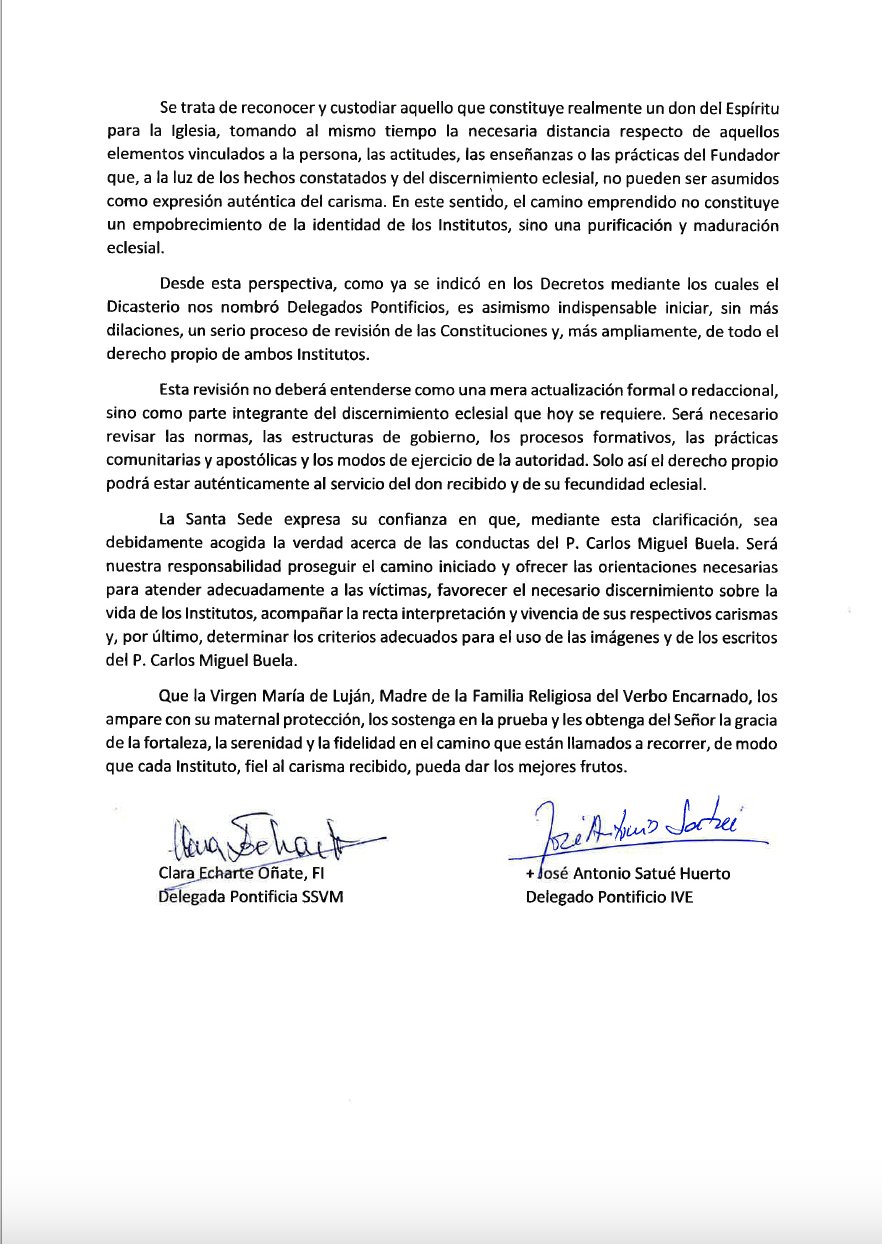
The communiqué is signed by Monsignor José Antonio Satué Huerto, pontifical delegate for the IVE; Sister Clara Echarte Oñate, pontifical delegate for the SSVM; and Sister Simona Brambilla, prefect of the Dicastery for Institutes of Consecrated Life and Societies of Apostolic Life.
The day before, Satué and Echarte had sent the members of both institutes a longer letter explaining the background of the proceedings and the reasons for the new communication.
The resolutions of first instance and appeal
According to the letter dated September 23, the Special Penal Tribunal was established by decree on May 14, 2020, to examine the complaints filed against Buela.
The delegates explain that, “after a careful process,” during which the priest himself, his lawyer, and numerous witnesses were heard, the tribunal determined on July 20, 2021, that Buela “committed the offense referred to in can. 1395 §2, that is, an offense against the VI commandment of the Decalogue committed with violence,” to the detriment of five members and former members of the IVE.
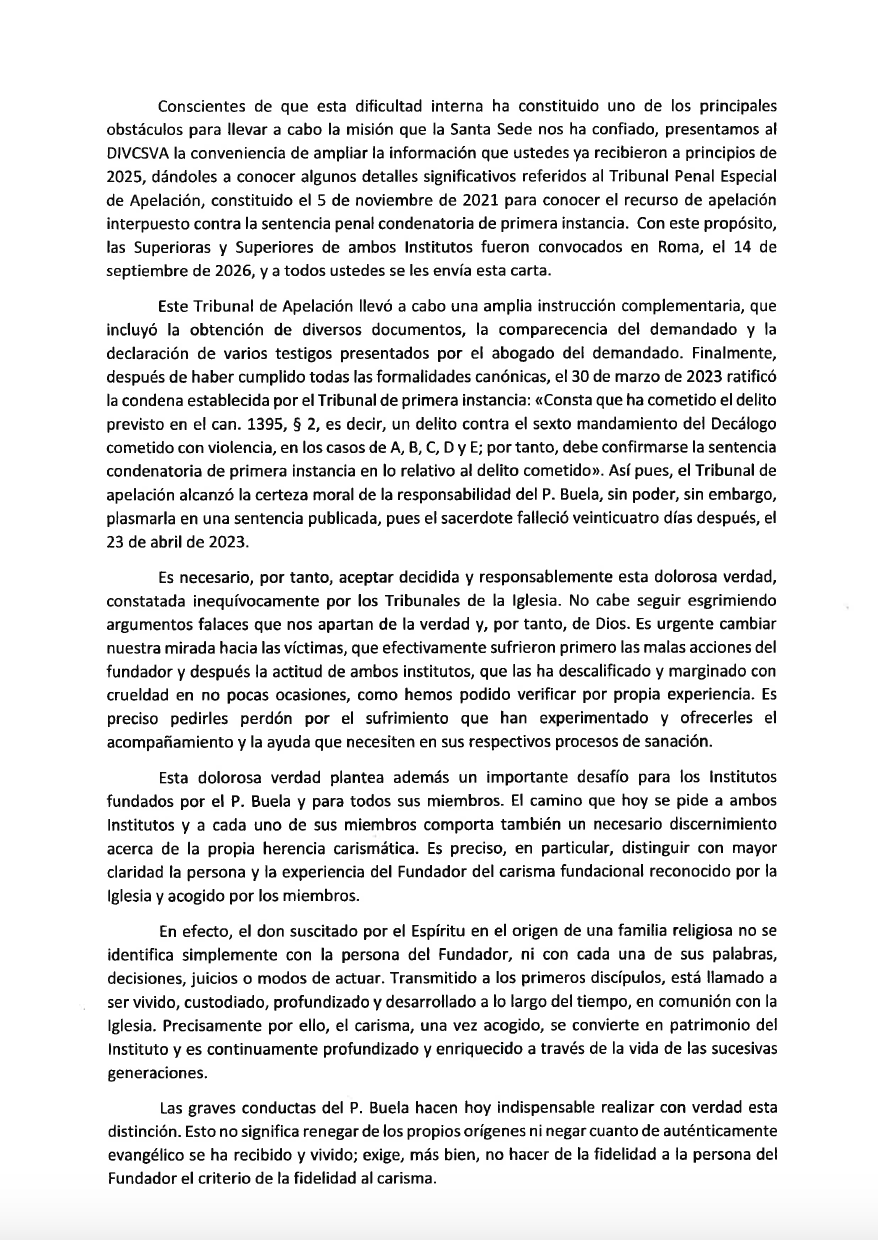
The resolution was appealed, and on November 5, 2021, a Special Penal Tribunal of Appeal was constituted. According to the letter, this second instance conducted a “broad complementary investigation,” which included obtaining documents, the appearance of the accused, and the testimony of several witnesses presented by his lawyer.
On March 30, 2023, the court of appeal upheld the first-instance decision. The letter reproduces the resolution:
“It is established that he committed the offense provided for in can. 1395, § 2, that is, an offense against the sixth commandment of the Decalogue committed with violence, in the cases of A, B, C, D, and E; therefore, the condemnatory sentence of first instance must be confirmed with respect to the offense committed.”
The delegates add that the Court of Appeal “reached moral certainty regarding Fr. Buela’s responsibility,” but indicate that this conclusion could not be embodied “in a published sentence,” since the priest died 24 days later, on April 23, 2023.
Different interpretations of the procedure
According to The Pillar, after a meeting held in Rome on September 14, an unsigned document attributed to major superiors of the IVE was circulated on a website, offering a different interpretation of the legal consequences of Buela’s death before the proceedings were concluded.
The text stated that, “since the penal process did not conclude due to the accused’s death, it is not for the Institute to issue a judgment of guilt regarding the Founder nor to consider legally concluded a process that did not reach its end.”
The letter from the pontifical delegates dated September 23, for its part, maintains that what was determined by the courts must be accepted. Satué and Echarte affirm that it is necessary “to accept this painful truth, unequivocally established by the Tribunals and the Church, in a decisive and responsible manner.”
“There is no room for continuing to wield fallacious arguments that distance us from the truth and, therefore, from God,” the document states.
The delegates also explain that in the preceding months they had observed “the pain and difficulty” that accepting this information caused some members, “to the point of considering it implausible, given the personal experience they had of Fr. Buela and the image of his person that had been transmitted and consolidated in the Institutes.”
The reference to the victims
The letter also expressly addresses the situation of the affected persons. The delegates write that “it is urgent to change our gaze toward the victims” and maintain that these persons “indeed suffered first the founder’s wrongful actions and then the attitude of both institutes.”
The document adds that, according to the delegates’ own assessment, the victims were “disqualified and cruelly marginalized on more than a few occasions, as we have been able to verify from our own experience.”
Satué and Echarte then consider it necessary “to ask their forgiveness for the suffering they have experienced and to offer them the accompaniment and help they need in their respective healing processes.”
The public communiqué of September 24 explains, in more general terms, that the clarification aims to contribute to “restoring the truth as an act of justice” toward the persons harmed by Buela’s conduct, in addition to providing information to the members of both institutes.
The distinction between the founder and the charism
Another matter addressed in the documents is the relationship between the figure of the founder and the charism of the congregations.
The delegates explain that the process requires “distinguishing more clearly the person and experience of the Founder from the foundational charism recognized by the Church and embraced by the members.”
The letter specifies that “the gift raised up by the Spirit at the origin of a religious family is not simply identified with the person of the Founder, nor with each of his words, decisions, judgments, or ways of acting.”
In this sense, the delegates maintain that making this distinction “does not mean renouncing our own origins or denying all that is authentically evangelical that has been received and lived,” but rather avoiding “making fidelity to the person of the Founder the criterion of fidelity to the charism.”
The communiqué of September 24 summarizes this objective as the need to distinguish “between the gift of the Spirit granted for the building up of the Church and the limitations or personal actions of the Founder.”
Review of the Constitutions and proper law
The letter also announces a review of the Constitutions and proper law of the two congregations.
According to the delegates, it will be necessary to review “the norms, the structures of government, the formative processes, the community and apostolic practices, and the modes of exercising authority.”
The document expressly states that this task “should not be understood as a mere formal or editorial update,” but as part of the discernment process being carried out by the institutes under the supervision of the Holy See.
It is also planned to determine “the appropriate criteria for the use of the images and writings” of Buela.
The September 14 meeting in Rome
The communication took place after the pontifical delegates convened the provincial superiors of the IVE and the SSVM for a meeting held in Rome on September 14, with the participation of officials from the Dicastery for Institutes of Consecrated Life and Societies of Apostolic Life.
According to the letter, the expansion of the information provided to the religious responds to the proposal made by the delegates themselves to the Dicastery, following the difficulties they had observed in the reception of the information previously communicated.
The communiqué of September 24 states that this clarification seeks to contribute both to informing the members and to the “path of re-reading the charism and of review, renewal, and purification of the spirituality, formation, and apostolate proper” to each institute.
The letter concludes by expressing the Holy See’s confidence that “the truth about the conduct of Fr. Carlos Miguel Buela” will be accepted and entrusts the delegates with continuing to accompany the process of both institutes, the care of the affected persons, and the discernment regarding their respective charisms.