


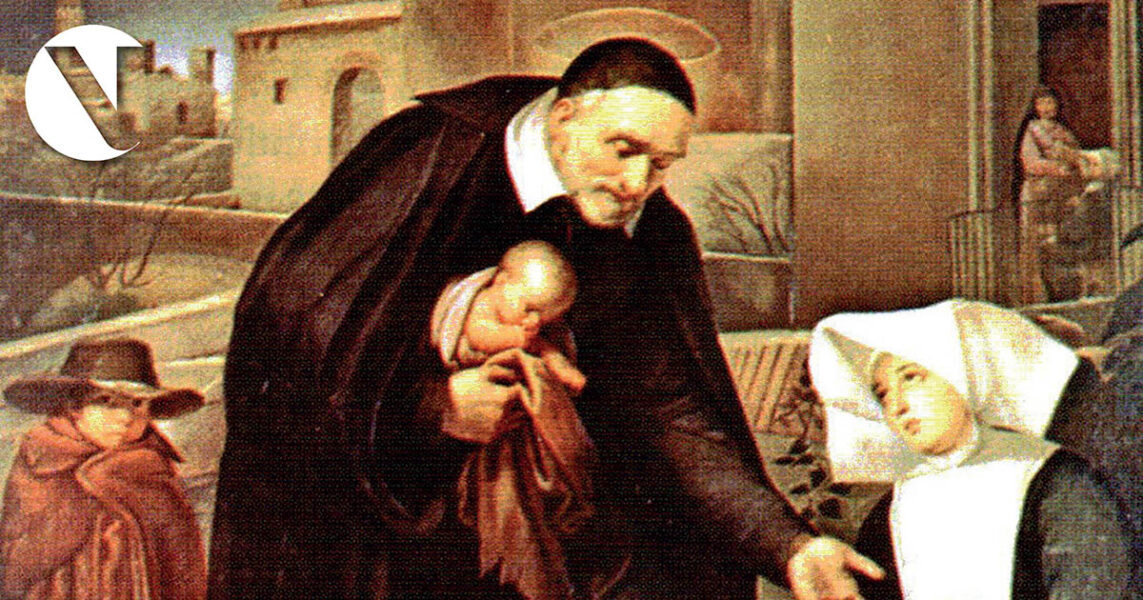
The Church commemorates on September 27 Saint Vincent de Paul, a French priest and one of the great figures of Catholic charity, founder of the Congregation of the Mission and, together with Saint Louise de Marillac, of the Daughters of Charity. His life was marked by a profound transformation: from initially seeking a stable position through the priesthood, he went on to consecrate himself to the spiritual and material service of the poor.
Vincent was born in 1581 into a peasant family in the French region of Gascony. His intelligence enabled him to study, and in 1600, when he was about 19 years old, he was ordained a priest. Four years later he completed his theological studies.
His early years in the priesthood were far from the image by which he would later pass into history. Vincent initially aspired to find a relatively comfortable situation that would also allow him to help his family financially. But direct contact with material misery and, above all, with the spiritual abandonment of the rural inhabitants transformed his understanding of the priesthood.
1617, the year that changed his life
Two events that occurred in 1617 proved decisive.
In Folleville, after spiritually attending to a gravely ill peasant, Vincent became aware of the lack of religious assistance suffered by a large part of the rural population. On January 25 he preached a sermon that the Vincentian tradition considers the beginning of the charism that would later give rise to the Congregation of the Mission, whose members would be known as Vincentians or Lazarists.
That same year, while serving as parish priest in Châtillon-les-Dombes, he learned of the case of a family whose members were ill and without resources. Vincent spoke of that need during his preaching, and numerous neighbors spontaneously came to their aid.
The response was generous, but it also made him understand that charity needed perseverance and organization. From that experience emerged the first Confraternities of Charity, intended to provide stable care for the sick and needy.
For Vincent, charity could not be reduced to a feeling of compassion. It demanded concrete works. One of the phrases that summarize his spirituality precisely expresses that conviction: “Let us love God, my brothers, but let us love Him at our own expense, with the work of our arms, with the sweat of our brow.”
To evangelize and relieve the poor
Vincent understood that material poverty and spiritual abandonment had to be addressed together. For this reason he organized popular missions especially aimed at rural populations and gathered priests willing to dedicate themselves to this task.
In 1625 the Congregation of the Mission was formally born, dedicated to the evangelization of the poor and the formation of the clergy.
The other great work linked to his name would come in 1633. Together with Saint Louise de Marillac, he founded the Daughters of Charity, a female community conceived in a novel way for its time: its members would not remain enclosed within a monastery, but would go out to directly attend to the sick, the poor, abandoned children, and other people in need.
Vincent also insisted that the poor could not be considered simply recipients of help. In them Christ Himself had to be recognized. He came to refer to them as “our lords and our masters,” an expression that encapsulated his particular understanding of Christian charity.
Saint John Paul II highlighted that the Church owed much to that peasant from the Landes who had ended up giving himself “without reserve” to God through the priesthood. Centuries later, Pope Francis also recalled that the encounter with the poor had provoked a decisive change in Vincent: he began to live “no longer for himself,” but to serve Christ in them.
Also a reformer of the clergy
Saint Vincent’s activity was not limited to charitable works. One of his great concerns was the formation of priests.
He participated in the organization of exercises for those about to receive holy orders and promoted the so-called Tuesday conferences, spiritual and pastoral formation meetings for priests. His influence thus also reached the renewal of the French clergy of the seventeenth century.
His spirituality was based on a simple but demanding idea: prayer and action could not be separated. Service to those in need had to proceed from union with God, and that union had to be translated necessarily into works of charity.
Vincent died in Paris on September 27, 1660, at the age of 79. He was canonized by Clement XII in 1737 and, in 1885, Leo XIII proclaimed him patron of Catholic charitable associations.
Four centuries after the events that gave rise to his work, the various branches of the Vincentian Family continue to be present in numerous countries.
The teaching left by Saint Vincent can be summarized in the conviction that guided his priestly maturity: Christian charity does not consist solely in speaking of God’s love, but in recognizing Christ in those who need to be evangelized, accompanied, and relieved.