


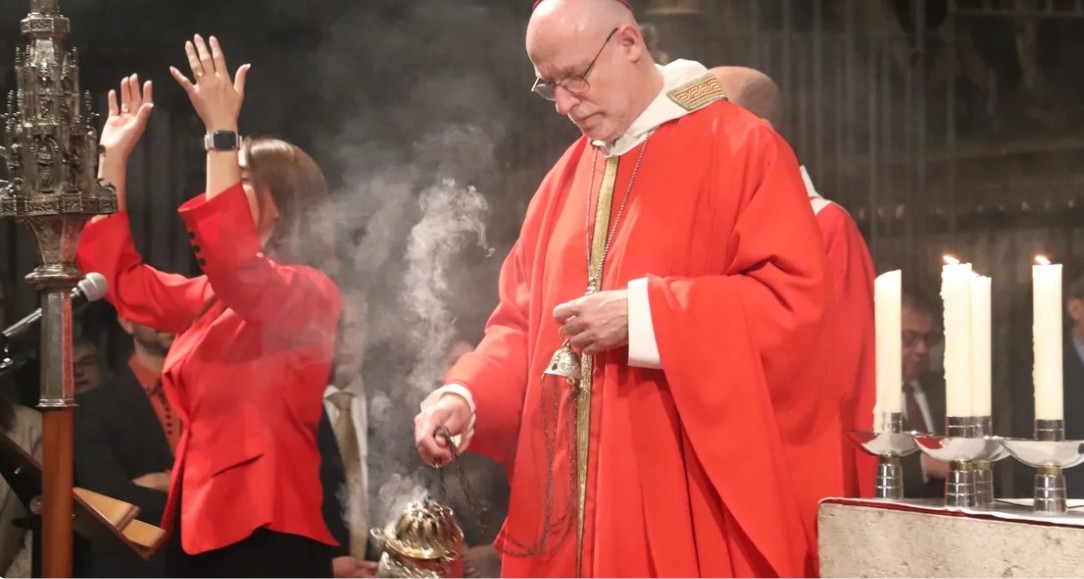
The Diocese of Girona, in Catalonia, roughly corresponds to the province of the same name. The most recent figures, according to the diocese itself, speak of a population of around 930,000 inhabitants, 381 parishes and 12 annexes, 123 active priests (of whom 102 are diocesan incardinated, plus extra-diocesan priests, religious with pastoral charges and members of Opus Dei residing there), as well as 13 permanent deacons. The seat of the diocese is in the city of Girona, where the Cathedral of Santa Maria is located.
Beyond these official figures, it is worth turning to non-confessional press to see, alongside errors, some truths. In 2021, the Diari de Girona reported a very alarming fact: that the number of priests in Girona had been halved in the last twenty years. If Girona currently has 123 priests (the vast majority of advanced age), at the end of 2000 there were 246. The figure of 123 priests recorded at the end of 2020 is the lowest in recent years. On 31 December 2010, the diocese had 196 priests. The decline over ten years is therefore 37%.
In response to this reduction, the newspaper explained “that the drop in the number of priests has been accompanied by an increase in other figures that help the diocese to maintain its activity in the parishes. Thus, the number of permanent deacons has doubled in a decade (from 7 to 13 between 2010 and 2026), along with religious with diocesan pastoral charges, who a decade ago numbered only 15, while now they number 43; to which must be added the laity who can lead liturgies of the Word. Nothing new in this diocesan trick of projecting an image of normality and a healthy state of a Church that makes up for the lack of priests with permanent deacons and laity, with liturgies of the Word and extraordinary ministers of Holy Communion instead of Masses, making a virtue of necessity: presenting it as if it were something creative.
As for the future of the diocesan structure, in the present year of 2026, the Bishop of Girona has ordained one priest; between 2018 and 2021, two had been ordained. And, apparently, the seminary currently has two seminarians.
In short, it seems like another diocese in a moribund state. But it is a particular case of a highly conflictive diocese. Not long ago, after Bishop Francesc Pardo died on 31 March 2022, the diocese had no new bishop until April 2024! Two years with the see vacant; finally, the abbot of the Cistercian monastery of Poblet, Friar Octavi Vilà (as you know: “we want Catalan bishops”), was appointed bishop; a person whom various events show to have a weak character. It is more or less openly said that the long vacancy was due to the fact that NO ONE wanted to be bishop in that diocese, in which there exists a lobby of priests, the feared Fòrum Alsina, progressive geriatrics who make life impossible for any bishop, trying to maintain the outdated post-conciliar (and also nationalist) agenda. Not long ago, it seems that two African priests arrived in the diocese dressed in cassocks, who almost immediately began to wear only clerical collars due to pressure from this lobby of checkered shirts. That is how they operate.
Until about 12 years ago, the Fòrum Alsina was made up of 70 priests, a very significant number considering the total number in the diocese. They already made life impossible for the bishop before Pardo, Mons. Soler i Perdigó, forcing him to publicly state that the activity of this group “generates a doctrine parallel to the message of the Church.” Since its foundation, the members of the Fòrum Alsina have demanded, among other things, that the Church “adapt and commit more to the problems of the people.”
They also made life difficult for Bishop Francesc Pardo. In response to the bishop’s lament over the lack of vocations to the priesthood in 2015, the Fòrum Alsina published a statement in which, replying to the bishop, they proposed, among other things, a “radical” reform of the ministry, including women, making celibacy optional, and allowing a temporary commitment. In the manifesto, they pointed to attitudes “within the Church that should be set aside”; they attacked “the pyramidal structure and control far removed from the people; the ‘suffocating’ celebrations that distance people from the message of Jesus, as well as ‘temples and luxurious vestments,’ ‘empty and dogmatic language,’ and the scarce opportunities for participation that the grassroots have compared to ecclesiastical institutions.”
These checkered-shirt priests also demand realistic strategies for the renewal of the Church, strengthening the role of parishes and communities and encouraging the participation of the laity, to “help foster vocations in the Church,” which, they maintain, “must be humble, not impose itself, and stand by the most vulnerable.”
Nothing new under the sun. The typical outdated arguments of the spirit of the council, which has borne rotten fruit and which, in 2026, only makes sense to the boomers, but to no one else born after them. The ecclesial spring of the 1970s, in which they remain anchored, no longer interests almost anyone who represents future for the Church.
Today, they are in low hours, as many of them have died, others are retired (and without parish responsibilities), and others have been laicized, in addition to the fact that none of the young priests of the diocese have joined this decrepit forum. Even so, they continue to cause trouble. And they have been given a bishop of little character, so, despite their dwindling strength, they once again feel strong.
The decline of the diocese is such that the end of the 2025/26 academic year has been marked by the halving of the deaneries of the diocese, according to a decree signed by the bishop; going from thirteen to six. In a statement, the diocese maintains that the territorial reorganization aims to “adapt the pastoral organization to the current reality of the diocese.” That is, there are not enough priests to maintain the structure: the decree for the reorganization of the Diocese of Girona “takes into account the number of priests, the life of Christian communities, and the challenges of the evangelizing mission.” In reality, it means that the same few, mostly elderly priests are being given more parishes on their shoulders.
Alongside these figures, there is an important issue in the Diocese of Girona that must be highlighted: a significant number of parishes are located on the Costa Brava; that is, in top-level beach tourist destinations where, during the summer months, the number of faithful attending Sunday Mass increases exponentially. And how does the diocese respond? For now, this summer they have used their social media to boast of overflowing churches, even with people outside listening to Mass. We will cite just two examples of these videos, which can be seen both on the website and on the diocese’s Instagram account: In Calella, the indescribable priest Cinto Busquets, the one who has tweeted for Catalan independence every morning since 2017 and has prayed a sacrilegious independence version of the Our Father for years without anyone calling him to order, and his collaborators, who act as extraordinary ministers of Holy Communion, explain how at the beginning of Mass (which, to no one’s surprise, they simply call “Eucharist”) the priest asks the congregation about their different origins, projects texts and prayers of the Mass in different languages on a large screen, and proclaims the Gospel in up to four languages.
For its part, in the parish of Platja d’Aro, one of those that receives the most tourists in the summer months, the priest, wearing an alb and stole but no chasuble (like Busquets), also boasts of his team of lay collaborators, four people of both sexes, as seen in the video, who spend the Mass in the sanctuary dressed any which way, read the readings, pass the collection basket, and distribute Communion, even though the images show a small church with no more than 150 people. Belgians and French seem to be the most numerous groups here, but they endure the entire Mass in Catalan.
A revealing anecdote is that one of these collaborators, when asked about the tasks she performs in these Masses that receive a greater influx of faithful, specifies that they only do so on Saturdays and Sundays, “because the parish priest only opens the church on weekends,” in a tone that sounds like a reproach. A matrix glitch.
This is a Church turned into a Tower of Babel. No one understands anything, and languages are constantly mixed in a pathetic cacophony that would be easily resolved if Mass were celebrated in Latin, the universal language of the Church. In this way, people from anywhere in the world would feel at home and could follow the entire Mass with their bilingual missals. Nor would extraordinary ministers of Holy Communion be necessary if there were a communion rail, which is an orderly and efficient way for the priest alone to distribute Communion, with the help of an acolyte holding the paten so that the host or any particle does not fall to the ground. But do not tell the priests of the Fòrum Alsina that the Church already had effective ways for crowds of any nationality to hear Mass and receive Communion without the priest needing a regiment of assistants walking through the church, including the sanctuary, incessantly…
To top it all off, Hakuna has arrived in Girona. For now, they only celebrate a weekly Holy Hour in the street!, with a small group of young and not-so-young people who gather to play the guitar and sing their childish pop songs before the Blessed Sacrament, illuminated, with a minimal monstrance, on a plastic table, with a couple of candles. They are nominated for the Latin Emmys! What greater distinction could Catholic musicians aspire to? That Hakuna has arrived in Girona is the height of revitalization, the diocesan youth delegation seems to consider. An exciting green shoot that will attract young people like bees to a flower. At last year’s Advent retreat, they even blessed the so-called “Mother of Hakuna,” one of the elements of the watermark of adoration of Hakuna, as Carlos Balén aptly called it.
Although the good news from Hakuna is not shared by all: the pamphlet El Punt Avui, for example, lamented in 2023 the “young ultracatholics on the rise in Catalonia, oblivious to the own and historical way of doing things in the parishes and the young people of the country” (when they say country, they mean the autonomous community of Catalonia). Those young people and that country that have apostatized en masse, he forgot to say; something very evident in Girona.
In the midst of this desert and this generalized decrepitude, however, there exists, like a beautiful flower grown in a crack in the asphalt, a young and growing traditional community in the diocese that has long been seeking a church to celebrate the vetus ordo Mass, to which the diocese unfortunately does not respond and does not cede any church. On the contrary, in response to requests from various members of that community, such a possibility is denied to them. A true green shoot. But precisely the only one of the “all, all, all” that has no place in the current Church.
All this reminds me of a text published in Germinans Germinabit a few years ago that described the different situations of decline that any diocese, almost all dioceses, experience, but in the face of which bishops not only turn a blind eye but do not even want to hear about it. The same portal recently addressed the painful but true reality that “in Rome they want bishops who are silent administrators of ecclesial decrepitude; who do not stand out in anything. Neither in theological studies, nor in preaching, nor in governance. Gray profiles, who have no character (…). Who keep the diocese in an induced coma and do not bother the government. The profile they are asking for is so narrow that there is no room even for a good village priest. They do not want to appoint good, capable, or pious priests as bishops.
The consequence of all this, which has been happening for decades, is evident to anyone who is not the bishop and his unconditional priests and clericalized synodal laity: many dioceses, in general, and the Diocese of Girona in particular, are dying. And what does the bishop do? He flees forward, multiplying even more the activities and news, however minimal, in his social media, without the slightest self-criticism.