


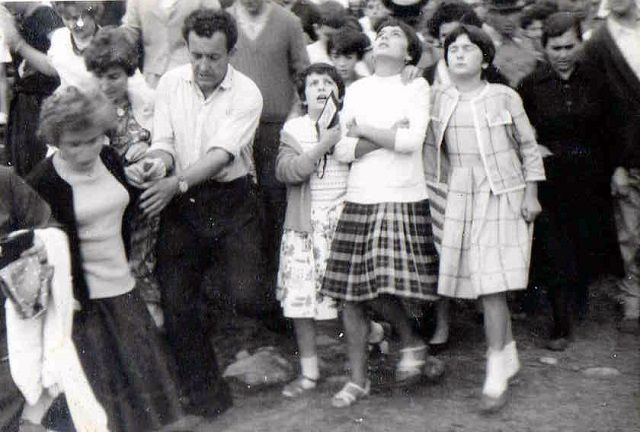
If certain prophecies prove difficult to study because they say very little, the one known as the “Great Miracle” of Garabandal presents the opposite problem: it says too much, but it does not say everything at the same time, nor in the same document, nor through the same person, nor with the same degree of certainty. When one reads a Garabandalist page today and finds, perfectly assembled, the announcement of a Thursday between the 8th and the 16th of March, April or May, at eight-thirty in the evening, the feast of a martyr of the Eucharist, coinciding with a very rare event in the Church, preceded by a Warning, followed by a permanent sign in the Pines, with the sick healed, unbelievers converted, a Pope who will behold it from wherever he may be, Padre Pio who will also see it, a blind man who will receive new eyes and a Jesuit whose incorrupt corpse will reappear, one gets the impression of facing a primitive revelation, compact and perfectly fixed since 1961, yet that is not the case. What exists is a dossier that was built up in layers over more than half a century.
And perhaps the most interesting thing is to study it without resorting much to opponents of Garabandal. To reconstruct this history one can use Conchita’s own Diary, the favorable book by Francisco Sánchez-Ventura, the interviews preserved and disseminated by Garabandalist centers and, for one specific point, an academic study published in American Anthropologist. In this way one avoids the suspicion that the difficulty arises from a hostile reading: to a large extent, it is the very documents used to defend Garabandal that allow us to observe the curious evolution of the announcement.
The primitive nucleus: a considerably simpler prophecy
The first care this question demands is to distinguish what Conchita wrote from what the editors later added as an explanation of what Conchita wrote. Her Diary, begun in 1962 and finished in the second half of 1963, contains an unequivocal paragraph in the first person. There she states that the Virgin has communicated to her “the date of the miracle and what it will consist of”; that she must announce it eight days beforehand so that people may come; that the Pope will see it from wherever he is, and likewise Padre Pio; that the sick present will be healed, sinners will be converted and those who behold the prodigy will be unable to doubt. This is truly the ancient nucleus and the most firmly documented part of the prediction.
But something significant occurs. In the published editions of the Diary there appears, a few pages earlier, a long paragraph in brackets—that is, editorial—which already gathers almost the entire known repertoire: Thursday, holy martyr linked to the Eucharist, great ecclesial event, eight-thirty in the evening, duration of ten or fifteen minutes, permanent sign, healings, Padre Pio, Pope… The very typography makes it possible to see where Conchita’s voice ends and where the editor’s systematization begins. This does not mean that those data are necessarily late or falsely attributed; it means something more modest, yet fundamental: not all of them are contained in that original autobiographical paragraph so often cited as if it contained them.
Nevertheless, several of them appear very early by another route. Francisco Sánchez-Ventura published in Spain in August 1965 Las apariciones de Garabandal and claimed to possess the originals of certain texts “written in Conchita’s own hand.” Among those texts there is already a much more developed description: the Miracle will coincide with an important event in the Church and with the feast of a “holy martyr of the Eucharist”; it will take place at eight-thirty in the evening on a Thursday; it will be visible from the village and the surrounding mountains; the sick present will be healed; unbelievers will believe; and in the Pines there will remain forever a sign that can be filmed and televised. This document is important because it shows that a large part of the complicated later program was not born yesterday on the Internet: it was already substantially configured in 1965.
Up to this point, therefore, the history can be reconstructed with a certain clarity. Around 1963 there exists a nucleus: the date known to Conchita, public announcement eight days in advance, healings and conversions, visual presence at a distance of the Pope and of Padre Pio. In 1965 the second stratum is documented: Thursday, 8:30 p.m., Eucharistic martyr, ecclesial event and permanent sign. What we still do not find assembled with the same solidity are March, April or May; the days from the 8th to the 16th; the month of April exclusively; the saint with the strange name; the one who is not Spanish; the year after 2000, and all the rest of the details that will eventually turn a religious prophecy into something resembling a problem of the perpetual calendar.
Proper names enter the scene
Even before that first development is completed, two concrete persons appear whose future will be linked to the Miracle. The first is Joey Lomangino, the American who had lost his sight in an accident. Here the documentation is particularly interesting because there exists a letter attributed to Conchita, dated 19 March 1964, whose transcription has even been collected in an academic study. Conchita tells Joey that on that day, in a locution in the Pines, the Virgin told her that he will receive “new eyes” on the day of the great Miracle. This is not, then, a rumor that appeared decades later. The individual promise is ancient and precise.
The second is the Jesuit Fr. Luis María Andreu, who died in August 1961 after exclaiming “Miracle!” during one of the ecstasies. A letter from Conchita derived from a locution of 18 July 1964 announces something even more surprising: the day after the Miracle Fr. Andreu’s body would be taken from the tomb and would appear incorrupt. The edition of the Diary preserves this formulation. Curiously, in a 1973 interview Conchita expressed it slightly differently: she said that on the day of the Miracle his body would be found incorrupt. It is not a capital difference—one day more or less is a small matter within so considerable a prodigy—but it is a good example of how difficult it is to turn this entire oral and written tradition into a single notarial protocol.
And then something happened that introduced a new difficulty into the prophecy. Padre Pio died on 23 September 1968. The prediction preserved in the Diary was very simple: Padre Pio “will see” the Miracle from wherever he is. The problem did not go unnoticed by those concerned. A source favorable to Garabandal expressly acknowledges that Conchita was perplexed by the Capuchin’s death because the prophecy seemed not to have been fulfilled. About a month later the explanation arrived: Fr. Bernardino Cennamo had assured her that Padre Pio had seen the Miracle in advance before dying, because he himself had told him so. The original datum was thus preserved, though by a small semantic shift: “he will see it” no longer meant that he would live to behold the future event when it occurred, but that he had already beheld it beforehand in a private vision. The solution is possible, of course; it is simply not exactly what the spontaneous reader would have understood before 23 September 1968.
This will be a procedure that reappears several times: when history poses a difficulty, the previous statement is not abandoned; its interpretation is broadened. Each new explanation makes it possible to keep the piece, even though the puzzle increasingly requires more detailed instructions.
From 1971 to 1978: the calendar narrows and, at the same time, becomes more complicated
The famous window from the 8th to the 16th of March, April or May does not belong to the primitive text of the Diary. Garabandalist sources usually trace it to a conversation Conchita is said to have had with a group of Americans on 10 August 1971: the Miracle would take place between the 8th and the 16th of March, April or May, excluding February and June. The datum is widely repeated today, but its documentary quality is inferior to the letter to Joey or the manuscript cited by Sánchez-Ventura: the pages that transmit it reproduce the conversation, but do not offer the original manuscript or the contemporary recording that would be desirable to possess for a precision of such magnitude.
In 1973, an interview with Conchita adds other pieces. She again asserts that she knows day, month and year; she states that the date will come “soon,” although she will reveal it only eight days beforehand; she specifies that the sick present will be healed regardless of their illness or religion; that all present will believe; that sinners will be converted; and she offers a truly singular description of the sign that will remain in the Pines: it can be seen, photographed and televised, it can be touched but not felt and it will be, she says, “like smoke”. She adds moreover that Joey Lomangino will recover his sight and that a paralyzed boy whose parents came from Garabandal will also be healed.
The “soon” of 1973 has now enjoyed a respectable existence of more than half a century. This, in itself, refutes nothing, because soon lacks a unit of measure and prophetic literature is well acquainted with the remarkable elasticity of certain adverbs; it does advise, however, against using them as too fine a chronological instrument.
Still more substantial is the interview of 7 February 1974, published in Needles. Conchita explains there that the “great event” that will coincide with the Miracle will be a singular ecclesial fact, very rare, that has occurred at other times but never during her lifetime, something— she says only by way of comparison—similar to the definition of a dogma, inasmuch as it will affect the whole Church. She further clarifies that this event will not be a consequence of the Miracle: both will simply coincide on the same day. When asked how she will announce the date, she replies that probably at midnight, eight days beforehand, she will call Joey, the radio, television and whoever can spread the news quickly.
That same interview contains two decisive data. The first is that, asked how much time will elapse between the Warning and the Miracle, Conchita answers with complete simplicity: “I do not know”. It is worth recalling this because three years later, in February 1977, Mari Loli stated that the Miracle would occur within the year following the Warning. Therefore the well-known formula “the Miracle will take place less than a year after the Warning” is not properly a precision of Conchita: it comes from Mari Loli and coexists with Conchita’s explicit statement that she did not know that interval.
The second datum again concerns Joey. In 1974 one no longer speaks only of ambiguous “new eyes.” Conchita specifies that at the moment of the Miracle Joey will have new eyes and afterwards will see permanently. The phrase matters greatly because it considerably hinders any later attempt to turn those “new eyes” into a purely spiritual metaphor.
In February 1977 a direct and solidly transmitted precision arrives: asked expressly about the months in which the Miracle may occur, Conchita replies: “from March to May”. She adds that someone situated in the mountains, if able to see the Pines, will be able to behold it clearly. The picture thus begins to seem fairly closed: Thursday, 8:30 p.m., between March and May and—if we accept the 1971 conversation—between the 8th and the 16th. The grid is narrow enough to keep calendar enthusiasts occupied for decades, yet, curiously, wide enough to continue offering possibilities year after year.
The corpse that had already decomposed
The interview that the Jesuit Fr. Francis Benac conducted with Conchita in June 1978 allows us to observe with extraordinary clarity another of these readjustments. Benac asks her about the prophecy concerning Fr. Luis Andreu. Conchita insists: after the Miracle, the priest’s body will be found incorrupt. Then Benac reminds her of a fact of no small importance: when the tomb was opened to transfer his remains to Loyola, the body was decomposed. Conchita replies that she knows this. Benac asks, with understandable logic, how one thing can be reconciled with the other, and she answers essentially that the Virgin said it would be found incorrupt after the Miracle and that she does not know how it will happen.
The prophecy, therefore, inevitably changes its nature. As long as the corpse had not been examined, “will be found incorrupt” could be understood as the miraculous preservation ordinarily attributed to certain saints. Once its decomposition was verified, what was announced now requires something different and still greater: a future supernatural recomposition of a corpse known to be corrupted. There is no logical contradiction if one admits such a divine intervention from the outset; but the affirmation is also placed on ground where no present verification can affect it. Everything remains pending the future event that one is precisely trying to demonstrate.
In the same interview, Benac asks another very pertinent question: when it was said that “the Pope” would behold the Miracle from wherever he was, was it referring to the reigning Pope at that time? Conchita replies no; when that statement was made, John XXIII reigned and the Virgin did not specify which pontiff it would be: she simply said “the Pope”. This means that one of the apparently most impressive data actually possesses a very notable temporal elasticity: as long as there is a Pope when the Miracle occurs, the condition may be considered fulfilled.
Three Popes, four Popes and a Pope who does not count
The famous “prophecy of the three Popes” deserves separate mention, because here arithmetic reaches a certain delicacy. Tradition places the episode around the death of John XXIII, on 3 June 1963: after that pontiff there would remain only three Popes and then would come the “end of times,” an expression Conchita would distinguish from the end of the world. There is also independent, though retrospective, support in an academic anthropological study that records this tradition as already established in 1963.
What is truly interesting occurs in an interview recorded by Msgr. Francisco Garmendia in August 1981. Conchita states with complete precision: when John XXIII was alive, the Virgin said that “three Popes remained.” Garmendia immediately performs the count in front of her: Paul VI, John Paul I and John Paul II, and exclaims that the circle is tightening. Conchita does not correct the enumeration by saying that John Paul I should not be counted; she simply speaks again of the “end of times.”
Later the interpretation changed. Presentations favorable to Garabandal began to explain that, in reality, after John XXIII there would be four pontiffs, but one of them should not be counted because he would reign very briefly. The one chosen for this curious category of true Pope but arithmetically dispensable was, naturally, John Paul I, whose pontificate lasted 33 days. The three who “count” thus become Paul VI, John Paul II and Benedict XVI, so that with Francis the “end of times” would have begun. Garabandalist pages today present this reading openly and some claim that the exception of the very brief pontificate would already have been known in 1963, although that precision does not appear in the 1981 interview precisely when Garmendia expressly counts John Paul I as one of the three.
However, a small additional inconvenience had to be resolved: if Francis inaugurated the “end of times,” was he to be the last Pope? The elaborated answer was no: “end of times” would designate an epoch, of indeterminate duration, during which there would continue to be Popes. The same favorable source states this expressly. Thus one arrived without special difficulty at Leo XIV, elected on 8 May 2025, 267th successor of St. Peter.
None of this constitutes a theological impossibility; but it does produce a curious documentary effect. The prophecy that seemed to offer a countdown—three Popes and then…—ends up admitting that, after the three, as many Popes as correspond during an “end of times” whose duration no one knows may come. The figure is saved, but it loses almost all usefulness for dating anything. It is an impeccable survival achieved at the modest price of renouncing the chronological function that initially made the figure so striking.
Joey Lomangino and the eyes that were to see
Something similar, though far more delicate from a human standpoint, occurred with Joey Lomangino. Let us recall the sequence: letter of 19 March 1964, “you will receive new eyes on the day of the great Miracle”; 1973 interview, he will recover his sight; 1974 interview, “he will have new eyes” and will see permanently afterwards. We are not dealing with an inference from opponents of Garabandal: these are statements preserved in Garabandalist sources and the 1964 letter is reproduced in an academic journal.
Joey died on 18 June 2014 without having recovered his sight. His death produced understandable bewilderment among those who for decades had hoped to see him behold the Miracle bodily; he himself had been one of the principal worldwide propagators of Garabandal.
It is possible, of course, to reinterpret the “new eyes” as glorified eyes, spiritual eyes or vision from eternity. Religious language permits such readings. But here the same phenomenon recurs as with Padre Pio: the interpretation available after the death is not the natural interpretation the words had while the person was alive, and it is especially difficult to harmonize with the 1974 precision that Joey, from that moment on, would see permanently. The prophecy does not disappear; it changes register. And each change of register increases a little the distance between the original formulation and the later solution.
2018: Father Morelos manages to determine April
One of the most picturesque layers of the dossier was still missing. On 6 October 2018, Guadalupe Morelos de Kania, niece of the Mexican priest Gustavo Morelos, published the recollection of a conversation her uncle is said to have had alone with Conchita almost half a century earlier. It is important to underline the nature of the source: we are not dealing with a recording of that conversation nor with a letter written then by Conchita, but with a niece recalling in 2018 what her uncle had told her decades earlier. And the witness herself, with laudable sincerity, acknowledges at the end that she was eleven years old, that 47 years had passed and that on some details she could not be sure whether she had heard them from her uncle or later from other people.
With those precautions, the conversation deserves to be told because it is almost a perfect miniature of the entire problem. Fr. Morelos is said to have tried to circumvent the prohibition against revealing the date by means of questions to which Conchita would only have to answer yes or no. First three months of the year? No. First semester? Yes. Month of Jesus? No. Month of Mary? No. Having thus ruled out March, May and June, the priest triumphantly concludes: April. Conchita is said to have answered affirmatively. Between the 7th and the 17th? Yes. Is the martyr Jesus? No. Have you seen it on the calendar? Yes. Is he Spanish? Conchita believes not, because he has a very strange name she had never heard. Later, when trying years, she is said to have indicated that much time remained, that she would already be very old to announce it on radio and television and, finally, to have confirmed that it would take place after the year 2000.
Thus, a conversation made public in 2018 would retrospectively narrow the prophecy down to a Thursday in April between the 8th and the 16th, after the year 2000, feast of a male Eucharistic martyr, apparently not Spanish and with a name unfamiliar to a Cantabrian girl of the 1960s. It is difficult to deny that the problem begins to acquire a certain combinatorial beauty.
And here appears the secular search for the mysterious saint. St. Tarsicius would seem an unsurpassable candidate: he is called “martyr of the Eucharist”; unfortunately his feast is on 15 August, outside the permitted months. St. Hermenegild, on the contrary, falls splendidly on 13 April and his martyrdom was directly related to his refusal to receive communion from the hands of an Arian bishop; but he has the discourtesy of being a Visigothic prince of Spain, which clashes with the late recollection that the saint would not be Spanish. Blessed Imelda Lambertini, celebrated in May and most closely linked to the Eucharist because she died after miraculously receiving Communion, fits admirably with one part of the riddle, but presents another inconvenience: she is not a martyr.
Each candidate seems to possess precisely the virtues necessary for one to think of him and the small defect sufficient for the search to continue. And thus the calendar of saints, which normally helps the faithful reach heaven, in this case lends the supplementary service of providing material for calendars across generations.
What remains when the papers are put in order?
After reconstructing the chronology, the question becomes considerably simpler. There does exist a prophecy of the Miracle that can be attributed documentarily to Conchita; but there does not exist a single primitive document in which the complex system that today is usually presented as a perfectly unitary revelation appears from the beginning. There is an ancient and strong nucleus; there are written precisions from 1964-65; there are interviews from the 1970s that add or clarify elements; there are data transmitted by conversations whose original documentation does not appear; there are divergences between the visionaries themselves; there are explanations produced after the death of the persons affected by certain predictions; and finally there are second-hand recollections published half a century later that further restrict the calendar.
The difference is not small. To accept the whole set as a single perfectly coherent prophecy it is necessary to grant practically the same value to a paragraph written by Conchita around 1963, a letter of hers dated 1964, a manuscript that Sánchez-Ventura claims to possess in 1965, a conversation with Americans attributed to 1971, interviews of 1973, 1974, 1977, 1978 and 1981, Mari Loli’s different statement about the interval between Warning and Miracle, an explanation received after the death of Padre Pio, a reinterpretation of Joey’s death, a new papal arithmetic that allows one not to count John Paul I and a recollection published in 2018 by a lady who honestly declares that she is not sure of all the details she heard when she was eleven years old. The whole can be harmonized; certainly it can. It merely requires a labor of harmonization of notable constancy.
And this is the most serious observation that can be made without injuring anyone. A prediction gains strength when subsequent events unequivocally narrow its meaning; it loses it when it is the events that force one to broaden the meaning of the earlier words. Padre Pio was to see the Miracle: he died, and then it was learned that he had seen it in advance. Joey was to receive new eyes and see permanently afterwards: he died blind, and the eyes could be understood in another way. Fr. Luis would be found incorrupt: it was verified that he was decomposed, and then incorruptibility became a future restoration after the Miracle. After John XXIII three Popes would remain: John Paul I was expressly counted in 1981, but later ceased to count; Benedict XVI took his place; Francis came to inaugurate the “end of times” and, so that Leo XIV would cause no difficulty, the end of times was defined as an epoch in which pontiffs may continue to succeed one another. Every difficulty finds a response; what is remarkable is that no response seems capable of diminishing the number of future possibilities.
There is, moreover, a paradoxical consequence. The enormous accumulation of data produces a sensation of precision: Thursday, 8:30 p.m., March-May, perhaps April, days 8-16, Eucharistic martyr, ecclesial event, eight days’ notice, sign, Pope, Pines… But when one examines closely the provenance of each piece, that precision dissolves into different degrees of certainty, different years, different witnesses and different reinterpretations. What seemed an increasingly verifiable prophecy ends up being a system increasingly difficult to refute, because there is always left open a distinction, an exception, a different sense of a word or a piece of information that was not yet known.
Nothing obliges the Catholic to venture indefinitely into such a labyrinth. The Catechism recalls that private revelations, even when recognized, do not belong to the deposit of faith; their function is never to complete the definitive Revelation of Christ. Perhaps this is, finally, the most restful exit from the whole problem. To live the Catholic faith it is not necessary to discover which Thursday in April will fall between the 8th and the 16th, to find which Eucharistic martyr possesses a sufficiently strange name, to decide which Pope counts and which does not, nor to determine in what way eyes that were to see can begin to do so after having been closed by death. The faith certainly has higher mysteries; but, fortunately, ones far less in need of calculation.