


Ninety years after his flight from Madrid, Manuel García Morente’s conversion continues to challenge the godless intellect
On September 26, 1936, Manuel García Morente, who had served for more than four years as dean of the Faculty of Philosophy and Letters at the Universidad Central, received word that he was going to be killed. He fled Spain and arrived in Paris with seventy-five francs in his pocket. Seven months later, that philosopher who was not a believer fell to his knees in an empty apartment and discovered that he no longer remembered how to pray.
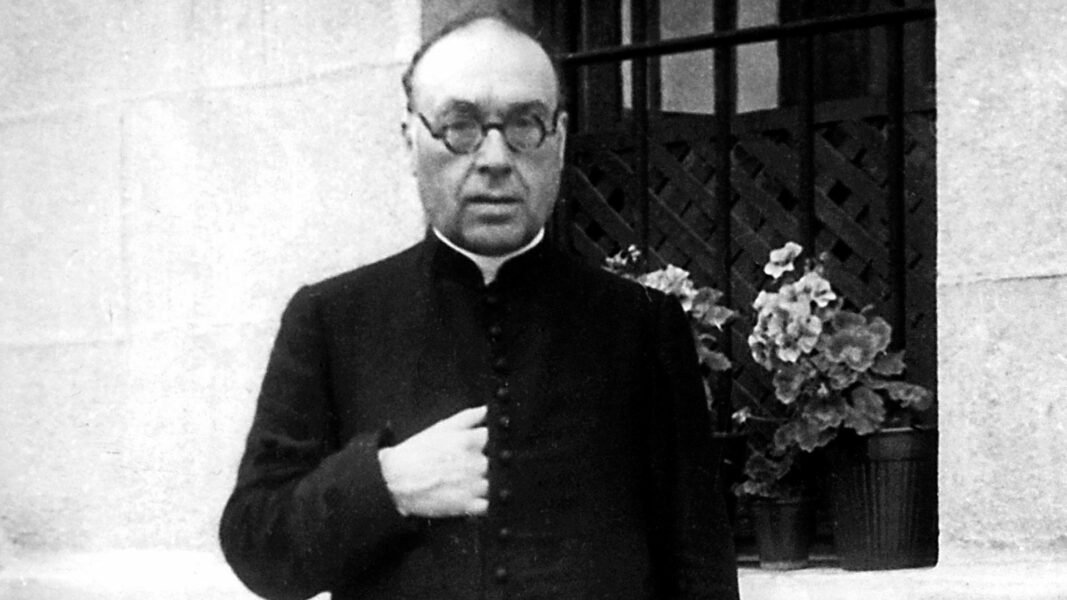
Born in Arjonilla in 1886, Morente had withdrawn from politics when the Republic was proclaimed, after serving as Undersecretary of Public Instruction, and was unanimously elected dean of the Faculty. He promoted a university reform plan that bore his name, and with it the Faculty inaugurated a new style and new buildings in the University City. Julián Marías remembered him as “the Dean,” adding: “He was unsurpassed, from every point of view.” He had been a practicing Catholic until adolescence; afterward, his thought was constructed without God, and at times against Him.
On August 28, 1936, while handing over the deanship to Besteiro, from which the Government had dismissed him, he was told by telephone that his son-in-law had been murdered in Toledo. He was twenty-nine, an engineer, a member of the Nocturnal Adoration, and had just become a father for the second time. Morente collapsed to the floor. Besteiro secured an official car with an escort to bring his daughter—widowed at twenty-two—and his two grandchildren to Madrid. At home, the women of the family gathered in a corner and prayed for hours. He would later write: “I then could not, and perhaps did not know how, to pray.”
Those weeks were filled with terror. The militiamen took the neighbors’ eldest son, who was later murdered in Paracuellos. Morente burned his government papers in the boiler, and the next day the house was searched. The family spent the day behind closed shutters, counting the footsteps of the assassins on the stairs and breathing again when they passed by. On September 26, a confidential warning informed him that they had decided to kill him. He obtained a safe-conduct pass through a friendly minister, left for Barcelona—where he was nearly arrested by mistake—and arrived in Paris on October 2.
Exile was a continuous humiliation. A friend lent him a room, and a French widow offered him her table. Alone on the eighth floor, he spent sleepless nights wondering if he had been a coward to abandon his daughters. Everything he tried on his own failed: dealings with the British embassy, the Red Cross, the search for work. Yet what he had not sought came to him unbidden: an editorial commission to compile a dictionary, a chair at the University of Tucumán, a chance encounter that opened the possibility of getting his family out of Spain.
Three times the idea of Providence brushed against him, and three times he rejected it with what he himself called stubbornness and pride. He felt like a straw driven by a hurricane, yet he took refuge in determinism. On April 27, 1937, a telegram arrived: the Government denied exit to his daughters. Alone in the apartment, he forced himself to think methodically. He concluded that his life had been made without him, that something or someone other than himself was making it and giving it to him. But that God of philosophy, in whom one thinks but to whom one does not pray, seemed cruel and distant to him.
The rebellion reached its extreme. He thought that the only free act left to him against that hostile Providence was to take his own life, and he was horrified to see where his reasoning had led him. To distract himself, he turned on the radio. French music was playing: César Franck, Ravel’s Pavane, and then a fragment of Berlioz on the childhood of Jesus. When it ended, he switched off the set so as not to break the peace it had left him, and scenes from the life of Christ began to pass through his mind, up to the cross raised above a suffering humanity.
Then he understood. “That is God, that is the true God, the living God,” he said to himself. Not the geometric and inhuman God of the philosophers, but the God made man who suffers as we do. He knelt to pray the Our Father and discovered, with horror, that he had forgotten it. He remembered his mother, who had died when he was nine, and the lap in which he used to lean to pray with her. It took him an hour to reconstruct the prayer; some phrases came out in French, and he copied it into a notebook. He also recovered the Hail Mary. The Creed and the Salve Regina resisted him.
Past midnight he fell asleep in an armchair. He awoke startled, opened the window, and, turning around, stood petrified: “There He was. I did not see Him, I did not hear Him, I did not touch Him. But He was there.” He described it as a perception without sensations, flooding him with a joy nothing could equal, which ended in an instant. By a freight train that passed in front of the house he calculated that it had lasted a little more than an hour, though he admitted it might have been a minute. He found something similar only in chapter 27 of the Life of Saint Teresa.
Most revealing is the caution with which he told it. The philosopher did not surrender to enthusiasm: he examined the hypothesis of hallucination and that of diabolical deception, and resisted believing that God would have chosen to visit a man who considered himself a sinner. Only one argument made him doubt: the fruits. The next day he resolved to become a priest. On June 29, 1938, in Vigo, he received what he called his second first communion. He entered the Mercedarians of Poyo, was ordained on December 21, 1940, and died in Madrid on December 7, 1942.
He spoke of that night to no one, not even in confession. In September 1940 he wrote it down for his spiritual director, José María García Lahiguera, now venerable, and asked for counsel and silence. Ninety years after his flight, Morente’s story says something the university of today needs to hear: the most brilliant intellect can construct an entire system not to pray, and one night of powerlessness is enough for it to collapse. The God he sought was not at the end of a reasoning, but on the cross of a man who awaited him.
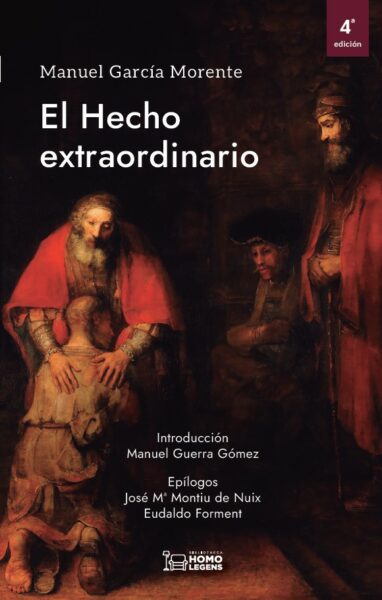
That relationship is at the center of The Extraordinary Event, published by Homo Legens with an introduction by Manuel Guerra Gómez on Morente’s spiritual itinerary and epilogues by José María Montiu de Nuix and Eudaldo Forment. Guerra maintains that the change was such that one might consider his beatification. Morente found the key to that night much later, reading Saint Augustine: “Restless is my heart until it rests in Thee.”

The Extraordinary Event, by Manuel García Morente. Introduction by Manuel Guerra Gómez. Epilogues by José María Montiu de Nuix and Eudaldo Forment Giralt. Bibliotheca Homo Legens.