


By Brad Miner
We have all done things we regret.
One of the many salvific glories of Catholicism is the sacrament of Penance, although, as we all know, the priest’s absolution does not turn the penitent into a tabula rasa – a clean slate.
For one thing, although our guilt before God is forgiven (not erased), the temporal consequences of sin will likely continue. Say I commit a murder and then, after experiencing remorse, I sacramentally confess the crime, turn myself in to the police (probably at the priest’s insistence), and am tried, convicted, and sentenced to life in prison. My confessor’s absolution would not erase, because it cannot, the effect of my crime on the lives of the victim’s family and friends.
In Hamlet, a company of actors arrives at Elsinore, and the officious and deceitful Polonius, chief counselor to the murderous King Claudius, assures Prince Hamlet that the actors (a profession of ill repute) will be treated “according to their desert,” to which Prince Hamlet replies:
God’s bodykins, man, much better: use every man
after his desert, and who should ‘scape whipping?
It is then that Hamlet realizes that his “play’s the thing/Wherein I’ll catch the conscience of the king.”
That word, conscience, has two meanings in the great play. The first is the one Jiminy Cricket (a euphemism for Jesus Christ, if ever there was one) says to his marionette friend Pinocchio (in the 1940 Disney version): “Always let your conscience be your guide.” Although in Carlo Collodi’s 1881 book he is known simply as the Talking Cricket, “he” is the same voice of moral reason that is heeded.
So Hamlet bets that, however depraved Claudius may be (and he is very much so), he still viscerally knows good from evil.
The other meaning of conscience appears in the Most Famous Soliloquy in the World, “To be or not to be . . .” The prince has nearly reached the breaking point and, although it has been debated whether Hamlet contemplates suicide (he does not), he is certainly weighing in his mind existential questions: life versus death, with much of either/or. “Thus,” he says, “conscience doth make cowards of us all.”
Credit must be given; he is in a tremendous mess, with fratricide and incest forbidden by Leviticus. As Hamlet says:
O cursed spite,
That ever I was born to set it right!
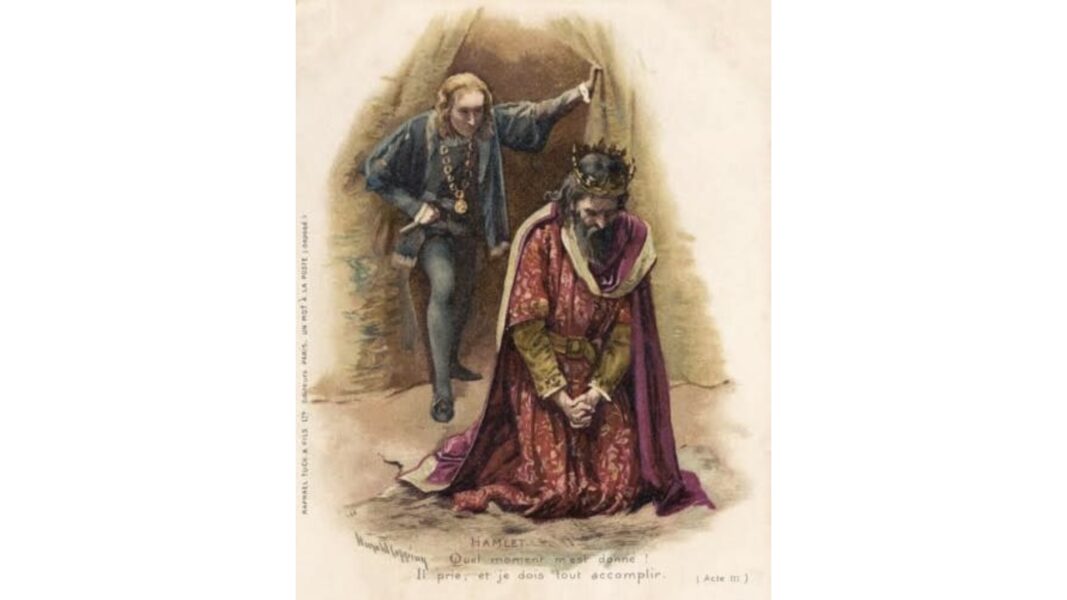
And Shakespeare’s wealth on guilt, conscience, and forgiveness does not end there. Hamlet, still guiltless in his own conduct, comes upon the murderous and fornicating King Claudius in prayer. The king whispers: “O, my offence is rank it smells to heaven,” and the prince thinks: now is the moment. Hamlet’s next words are difficult for an actor:
Now might I do it pat, now he is praying;
And now I’ll do’t. And so he goes to heaven . . .
Is this a false conscience on Hamlet’s part? If so, actor, recite it quickly! If, instead, the prince is thinking aloud (as everyone in the play seems to do), then go slowly; let that last phrase rise almost like another existential question. After all, Hamlet knows he cannot open the Gates of Heaven, nor can he judge the usurper king’s soul. Unresolved, Hamlet withdraws; too soon to hear Claudius reject his own prayers, wallowing in his sins:
My words fly up, my thoughts remain below:
Words without thoughts never to heaven go.
Up to that point, Hamlet has done nothing that requires him to present himself for confession. Earlier in the play, Hamlet’s father’s ghost is clearly in Purgatory – according to the ghost’s own account. Hamlet senior even says he is there because he died with unconfessed sins. This comes straight from the Catholic Catechism. Of course, Hamlet junior later doubts: perhaps the apparition he saw was actually a demon! That is why “The Mousetrap,” the play the visiting actors will perform before Claudius, is essential: Claudius’s reaction will give him away. And it does! Seeing his own murder of his brother accurately portrayed makes him run out shouting: “Give me some light: away!”
It is easy to say that Hamlet should have run Claudius through with a rapier while he was on his knees, although leaving vengeance to the Lord is the better course. And yet, it is hard to argue with the consequences of Hamlet’s inaction: Polonius, Ophelia, Laertes, Gertrude, Claudius, and Hamlet himself will die because of the prince’s procrastination.
Catholic elements abound in Hamlet, probably because the Bard was a recusant Catholic, but almost certainly because he was versed in the moral theology of Thomas Aquinas. And this we see not so much in Hamlet’s scruples as in Claudius’s resignation. Not only does he realize he lacks contrition for having murdered his brother, but he goes on to kill his nephew and thus knowingly trades his reign for damnation.
In the Summa Theologiae, Saint Thomas is inflexible about what is required for the forgiveness of sins involving theft or usurpation. He states that restitution is an act of commutative justice and is strictly necessary for salvation. In a famous echo of Saint Augustine, the Thomistic tradition dictates that “without restitution, repentance is nothing but a mockery.”
In that scene in which he offers his empty prayer, Claudius confronts this truth. “May one be pardon’d,” he asks, “and retain the offence?” He knows it is impossible, but he is unwilling to repent, confess, and surrender. Aquinas emphasized the contrast between synderesis, our innate sense of good and evil (“do good and pursue it, and avoid evil”), and conscientia, the way we choose to act (“knowledge applied to” concrete situations). Claudius’s sin is a failure of conscientia to recognize synderesis.
As happens to all of us, at times, for which we pray that God have mercy on us all.
About the author
Brad Miner, husband and father, is senior editor of The Catholic Thing and senior fellow of the Faith & Reason Institute. He was literary editor of National Review and had a long career in the publishing industry. His most recent book is Sons of St. Patrick, written with George J. Marlin. His best-seller The Compleat Gentleman is now available in a third revised edition and also as an Audible audio edition (read by Bob Souer). Mr. Miner has served on the board of Aid to the Church In Need USA and also on the board of the Selective Service System in Westchester County, NY.