


By Michael Pakaluk
St. John of Antioch, called Chrysostom or “golden mouth” (d. 407), “is generally considered… the greatest preacher ever heard in a Christian pulpit,” according to the Catholic Encyclopedia.
Or are homilies even more golden when they are concise? Almost all the surviving works of the fifth-century bishop of Ravenna, Peter, are homilies remarkable both for their brevity and their eloquence. Tradition holds that this Peter received his nickname, “of the golden word,” when the Roman empress heard him preach and proclaimed him “Chrysologus!” Venerated as a saint and later declared a Doctor of the Church, he is today called the “Doctor of Homilies.”
It is not that golden words are the same as holiness. They sound hollow and seem manipulative, like a cheap cymbal that tinkles, unless they express sincere devotion. St. Paul lays down the principle: “my speech and my preaching were not with persuasive words of human wisdom, but with demonstration of the Spirit and of power, so that your faith might not rest on the wisdom of men, but on the power of God” (1 Corinthians 2:4-5).
Fulton, the twentieth-century bishop of Rochester, New York—who will be beatified today—fully understood the point. A necessary condition of his preaching was to spend an hour before the Blessed Sacrament in prayer, which he did without fail for more than sixty years.
He was first a philosopher and theologian, but also—and this is quite rare—he was an orator, and recognized as a great one, when the traditions of oratory were still transmitted, though fading, in Catholic colleges and universities. He said he never spoke from a written text. People had to be addressed as people, not texts. He quoted what an old Irish woman said about a bishop who read his speech: “If he cannot remember it, how does he expect us to remember it?”
In his autobiography, Treasure in Clay, he recounts that above all he studied the style of G. K. Chesterton—“who never used an unnecessary word, who saw the value of paradox and avoided the trite”—but also that of C. S. Lewis and Malcolm Muggeridge.
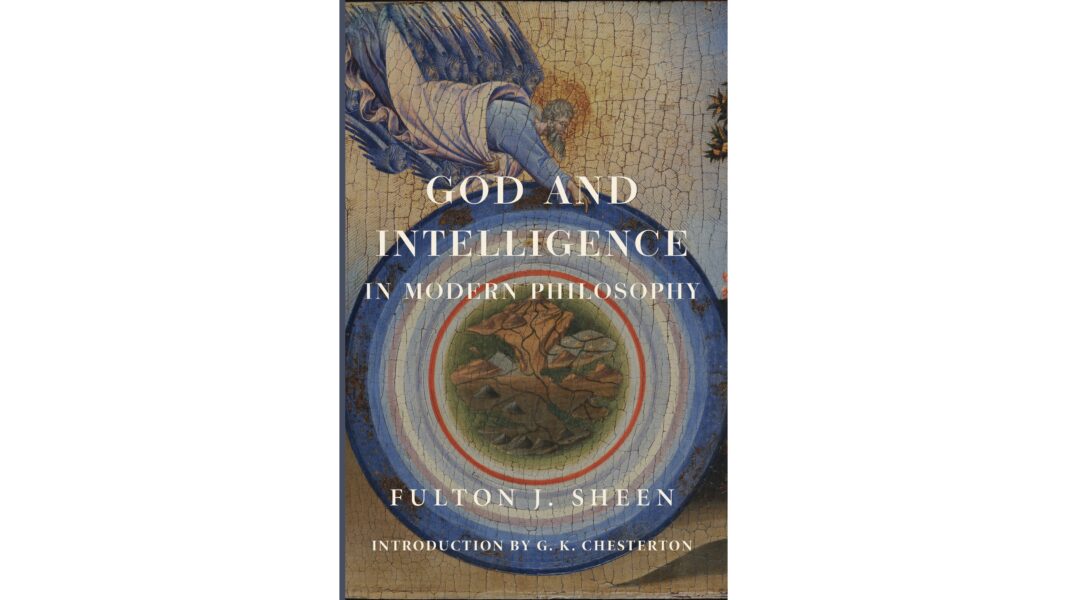
After writing his dissertation in Louvain, Belgium, he taught at the seminary of the Archdiocese of Westminster in England, St. Edmund’s, where Fr. Ronald Knox was his colleague. Perhaps it was Knox who introduced him to Chesterton in 1925. In any case, Chesterton later agreed to write an introduction for Sheen’s first book, God and Intelligence in Modern Philosophy (1925).
The book is based on Sheen’s dissertation in Louvain. But it is far from being a dissertation, or the dissertation was a most unusual one, because it is not written in a flat academic style, but sparkling with Chestertonisms and quasi-paradoxes. From the beginning, Sheen’s words were golden on the page as well as from the pulpit.
His opening paragraph is a variation on “Wanted, An Unpractical Man,” by Chesterton, in What’s Wrong with the World:
Modern philosophy has seen the birth of a new notion of God. There is nothing of greater importance, nor could there be anything more ultimate. Even the very attitude of one man toward another or of one nation toward another varies with the conception of God. The outlook on the world changes the moment the outlook on God changes. And if we had sufficient intellectual vigor to ascend from effects to causes, we would explain political, economic, and social phenomena less by balance sheets, trade balances, and reparations, than by our attitude toward God.
The new notion of God is not that of a divinity who is, but of one who becomes. But to accept this notion, Sheen says, is necessarily to accept a changed view of human intelligence. How we understand God and how we understand our own intelligence rise and fall together: “What happens, then, when a philosophy rejects the intellect? It breaks the bond between the world and God, denies a hymn of divine praise to the Creator, and casts the world into an unintelligible pluralism.”
Although published in 1925, no book could be more pertinent to today’s discussions of “artificial” intelligence. “What is the purpose of the intellect?” he asks. “Is it the faculty of the divine, the transcender of the contingent, the plaything of the contemplative, or is it merely a primitive tool used clumsily by men for want of a better instrument?” The latter alternative sums up where we have landed. And now a better instrument is at hand.
Such a world, of a redefined God and a redefined intelligence, must precipitate us into an animal state, living in a society of “scientific feeding” (as Weaver called it in Ideas Have Consequences):
Only a century ago rationalism gloried in having freed the intellect from extrinsic control. Now it has entirely denied the rights of reason and prostrates itself before the altar of feeling. In tearing off the mitre of the intellectual man, it has torn off his head with it. We are no longer men, but animals. We “feel” our way instead of knowing it.
Sheen’s book appeared in the heady days of neo-scholasticism—the first “Catholic moment” of the twentieth century—when serious administrators of secular universities supposed that Thomism might supply what was lacking in their hollow institutions. About the same time that Gilson was invited to lecture at Harvard, Sheen was invited by the president of Columbia to lecture on scholasticism; Cardinal Bourne wanted him at Oxford, alongside Knox.
His bishop sent him instead to be coadjutor of a poor parish in Peoria, and only after a year to The Catholic University of America, where by 1929 he was already speaking of “Educating for a Catholic Renaissance.”
That renaissance did not come. At the end of his life, Sheen told a priests’ retreat: “The only argument the world will now listen to is the argument of personal holiness. It has heard everything else and rejected it.”
Blessed Fulton Sheen, pray for us, that we may play our own part in the renaissance you hoped for, not only with eloquence, but also with the argument of holiness.
About the author
Michael Pakaluk, an Aristotelian scholar and Ordinary of the Pontifical Academy of St. Thomas Aquinas, is professor of Political Economy at the Busch School of Business of The Catholic University of America, Distinguished Senior Fellow at the Gibbons Institute, and editor-in-chief of the American Catholic Quarterly Review. He lives in Hyattsville, MD, with his wife Catherine, also a professor at the Busch School, and their children. His most recent book, on natural law and civic friendship, Walk in the Good Way, is forthcoming from The Catholic University of America Press. You can follow him on Substack at Michael Pakaluk.