


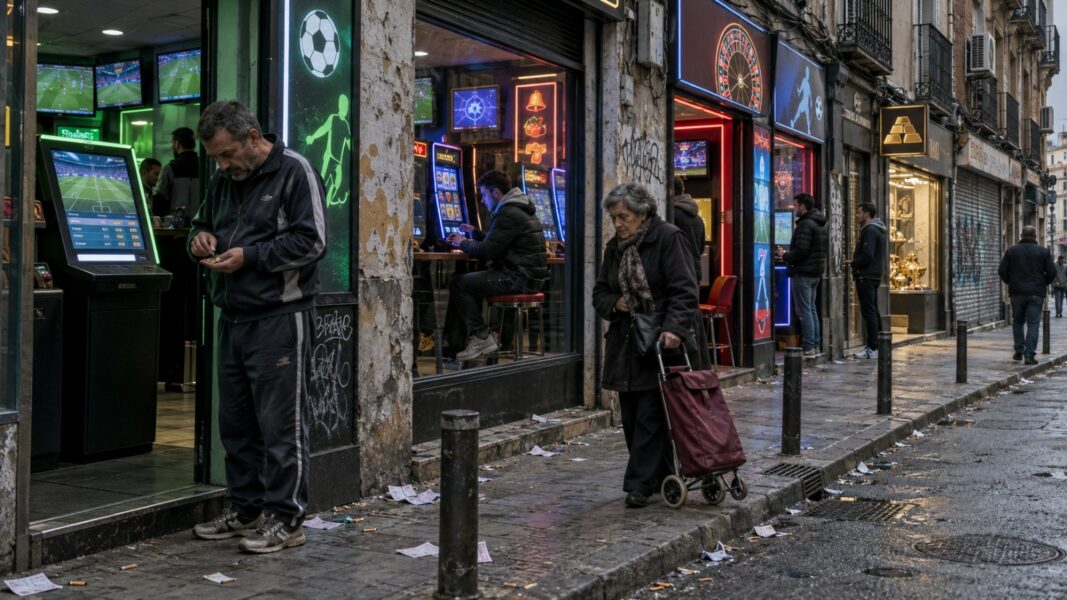
Between the early hours of Wednesday the 23rd and those of Thursday the 24th of September, Cadena COPE broadcast seventeen advertising insertions from six online gambling operators: three sports betting houses, a platform that combines betting with “the best live casino,” a poker and slot-machine brand (“more than 2,500 slots, live games and exclusive releases”) and a sixth operator selling a “free bet” of up to one hundred euros. Two of those insertions were not pre-recorded spots but odds read live by the hosts of the nightly sports program. All of this within the time slot permitted by law, and all of it on a station 75 % owned by Ábside Media, the communications platform created by the Spanish Episcopal Conference in 2020 with the Conference’s own shares and those of most dioceses. Nine months earlier, on 29 December 2025, Leo XIV had told the mayors of Italy about “the scourge of gambling that ruins so many families.”
The Wednesday inventory begins at 01:07:28. The presenter announces “this message” and an institutional voice explains that a betting house “offers you the rest of the program in advance”: it is not an ad between two breaks but the sponsorship of a section of the show itself. The spot from that same house follows (“they know about betting,” “combine thousands of markets in a single play”); at 01:08:41 the live-casino platform; at 01:09:11 a second house offering “a personalized odds” for “your ideal scenario”; at 01:09:48 a former footballer presenting in the first person the free-bet promotion (“if you lose your first bet”); and at 01:10:32 a third house boasting “more than 40 years in this.” Between the former footballer and the third house, the network inserts the spot for the master’s degree in sports journalism of CEU San Pablo University and the COPE Foundation. In those three minutes the phrase “play responsibly, only for those over 18” is heard six times. At 01:25:50 the format changes: a presenter reviews Saturday’s England-Spain match at Wembley, “the first thing we look at is a Spanish victory,” “you get odds of 2.40,” “a goal by Lamine Yamal has odds of 3.10,” and closes with the house’s slogan.
Thursday repeats and expands the pattern. At 01:09:17 the section sponsorship, “today with Grupo Risa”; at 01:10:26 the live casino; at 01:10:57 the forty-year house; at 01:11:17 the newcomer, the poker and slot-machine brand (“enter the house of gaming”); at 01:12:00 the second house with “the best welcome bonus on the market,” which consists of refunding “up to 150 % of your losing bets with your first deposit”; at 01:12:40 the former footballer, who this time chats with the presenter before reading the promotion and receives a “thank you” at the end. In between, again the COPE Foundation. At 01:18:51 the presenter introduces “our message” from the sponsor, “as always at this hour on Partidazo,” goes to the operator’s website, reads the live odds for England-Spain (“Spain wins or draws, odds of 1.40,” “exact score 0-1, 8.50”) and invites listeners to bet. At 01:19:41 the third house returns. And at 04:34:02, already outside the sports program and between a Herrera en COPE promotion and the early-morning bulletin, the 2,500-slot spot plays again. Ten “play responsibly” warnings on Thursday night, sixteen across both nights.
To that must be added, in daytime hours and under a different legal regime, the advertising of public lotteries: an Euromillions spot at 08:58 on Thursday and, at 08:18, in the morning’s highest-audience slot, the promotion of a lottery-sales app offering “credit to try for free” to anyone who registers and enters “the code COPE.” ONCE closes the day at 23:17. None of the above is illegal. Royal Decree 958/2020 limits gambling advertising on radio and television to the slot from one to five in the morning, with the exception of sports broadcasts that begin after eight in the evening, and COPE’s insertions fit that schedule with stopwatch precision. The decree also banned welcome bonuses and the appearance of famous personalities, but the Supreme Court annulled those articles in its ruling 527/2024 of 2 April for lack of legal coverage, so the 150 % refund and the former footballer are now within the rules. What no regulation decides is whether a media outlet accepts or rejects that money. That is decided by the owner.
And the owner has a magisterium to consult. The Catechism (2413) does not condemn gambling itself: “games of chance or wagers are not in themselves contrary to justice,” but “they become morally unacceptable when they deprive the person of what is necessary to provide for his needs and those of others,” and it warns that “the passion for gambling carries the risk of becoming a grave addiction.” On that basis, recent pontiffs have raised their tone as gambling moved from bingo to the phone. Francis, at Roma Tre University in February 2017, cited “the gambling industry” as an example of “present contradiction” and urged universities to work against “gambling addiction, which causes serious harm to individuals and families, with high social costs.” In September 2024, before popular movements, he warned that online betting “destroys entire families” and called for preventing networks from being used “to spread gambling addiction.” In his book “Hope Never Disappoints,” published that same year, he left a phrase that Argentine bishops have turned into a banner: “Our governments cannot be accomplices in inciting gambling addiction.” And it was not only doctrine: the Holy See’s investment policy approved in 2022, in force since 1 September of that year, expressly excludes the sectors of gambling, pornography and weapons. The Vatican cannot hold shares in a betting house. Spanish bishops can collect a spot from one.
Leo XIV has continued in the same line. In his audience with the National Association of Italian Municipalities he pointed out “in particular the scourge of gambling that ruins so many families,” cited Caritas’s annual report and described the phenomenon as “a serious educational, mental-health and social-trust problem.” He said it in a country, Italy, that has banned all gambling advertising since 2019. And other episcopal conferences have gone further than the Pope: the Argentine one asked Congress in November 2024 to prohibit betting advertising “as occurs in other areas harmful to health,” and in 2025 wrote to the Senate a letter titled “Gambling Addiction Is an Attack on Life” demanding urgent processing of the law that bans online-gambling ads. No equivalent statement from the Spanish Episcopal Conference on gambling advertising, nor an internal Ábside Media rule regulating which advertisers the group accepts, is on record at the time of writing. Its accounts also do not break down advertising revenue by sector, so it is impossible to know how much the network invoices betting operators.
What is possible to know, because it is heard on air, is the proportion. In the same twenty-four hours on Thursday in which the bishops’ radio station broadcast ten gambling insertions, it broadcast eleven times the spot of the Episcopal Conference itself asking listeners to include their parish or diocese in their will, twelve seconds about the 159 prison chaplains on the feast of Our Lady of Mercy, and, at five past seven in the morning, the episcopal back-to-school campaign dedicated to catechists. The bishops of Argentina ask their government to ban online-gambling advertising. The bishops of Spain, in the slot in which their government permits it, broadcast it.
Read also