


By Christopher M. Reilly
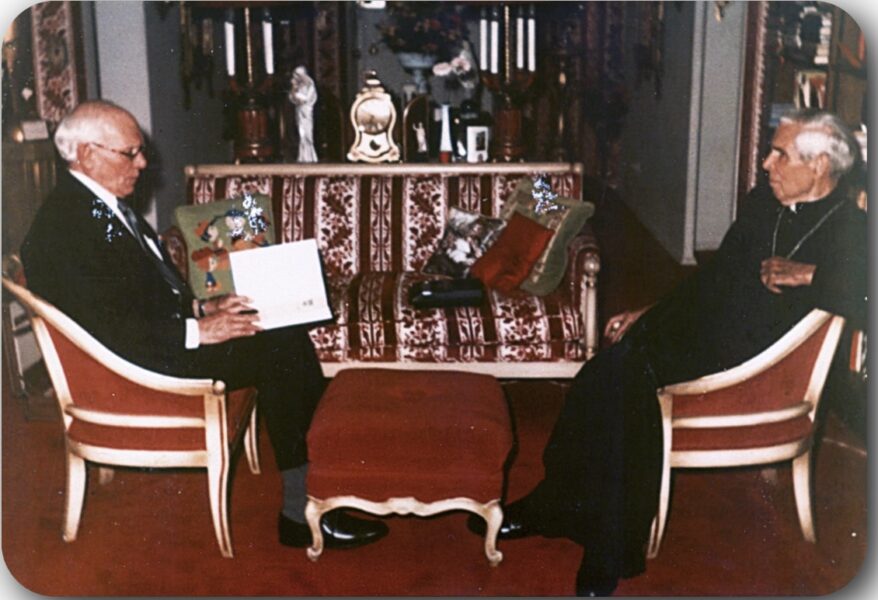
In May 1979, Archbishop Sheen was suffering the effects of recent open-heart surgery. Sheen still longed for social interaction, and had written a note to James P. McFadden, associate editor of National Review and founder of both the Human Life Review and the National Committee of Catholic Laymen: “you spoke of [the celebrated British journalist] Malcolm Muggeridge. There are few men in the world for whom I have a higher esteem… It would honor, delight, and inspire me if both of you could come visit me at my apartment.”
Malcolm Muggeridge was visiting New York that May, and the entire subsequent conversation among Archbishop Sheen, Muggeridge, and McFadden—an inspiring, winding tour through topics as diverse as the value of suffering, the poverty of Marxism and the Soviet Union, and the praise of Mother Teresa of Calcutta—was recorded on audio cassette. The full transcript of this conversation, along with several related documents, was published this month on the website of the Human Life Review.
At one point in the conversation, Sheen was asked if his pain and exhaustion required a break. He replied: “a thousand times no. I’m inspired. I’ve been waiting for this. Oh heavens, if you only knew what a privilege it is. Because I draw light from you and I draw strength from you.”
Of particular interest to contemporary readers is their discussion of evangelization. Sheen insisted that the focus of communication must be the central substance of the faith rather than tricks: “I know that when we spend that money on dramas and on debates and on television programs of any kind, and on crossword puzzles, we’re not going to influence anybody.”
Muggeridge emphatically agreed, presenting Mother Teresa as the prime example: “But that’s the point, because it’s true that words—or the Word—are irresistible, presented by someone who truly believes and lives them.”
Sheen, ever alert to an opportunity to inspire a conversion (Muggeridge was not yet Catholic at that time), stated: “However unaware you may be of it, you appear to people as someone for whom Christ is vital. You are a man in love; ‘out of the abundance of the heart the mouth speaks.’ And people can notice it. They can notice who the phonies are.”
At one point, Archbishop Sheen revealed a more direct—and surprising—approach to evangelization. He launched into a singularly humorous anecdote about his time working in Europe as a college student, where he met a girl at the door of a church:
She said, “Where am I, where am I, Father?” I said, “Oh, are you a Catholic?” She said, “I was. I’m not anymore.” So I made her a cup of coffee, because she’d been exposed to the January air in London. And I asked her to come back. She said, “As long as you don’t ask me to go to confession.” I said, “All right”… I said, “We have a Rembrandt in this church: would you like to see it?” As we walked down a side aisle, I pushed her into the confessional. [laughter] I had only promised her I wouldn’t ask her. Well, she’s been a nun all these years. That was in 1923. And she had a second chance. That’s what we’re dealing with.
Adopting a contemplative tone, Muggeridge later asked: “Do you think it’s legitimate to pray for one’s own death?” Sheen’s response: “Is it right to pray for one’s own death? Well, I did it anyway. Whether it was right or not, I didn’t get it.” Muggeridge offered a deeper analysis: “But it’s a curiously contemporary attitude toward death that rather fascinates me, because I suppose for people who have no idea of any sequel to our existence here, death is an offense to their egos, really, because it’s their final frustration.”
Sheen, Muggeridge, and McFadden spoke of their concerns about the modern Church. At one point, Sheen joked: “Well, the whole concept is, you see, today nobody’s a sinner. Before, only we believed in the Immaculate Conception. Today everybody is immaculately conceived.”
Muggeridge shared a rather somber outlook, declaring that “there’s nothing in history that seems to me necessarily eternal, nothing in history that cannot be bent and disintegrate—no human quality that can withstand the coming of another dark age.”
Sheen, however, reassured his friends about the permanence of the Church even amid its struggles. He shared a deeply personal experience: “the Lord put me through a real crucifixion, this open heart [surgery]. I suffered a pain I didn’t even know existed, a pain that was no longer outside of me, a pain that possessed me, like an ocean overwhelming me. And out of virtue, that’s the only educator in the world.”
But in suffering there is opportunity: “I think when someone wants counsel, they either go to a holy person or to someone who suffers. And while I’ve been in that bed—I’m kept in it most of the time—I’ve instructed four converts and now I’m instructing the fifth… and I validated the marriage, in that bedroom, of my cardiologist and his wife [inaudible] and we had a nuptial Mass in the bedroom.”
For Archbishop Sheen, the Eucharist absolutely must be at the center of revitalization. “And there, I think, is where we’ll recover our catechisms and where we’ll recover our devotions and where we’ll recover our true sense of radio broadcasting and television broadcasting and everything else. We’ll draw near to the fire and then, when we move away from it, we’ll catch sparks.”
Only a few months later, on December 9, 1979, Archbishop Sheen died while praying before the Blessed Sacrament.
About the author
Christopher M. Reilly, Th.D., is coeditor of the Human Life Review. He is also coeditor of a forthcoming book, The Abolition of Meaning: 15 Catholic Thinkers Challenge the AI Paradigm. The full transcript of this conversation between Archbishop Sheen, Malcolm Muggeridge, and James McFadden, along with associated letters and documents, is available online at The Human Life Review.